Derivation of some integral formulas

Click For Summary
The discussion revolves around proving well-known integral formulas without using them directly in a test. Participants suggest various methods, including trigonometric substitutions and partial fractions, to derive the integrals. One user successfully proves two of the integrals but struggles with the others, prompting requests for clarification on the techniques. Specific suggestions include using substitutions like x = a·sec(θ) or x = a·sinh(u) for different integrals. The conversation emphasizes the importance of understanding these derivations for test preparation.
Edd257
Messages
5
Reaction score
0
Hi,

The integrals in the image are well-known, but we are not allowed to use them in the test.

I have tried to prove them using changing variable t, but I didn't succeed.

Can you show me the way?
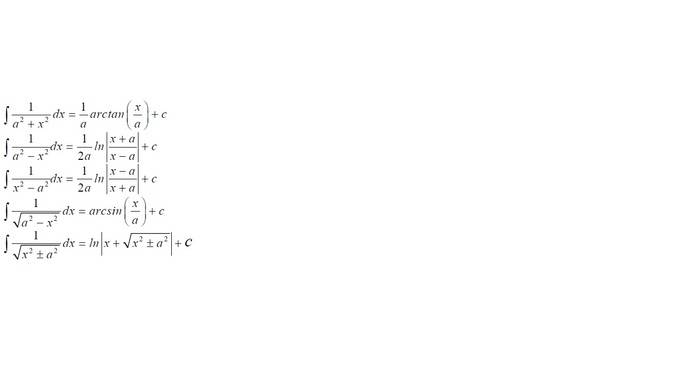
YvnnR3H.jpg
 
Physics news on Phys.org
Edd257 said:
Hi,

The integrals in the image are well-known, but we are not allowed to use them in the test.

I have tried to prove them using changing variable t, but I didn't succeed.

Can you show me the way?
YvnnR3H.jpg
Show us your actual work on at least one example above---whether it failed or not.
 
What do you mean by "not allowed to use them"? How would being able to prove them help you on a test?

The first and fourth can be done by considering the derivatives of arctan and arcsin. The second and third by factoring and "partial fractions".
 
Edd257 said:
Hi,

The integrals in the image are well-known, but we are not allowed to use them in the test.

I have tried to prove them using changing variable t, but I didn't succeed.

Can you show me the way?
[ IMG]http://i.imgur.com/YvnnR3H.jpg[/PLAIN]
For the first integral, try the trig substitution, ## x = a\cdot\tan(\theta)\ ##.
 

Attachments

  • YvnnR3H.jpg
    YvnnR3H.jpg
    9.5 KB · Views: 449
Geez I didn't think it was necessary to use a trig substitution for any of these. In the first three you can just multiply the numerator & denominator by 1/a2 & in the last two multiply numerator & denominator by 1/a.
 
ok,

I succeed proving number one and four- please check if I did it correctly.
But I still didn't understand how to prove the rest... how do I use partial fractions?
can you show me the way on one of the other integrals?
26R3FQy.jpg
tjaQ3Wg.jpg
 
fourier jr said:
Geez I didn't think it was necessary to use a trig substitution for any of these. In the first three you can just multiply the numerator & denominator by 1/a2 & in the last two multiply numerator & denominator by 1/a.

I have tried to do that in your way in the second integral and didn't succeed.
Can you show me your way?
 
Hey, I'm on my mobile right now so I can't see your proves for first and four integrals but for the second and third use simple fractions. I mean, you have the denominator

a^2 - x^2 = (a+x)(a-x)

So you can write

1/(a^2 - x^2) = 1/((a+x)(a-x)) = A/(a+x) + B/(a-x)

For some constants A, B which you should find easily then you just have a sum of two integrals which are two logarithms and using a basic property of log you will get what you are looking for. Third integral is analogous to this.

Should I said why take abs value?
 
Tnx, now I got it.

But I still didn't understand how to solve the last integral...

I need to use some substitution t?
 
  • #10
I think in the last one you need to use the substitution x = a⋅sec θ then dx = a⋅secθ⋅tanθ dθ etc
 
  • #11
fourier jr said:
I think in the last one you need to use the substitution x = a⋅sec θ then dx = a⋅secθ⋅tanθ dθ etc
That works for the " - " sign. Alternatively, you can use x = a ⋅ cosh(u) .

Use x = a⋅sinh(u) for the "+" sign.

Of course the results will look a bit different: cosh-1(x/a) & sinh-1(x/a) .
 

Similar threads

  • · Replies 9 ·
Replies
9
Views
2K
Replies
4
Views
2K
  • · Replies 23 ·
Replies
23
Views
2K
  • · Replies 5 ·
Replies
5
Views
1K
  • · Replies 1 ·
Replies
1
Views
1K
Replies
3
Views
2K
  • · Replies 10 ·
Replies
10
Views
2K
  • · Replies 2 ·
Replies
2
Views
2K
  • · Replies 2 ·
Replies
2
Views
2K
  • · Replies 9 ·
Replies
9
Views
2K