Derivative of a difficult integral

Join the discussion
Registration is free. Ask a follow-up in this thread, or start your own.
12 replies · 2K views
E'lir Kramer
Messages
73
Reaction score
0
Spivak, 14.1.iii: Derivative of F, where

gif.gif


I have the FTC. The answer is also given,
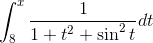
gif.gif


But I don't know how to find it.

First I want to try a function decomposition:
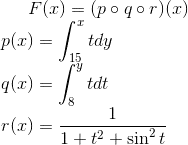
gif.gif


and from the Chain Rule:

gif.gif
But now I'm stuck. For I do not know an expression for p' or q'. And worse, r' doesn't show up in the given solution. Thanks in advance for your time :).
 
Physics news on Phys.org
E'lir Kramer said:
Spivak, 14.1.iii: Derivative of F, where
gif.gif


I have the FTC. The answer is also given,

gif.gif


But I don't know how to find it.

First I want to try a function decomposition:

gif.gif


and from the Chain Rule:

gif.gif


But now I'm stuck. For I do not know an expression for p' or q'. And worse, r' doesn't show up in the given solution. Thanks in advance for your time :).

If you let ##f(y) = \int_{8}^{y}\frac{1}{1+t^{2}+\sin^{2}t}dt## so ##F(x) =
\int_{15}^xf(y)dy## what would ##F'(x)## be in terms of ##f##?
 
Thanks for your reply. When you put it that way, we have [itex]F'(x) = f(y) = \int_{8}^{y} \frac{1}{1+t^{2}+sin^{2}t}dt[/itex]

But the given answer has [itex]\int_{8}^{x} \frac{1}{1+t^{2}+sin^{2}t}dt[/itex]. How can we just change the integrand variable like that?
 
LCKurtz said:
If you let ##f(y) = \int_{8}^{y}\frac{1}{1+t^{2}+\sin^{2}t}dt## so ##F(x) =
\int_{15}^xf(y)dy## what would ##F'(x)## be in terms of ##f##?

E'lir Kramer said:
Thanks for your reply. When you put it that way, we have F'(x) = f(y)

No it doesn't! That y is a dummy variable and F is a function of x. And its derivative must be a function of x.
 
E'lir Kramer said:
Thanks for your reply. When you put it that way, we have [itex]F'(x) = f(y) = \int_{8}^{y} \frac{1}{1+t^{2}+sin^{2}t}dt[/itex]

But the given answer has [itex]\int_{8}^{x} \frac{1}{1+t^{2}+sin^{2}t}dt[/itex]. How can we just change the integrand variable like that?

The y inside the y-integral is "integrated over", so goes away. For example, you can think of ##F(x) = \int_8^x f(y) \, dy## as a limit of the form
[tex]\lim_{n \to \infty} \sum_{i=1}^{n} \frac{x-8}{n} f\left(8 + \frac{i (x-8)}{n}\right),[/tex]
and there is no 'y' at all in this expression. In other words,
[tex]F(x) = \int_8^x f(\text{anything}) \; d\: \text{anything},[/tex]
and it does not matter what name you give to "anything" (except that it should not be x, f or d).
 
Thanks. I think I get it. Because we're integrating over ##dy##, that means we're plugging in ##x## for y when we integrate.
 
Just remember... [itex]\int _{ a }^{ b }{ f(x)dx } =F(b)-F(a)[/itex] so let's call [itex]\int _{ 8 }^{ y }{ g(t)dt } =G(y)-G(8)[/itex] where [itex]g(t)=\frac { 1 }{ 1+ t^{2}+sin^{2}t }[/itex] then [itex]\int _{ 15 }^{ x }{ \int _{ 8 }^{ y }{ g(t)dt } } =\int _{ 15 }^{ x }{ G(y)-G(8){dy} }[/itex] since the last term is a constant, we get [itex]F(x)=\int _{ 15 }^{ x }{ \int _{ 8 }^{ y }{ g(t)dt } } =\left[ H(x)-H(15) \right] -G(8)\left( x-15 \right) =H(x)-G(8)x+15G(8)-H(15)[/itex] Now derive and see what constants drop out :-)
 
Ok guys, I struggled through that one and I think I understand it now. To test my knowledge, I've attempted another one, which isn't solved.

##F(x) = \sin \left ( \int_{0}^{x} \sin \left ( \int_{0}^{y} \sin^{3} t dt \right ) dy \right )##

So now I will try another composition. I will use capital letters for functions defined by integrals, and lowercase for functions that aren't.

## f(x) = \sin x \\
G(x) = \int_{0}^{x} \sin y dy\\
H(y) = \int_{0}^{y} \sin^{3}t dt \\
##
then,

##F(x) = f \circ G \circ H##

By the chain rule,

## F'(x) = f'(G \circ H)\cdot G'(H) \cdot H' ##

## f'(x) = \cos x ##

By the FTC,

## G'(x) = \sin x \\
H'(y) = \sin^{3} y \\
##

Composing,

##F'(x) = \cos(\int_{0}^{x} \sin \left ( \int_{0}^{y} \sin^{3}t dt \right )dy \cdot \sin \left (\int_{0}^{x} \sin^{3} t dt \right ) \cdot sin^{3} x##

How'd I do?
 
E'lir Kramer said:
Ok guys, I struggled through that one and I think I understand it now. To test my knowledge, I've attempted another one, which isn't solved.

##F(x) = \sin \left ( \int_{0}^{x} \sin \left ( \int_{0}^{y} \sin^{3} t dt \right ) dy \right )##

So now I will try another composition. I will use capital letters for functions defined by integrals, and lowercase for functions that aren't.

## f(x) = \sin x \\
G(x) = \int_{0}^{x} \sin y dy\\
H(y) = \int_{0}^{y} \sin^{3}t dt \\
##
then,

##F(x) = f \circ G \circ H##

By the chain rule,

## F'(x) = f'(G \circ H)\cdot G'(H) \cdot H' ##

## f'(x) = \cos x ##

By the FTC,

## G'(x) = \sin x \\
H'(y) = \sin^{3} y \\
##

Composing,

##F'(x) = \cos(\int_{0}^{x} \sin \left ( \int_{0}^{y} \sin^{3}t dt \right )dy \cdot \sin \left (\int_{0}^{x} \sin^{3} t dt \right ) \cdot sin^{3} x##

How'd I do?

You are missing a big closing parentheses on the first cos( part. But it looks ok to me.
 
I don't think it is quite correct. If you call$$
f(y) = \sin(\int_0^y \sin^3(t)dt)$$ then$$
F(x) = \sin(\int_0^xf(y)dy)$$Then$$
F'(x) = cos(\int_0^xf(y)dy)\cdot \frac d {dx}\int_0^xf(y)dy=
cos(\int_0^xf(y)dy)\cdot f(x)
=cos(\int_0^xf(y)dy)\cdot \sin(\int_0^x \sin^3(t)dt)$$ $$
=cos(\int_0^x\sin(\int_0^y \sin^3(t)dt)dy)\cdot \sin(\int_0^x \sin^3(t)dt)
$$I think you have an extra ##\sin^3(x)##.
 
Though I am convinced by Kurtz's answer, I am having a hard time seeing where I went wrong in my own reasoning.

Is my function composition wrong? Does ##F(x) ≠ (f \circ G \circ H)(x)##?
 
E'lir Kramer said:
Though I am convinced by Kurtz's answer, I am having a hard time seeing where I went wrong in my own reasoning.

Is my function composition wrong? Does ##F(x) ≠ (f \circ G \circ H)(x)##?

You have ##G(x) = \int_0^x \sin y\, dy##, but let's call that dummy variable of integration ##u## so ##G(x) = \int_0^x \sin u\, du##. Also, you have ##H(y) = \int_0^y \sin^3 t\, dt##. Then$$
G(H(y)) =\int_0^{H(y)} \sin u\, du=\int_0^{\int_0^y \sin^3 t\, dt} \sin u\, du$$I don't think that is what you want.
