Derive Equation of motion using Lagrangian density?

3 replies · 4K views · last reply
safekhan
Messages
6
Reaction score
0
Homework Statement [/b]

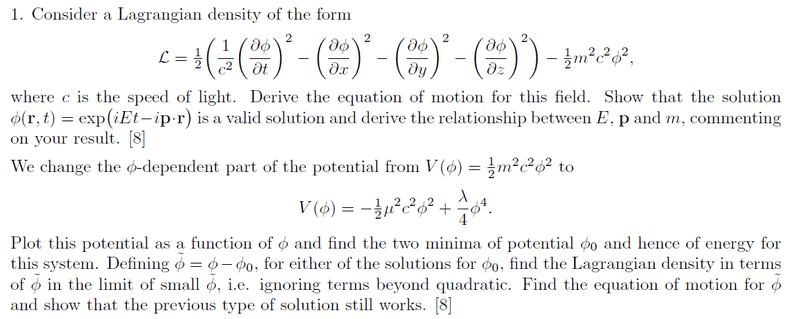
Typeset homework problem: Lagrangian density L with kinetic terms (1/c^2)(dφ/dt)^2 minus spatial gradient terms, minus (1/2)m^2c^2φ^2, followed by a potential V(φ) = -(1/2)μ^2c^2φ^2 + (λ/4)φ^4 and questions on equations of motion and minima.

The attempt at a solution[/b]
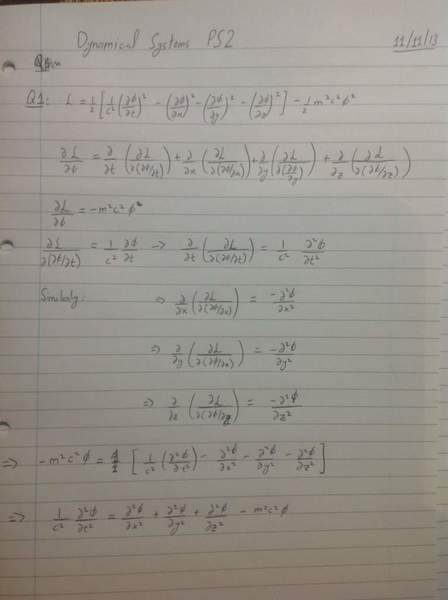
Handwritten derivation on lined paper titled Dynamical Systems PS2, dated 11/11/13, of Lagrangian density L and Euler-Lagrange equations for a field phi with partial derivatives in t, x, y and z, ending in the wave equation (1/c^2) d^2phi/dt^2 = d^2phi/dx^2 + d^2phi/dy^2 + d^2phi/dz^2 - m^2c^2 phi.


I have done the first bit but don't know how to show that phi(r,t) is a solution to the equation of motion.
 
Substitute the given ##\phi## into the left side of your equation; substitute the given ##\phi## into the right side of your equation. After doing this, show that left = right.

Equivalently, but perhaps a little cleaner: take all your terms to the left side; show that substituting ##\phi## into the left side gives zero.
 
thanks, but how should I treat p.r term in the solution while differentiating with respect to (t,x,y,z)
 
safekhan said:
thanks, but how should I treat p.r term in the solution while differentiating with respect to (t,x,y,z)

What does

$$\mathbf{p} \cdot \mathbf{r}=?$$