Deriving an equation for theta via the Projectile Motion Trajectory Eq

Click For Summary
SUMMARY

The discussion centers on deriving the angle theta in the context of projectile motion using trigonometric identities. The user expresses difficulty in solving for theta given other variables and mentions the relevant identities: secant and the Pythagorean identity involving tangent. The identities identified are ##\frac{1}{\cos} = \sec## and ##\sec^2 = 1 + \tan^2##, which simplify the problem to a quadratic equation in terms of tangent. The user acknowledges finding a solution on Wikipedia but seeks further clarification and derivation.

PREREQUISITES
  • Understanding of projectile motion equations
  • Familiarity with trigonometric identities, specifically secant and tangent
  • Basic algebra skills for solving quadratic equations
  • Knowledge of how to manipulate equations involving trigonometric functions
NEXT STEPS
  • Study the derivation of projectile motion equations in physics
  • Learn how to apply trigonometric identities to solve equations
  • Practice solving quadratic equations involving trigonometric functions
  • Explore advanced topics in trigonometry, such as inverse trigonometric functions
USEFUL FOR

Students of physics and mathematics, educators teaching projectile motion, and anyone interested in applying trigonometric identities to solve equations.

lightlightsup
Messages
100
Reaction score
11
Homework Statement
Given all the other variables in this equation, find theta.
Relevant Equations
Y = x(tanθ)-[(gx^2)/(2(v0cosθ)^2)]
Perhaps I should ask this question in the math section of these forums.
But, I'm stumped and I don't think this equation is solvable?
Find theta given all the other variables:
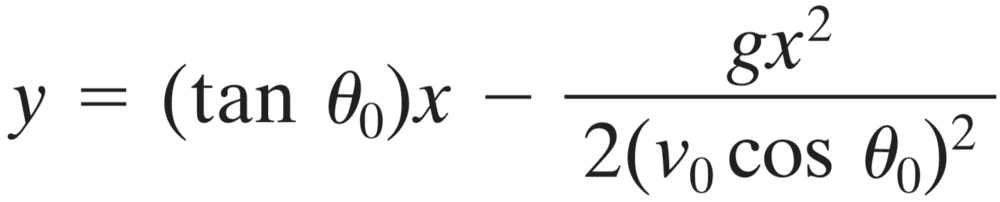
Trajectory Eq.png
 
Physics news on Phys.org
Do you know some trig identities relating tan, sec, cos and their squares?
 
I know some trig identities and can lookup others.
But, it looks like I found the answer on Wikipedia. o0)
2c5c375af9d89e403690dceeb6d074eab6ed27fe

P.S. This wasn't really the homework question. I was just curious when I looked at and derived the same trajectory equation that was in my book. But, then I started wonder if it could give me the other parameters. v was easy to find, x was harder. theta is impossible at my level of intelligence/knowledge (at least without guidance).

Nonetheless, i'd be curious to see someone derive this.
 
Last edited:
lightlightsup said:
I know some trig identities and can lookup others.
But, it looks like I found the answer on Wikipedia. o0)
2c5c375af9d89e403690dceeb6d074eab6ed27fe

P.S. This wasn't really the homework question. I was just curious when I looked at and derived the same trajectory equation that was in my book. But, then I started wonder if it could give me the other parameters. v was easy to find, x was harder. theta is impossible at my level of intelligence/knowledge (at least without guidance).

Nonetheless, i'd be curious to see someone derive this.
The two that solve it are ##\frac 1\cos=sec## and ##\sec^2=1+\tan^2##. Those reduce it to a quadratic in tan.
 
  • Like
Likes   Reactions: lightlightsup

Similar threads

  • · Replies 18 ·
Replies
18
Views
2K
  • · Replies 2 ·
Replies
2
Views
705
  • · Replies 7 ·
Replies
7
Views
3K
  • · Replies 13 ·
Replies
13
Views
3K
  • · Replies 42 ·
2
Replies
42
Views
2K
Replies
2
Views
2K
Replies
21
Views
3K
  • · Replies 1 ·
Replies
1
Views
2K
Replies
25
Views
3K
Replies
15
Views
3K
