Deriving equation of wave motion

1 reply · 5K views · last reply
Pushoam
Messages
961
Reaction score
53
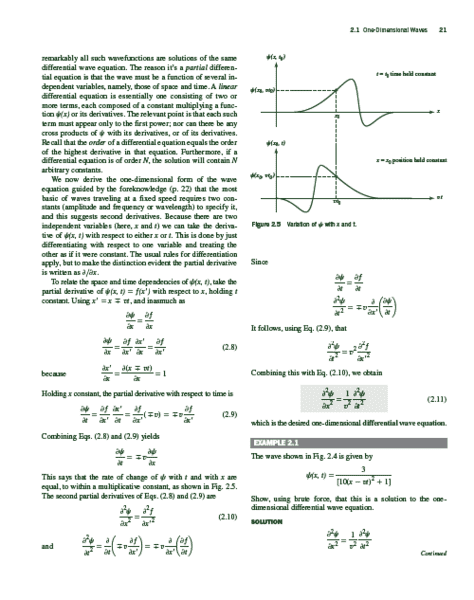
The equation below (2.9) is also a linear differential equation.
This equation also describes the wave phenomena.
So, why is this equation not considered as wave equation?
I have taken it from the optics book by Chapter two Eugene Hecht,5th edition ,Pearson.
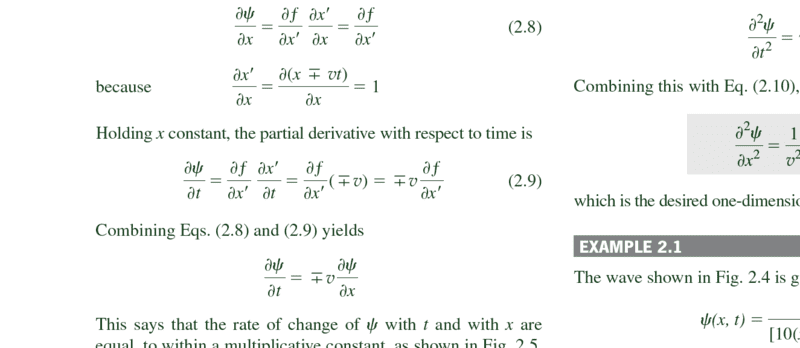
Printed textbook page showing partial derivative equations (2.8) and (2.9) for a wave function psi with respect to x and t, ending with the relation dpsi/dt = minus or plus v times dpsi/dx.


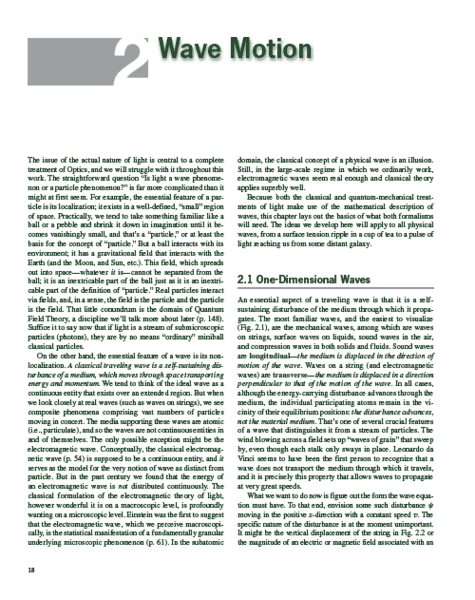
Textbook page titled Chapter 2 Wave Motion, showing body text about light as a wave phenomenon and a section header 2.1 One-Dimensional Waves.
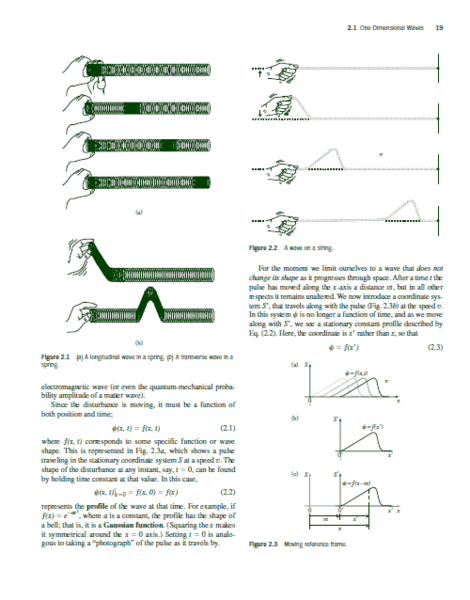
Textbook page showing wave diagrams: a longitudinal wave in a spring and a transverse wave on a string, followed by a sequence of string snapshots and three panels of a moving pulse plotted against x in a moving reference frame.
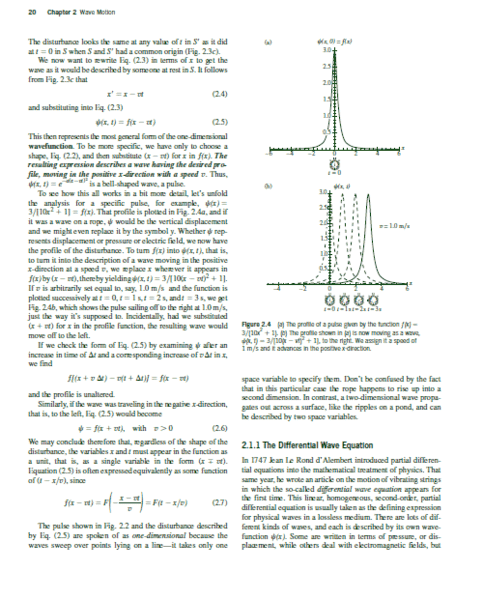
Textbook page showing two graphs of a Gaussian-shaped pulse moving along the x-axis at successive times, with the caption describing a pulse traveling at 1.0 m/s, and running text about wave motion and the wave equation.
Textbook page on one-dimensional waves showing plots of phi(x, t0) at fixed time, phi(x0, t) at fixed position, and their derivative relations, followed by equations (2.8) to (2.11) and Example 2.1.

391fdd9f-40f6-4648-874e-37d04b73169a
 
Last edited:
I must say that this is the worst derivation of the D'Alambert equation I've ever seen. It's simple but seems to describe any differentiable function. It is true that "wave" is a really general concept, in fact there are many different kind of waves and many different equation describing them, but it's not like anything is a wave!
Anyway, as the text say on page 21, you need at least a second order differential equation to describe a wave since it has in the simplest case an amplitude and a frequency, so two parameters which requires two conditions.