spaghetti3451
- 1,311
- 31
Consider the following tree-level Feynman diagrams for the ##W^{+}W^{-} \to W^{+}W^{-}## scattering process.
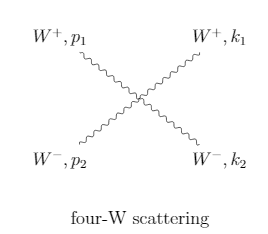
The matrix element for this diagram can be read off from the associated quartic term ##\mathcal{L}_{WWWW}## in the electroweak boson self-interactions, where
##\mathcal{L}_{WWWW} = -\frac{1}{2}g^{2}_{2} \left[ (W_{\mu}^{+}W^{-\mu})^{2} - (W_{\mu}^{+}W^{+\mu})(W_{\nu}^{-}W^{-\nu}) \right]##
##= -\frac{1}{2}g^{2}_{2} \left(\eta_{\mu\nu}\eta_{\rho\sigma}-\eta_{\mu\rho}\eta_{\nu\sigma}\right)W^{+\mu}W^{-\nu}W^{+\rho}W^{-\sigma}.##
Why does this mean that the matrix element is
##\mathcal{M} = -g_{2}^{2}(2\eta_{\mu\sigma}\eta_{\nu\rho}-\eta_{\mu\nu}\eta_{\rho\sigma}-\eta_{\mu\rho}\eta_{\nu\sigma})\epsilon^{\mu}(p_{1})\epsilon^{\nu}(p_{2})\epsilon^{\rho}(k_{1})\epsilon^{\sigma}(k_{2})?##
More specifically, I am not able to derive the factor of ##(2\eta_{\mu\sigma}\eta_{\nu\rho}-\eta_{\mu\nu}\eta_{\rho\sigma}-\eta_{\mu\rho}\eta_{\nu\sigma})## in the matrix element.
The matrix element for this diagram can be read off from the associated quartic term ##\mathcal{L}_{WWWW}## in the electroweak boson self-interactions, where
##\mathcal{L}_{WWWW} = -\frac{1}{2}g^{2}_{2} \left[ (W_{\mu}^{+}W^{-\mu})^{2} - (W_{\mu}^{+}W^{+\mu})(W_{\nu}^{-}W^{-\nu}) \right]##
##= -\frac{1}{2}g^{2}_{2} \left(\eta_{\mu\nu}\eta_{\rho\sigma}-\eta_{\mu\rho}\eta_{\nu\sigma}\right)W^{+\mu}W^{-\nu}W^{+\rho}W^{-\sigma}.##
Why does this mean that the matrix element is
##\mathcal{M} = -g_{2}^{2}(2\eta_{\mu\sigma}\eta_{\nu\rho}-\eta_{\mu\nu}\eta_{\rho\sigma}-\eta_{\mu\rho}\eta_{\nu\sigma})\epsilon^{\mu}(p_{1})\epsilon^{\nu}(p_{2})\epsilon^{\rho}(k_{1})\epsilon^{\sigma}(k_{2})?##
More specifically, I am not able to derive the factor of ##(2\eta_{\mu\sigma}\eta_{\nu\rho}-\eta_{\mu\nu}\eta_{\rho\sigma}-\eta_{\mu\rho}\eta_{\nu\sigma})## in the matrix element.