Deriving spatial derivatives

Click For Summary

SUMMARY

The discussion focuses on deriving spatial derivatives—gradient, divergence, and curl—in spherical coordinates using the basis vectors {r, θ, φ}. The user identifies the importance of maintaining the correct order in the determinant for the curl calculation, specifically r × θ = φ, to obtain standard results. They highlight the challenge of factoring out variables within partial derivatives when deriving the gradient and emphasize the need for clear, typed equations rather than low-resolution hand-written images. The user also explains their approach of undoing vector integrals to derive divergence and curl formulas by comparing integral definitions and determinant expansions.

PREREQUISITES

  • Spherical coordinate system basis vectors and their properties
  • Vector calculus operators: gradient, divergence, and curl in curvilinear coordinates
  • Determinant method for evaluating curl in spherical coordinates
  • Vector integral theorems: Divergence theorem and Stokes' theorem

NEXT STEPS

  • Learn LaTeX typesetting for clear mathematical expression of vector calculus derivations
  • Study the factorization of variable coefficients within partial derivatives in spherical gradients
  • Practice applying the determinant method for curl calculation in spherical coordinates
  • Review vector integral theorems and their use in deriving differential operators

USEFUL FOR

Students and researchers in physics, engineering, and applied mathematics working on vector calculus in spherical coordinates, particularly those deriving or verifying gradient, divergence, and curl expressions. Also valuable for educators preparing clear instructional materials on spatial derivatives and vector integral theorems.

slurms
Messages
5
Reaction score
0
Homework Statement
I'm trying to derive the various spatial derivatives, and find that I'm missing pieces. I'd like another set of eyes please.
Relevant Equations
div, grad, curl, grad^2
See photo. First, I see that I get more standard results by crossing theta before phi. What's the importance of that? Also I'd get more standard results by allowing some r or sine factors to leave their derivative enclosures and unify.
 

Attachments

  • IMG_20260226_141607859.webp
    IMG_20260226_141607859.webp
    43.1 KB · Views: 15
  • IMG_20260226_141617758.webp
    IMG_20260226_141617758.webp
    32.6 KB · Views: 22
Physics news on Phys.org
Your images are very difficult to read, due to how small the images appear. This is one of the reasons that we recommend against posting hand-written images of work.
 
  • Agree
Likes   Reactions: robphy
Mark44 said:
Your images are very difficult to read, due to how small the images appear. This is one of the reasons that we recommend against posting hand-written images of work
I actually figured out at least part of my answer. I was ignoring the space made by r x theta = phi, or more specifically i was working in the incorrect space r x phi = theta, which is why some of my components are the negative of the accepted answers. I figured this out by looking at my drawing, where on the upper left of my sphere the r meets the r theta and the r phi sin theta.

There's my second question tho. I derived the gradient by comparing to the results of the cross, assuming the del operator there is the gradient. But mine contain variables within the partials. I wonder if the accepted answers allow those to be factored out because they're unrelated to the associated scalae function's component
 
Last edited by a moderator:
slurms said:
There's my second question tho.
Which is still illegible.
 
haruspex said:
Which is still illegible.
you read the rest of the paragraph. This is it?
 
slurms said:
you read the rest of the paragraph. This is it?
He's referring to the images you posted.
 
Mark44 said:
He's referring to the images you posted.
I know. But I did describe the problem I was having. I didn't realize how low-res rhe images would come out. Initially I posted the entire page, and then I divided it in 2 like this. My work is kinda legible enough if you know what you're looking for
 
slurms said:
But I did describe the problem I was having.
But that doesn't help much if we can't see the work.

slurms said:
My work is kinda legible enough
That's a pretty subjective assessment. So far, two people say no vs. one who says yes.
 
Mark44 said:
But that doesn't help much if we can't see the work.

That's a pretty subjective assessment. So far, two people say no vs. one who says yes.
And the one knows what it says anyway, which helps.
 
  • #10
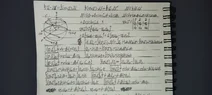
ok, I'll just describe what I did. First I drew a sphere and arrows representing the basis vectors: r, r theta, r phi sin theta. Where they meet, r x theta = phi. I see that maintaining that implicit order for the determinant of the curl results in the correct results for the curl: {r, theta, phi}.

I defined unit vector path and vector area, dl and da, and I note that (1/3) dl dot da = dV, the unit volume. I undid two vector integrals to create both the divergence and the curl: for vector function U, its closed integral dot da = integral divergence U dV; and also closed integral curl U dot da = closed integrals U dot dl.

For the curl, I wrote out the results of the determinant of column vectors (r, del r, U r), (theta, del theta, U theta), and so for phi. Then I followed a similar procedure as the divergence, undoing the integrals by direct comparison.

For the gradient, I assumed the dels within the column vectors of the curl were gradients. I listed the results of the curl, and then took the most general form of each del operator as the gradient.
 
  • #11
slurms said:
I'll just describe what I did
That really does not help much by itself. Please take the trouble to post the working as well, typing the equations in, preferably using LaTeX.
 

Similar threads

  • · Replies 14 ·
Replies
14
Views
4K
  • · Replies 4 ·
Replies
4
Views
1K
  • · Replies 7 ·
Replies
7
Views
3K
  • · Replies 2 ·
Replies
2
Views
1K
  • · Replies 11 ·
Replies
11
Views
3K
  • · Replies 4 ·
Replies
4
Views
2K
Replies
2
Views
2K
  • · Replies 8 ·
Replies
8
Views
4K
  • · Replies 6 ·
Replies
6
Views
3K
  • · Replies 5 ·
Replies
5
Views
3K