Deriving the derivative boundary conditions from natural formulation

Click For Summary
SUMMARY

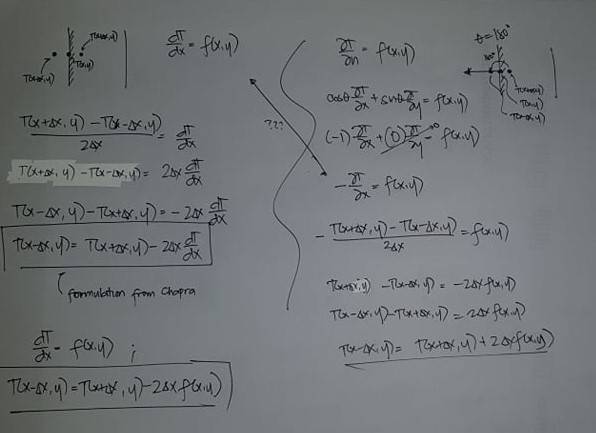
The discussion focuses on deriving derivative boundary conditions from a natural formulation in the context of heat transfer. The user is attempting to reconcile the general derivative boundary condition f(x,y) with a boxed formulation, specifically addressing the heat flux, denoted as q_x, which is consistently defined by the equation q_x=-k(dT/dx). The user identifies discrepancies in results between the left and right boundaries, leading to confusion regarding the application of boundary conditions. The mathematical expressions provided clarify the relationship between temperature and heat flux at fictitious boundary points.

PREREQUISITES
  • Understanding of heat transfer principles, specifically Fourier's law.
  • Familiarity with boundary condition formulations in differential equations.
  • Knowledge of temperature gradient calculations in one-dimensional systems.
  • Proficiency in mathematical notation and manipulation of differential equations.
NEXT STEPS
  • Study Fourier's law of heat conduction in detail.
  • Research the application of natural boundary conditions in differential equations.
  • Explore numerical methods for solving boundary value problems.
  • Learn about the implications of fictitious points in boundary condition analysis.
USEFUL FOR

Researchers, engineers, and students in the fields of thermal engineering, applied mathematics, and physics who are working on heat transfer problems and boundary condition formulations.

maistral
Messages
235
Reaction score
17
TL;DR
How to derive the finite difference derivative formulation from the natural boundary formulation?
PS: This is not an assignment, this is more of a brain exercise.

I intend to apply a general derivative boundary condition f(x,y). While I know that the boxed formulation is correct, I have no idea how to acquire the same formulation if I come from the general natural boundary condition formulation. I honestly do not know what am I doing wrong. Can someone check where am I incorrect?
67846231_357745925149080_6309915412955922432_n.jpg
 
  • Like
Likes   Reactions: exln
Physics news on Phys.org
Looks OK. So what is the problem?
 
Chestermiller said:
Looks OK. So what is the problem?

The left side and the right side have different results.
 
If ##q_x## is the heat flux in the x direction, then ##q_x## is always given by $$q_x=-k\frac{dT}{dx}$$irrespective of whether it is the left- or the right boundary. Of course, the sign of the flux in the x direction can be negative. So, at the fictitious point at the left boundary, you have:
$$T(-\Delta x)=T(+\Delta x)+q_x(0)\Delta x$$and, at the fictitious point at the right boundary, you have:
$$T(L+\Delta x)=T(L-\Delta x)-q_x(L)\Delta x$$
 
that is a good answer
 

Similar threads

  • · Replies 2 ·
Replies
2
Views
2K
  • · Replies 4 ·
Replies
4
Views
3K
Replies
3
Views
3K
  • · Replies 1 ·
Replies
1
Views
2K
  • · Replies 1 ·
Replies
1
Views
2K
  • · Replies 8 ·
Replies
8
Views
3K
  • · Replies 8 ·
Replies
8
Views
4K
  • · Replies 8 ·
Replies
8
Views
5K
  • · Replies 1 ·
Replies
1
Views
1K
  • · Replies 1 ·
Replies
1
Views
2K