Deriving the kinetic energy equation?

Join the discussion
Ask a follow-up here, or get your own question answered by working scientists, mathematicians and engineers — people, not an autocomplete.
Real named experts · corrections over time · the nuance an AI answer skips
2 replies · 2K views
EchoRush
Messages
9
Reaction score
1
Hello, I just have a quick question on deriving the kinetic energy formula using calculus. I understand most of it, I just have a question about one of the steps. here are the steps.

  • Begin with the Work-Energy Theorem.The work that is done on an object is related to the change in its kinetic energy.
    • \Delta K=W
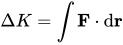
  • Rewrite work as an integral.The end goal is to rewrite the integral in terms of a velocity differential.
    \Delta K=\int {\mathbf  {F}}\cdot {\mathrm  {d}}{\mathbf  {r}}
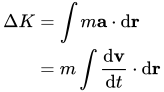
  • Rewrite force in terms of velocity.Note that mass is a scalar and can therefore be factored out.
    {\begin{aligned}\Delta K&=\int m{\mathbf  {a}}\cdot {\mathrm  {d}}{\mathbf  {r}}\\&=m\int {\frac  {{\mathrm  {d}}{\mathbf  {v}}}{{\mathrm  {d}}t}}\cdot {\mathrm  {d}}{\mathbf  {r}}\end{aligned}}
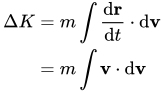
  • Rewrite the integral in terms of a velocity differential.Here, it is trivial, because dot products commute. Recall the definition of velocity as well.
    {\begin{aligned}\Delta K&=m\int {\frac  {{\mathrm  {d}}{\mathbf  {r}}}{{\mathrm  {d}}t}}\cdot {\mathrm  {d}}{\mathbf  {v}}\\&=m\int {\mathbf  {v}}\cdot {\mathrm  {d}}{\mathbf  {v}}\end{aligned}}


  • Integrate over change in velocity. Typically, initial velocity is set to 0.
    {\begin{aligned}\Delta K&={\frac  {1}{2}}mv^{{2}}-{\frac  {1}{2}}mv_{{0}}^{{2}}\\&={\frac  {1}{2}}mv^{{2}}\end{aligned}}


    My question is about step number 4. Why were we just able to flip the "dv" and the "dr" like that? What do they mean when they say "dot products commute"? Why can we just switch around the 'dv" and the "dr"?
 
Physics news on Phys.org
EchoRush said:
My question is about step number 4. Why were we just able to flip the "dv" and the "dr" like that? What do they mean when they say "dot products commute"? Why can we just switch around the 'dv" and the "dr"?

One way to look at it is to start with a small but finite increment:

##\Delta \vec r \approx \vec v \Delta t##

## \Delta \vec v \cdot \Delta \vec r \approx (\Delta \vec v \cdot \vec v) \Delta t ##

## \frac{\Delta \vec v}{\Delta t} \cdot \Delta \vec r \approx \Delta \vec v \cdot \vec v##

And, in the limit we have:

## \frac{d \vec v}{dt} \cdot d \vec r = \vec v \cdot d\vec v##
 
  • Informative
Likes   Reactions: Dale
EchoRush said:
My question is about step number 4. Why were we just able to flip the "dv" and the "dr" like that? What do they mean when they say "dot products commute"? Why can we just switch around the 'dv" and the "dr"?
Here's a slighty more formal approach. We parametrise the path ##\vec r(t)## by time (*). I.e. we define the path as a function of time. This gives ##d \vec r = \frac{d \vec r}{dt} dt = \vec v dt##, hence:

##\int_{r_0}^{r_1} \frac{d \vec v}{dt} \cdot d \vec r = \int_{t_0}^{t_1} \frac{d \vec v}{dt} \cdot \vec v dt = \frac 1 2 \int_{t_0}^{t_1} \frac{d}{dt}(v^2) dt = \frac 1 2 (v^2(t_1) - v^2(t_0))##

(*) Note that a parameterisation of some sort is actually the definition of a line integral That's how you define what is meant by a line integral in the first place.
 
  • Informative
  • Like
Likes   Reactions: vanhees71 and Dale