Deriving the particle's motion using numerical integration

Click For Summary
SUMMARY

This discussion focuses on deriving the motion of a particle subjected to a resistive force proportional to its velocity, represented by the equation F = -k*v. The user seeks guidance on using numerical integration techniques, specifically finite summations, to find the position x as a function of time t and to calculate the time t_1/2 for the particle to lose half its speed. Key equations include x(t_n) = ∑(i=0 to n){v(t_i)} * delta t and v(t_n) = ∑(i=0 to n){a(t_i)} * delta t. The forward Euler method is suggested as a basic numerical integration approach for solving ordinary differential equations (ODEs).

PREREQUISITES
  • Understanding of Newton's Second Law and its application to motion.
  • Familiarity with numerical integration techniques, particularly the forward Euler method.
  • Knowledge of differential equations and their solutions.
  • Basic skills in dimensional analysis to relate variables such as v_0, k, and m.
NEXT STEPS
  • Implement the forward Euler method to numerically integrate the motion equations.
  • Explore higher precision numerical integration methods, such as the Runge-Kutta method.
  • Conduct a comparative analysis between numerical solutions and analytical solutions for ODEs.
  • Study dimensional analysis techniques to derive relationships between physical quantities in motion problems.
USEFUL FOR

Students and professionals in physics, engineering, and applied mathematics who are interested in numerical methods for solving differential equations and understanding particle motion dynamics.

theblazierbroom
Messages
9
Reaction score
1
Homework Statement
A particle of mass m moves along a straight line. Its motion is resisted by a force proportional to its velocity, F=-k*v. It starts with speed v = v_0 at x = 0 and t = 0.

(a) Find x as a function of t by numerical integration.
(b) Find the time t_1/2 required to lose half its speed, and the maximum distance x_max attained.

Notes:
(1) Adjust the scales of x and t so that the equation of motion has simple numerical coefficients.
(2) Invent a scheme to attain good accuracy with a relatively coarse interval for delta t.
(3) Use dimensional analysis to deduce how t_1/2 and x_max should depend upon v_0, k, and m, and solve for the actual motion only for a single convenient value of v_0, say v_0 = 1.00 (in modified x and t units).
Relevant Equations
x(t_n) = \sum{i=0}^{n}{v(t_i)} * delta t
v(t_n) = \sum{i=0}^{n}{a(t_i)} * delta t
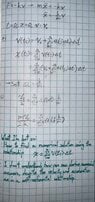
When I used differential equation techniques, I found the function of x and v to be a negative exponential function.

However, based on the notes, I believe the problem wants me to use finite summations as the relevant equations above. This stumps me because the acceleration is dependent on the velocity, and I get stuck in this self-referential thought process.

I believe figuring out a solution to this problem would help me better understand the thought process behind integration. I would appreciate any guidance!
 

Attachments

  • IMG_0068.jpg
    IMG_0068.jpg
    36.4 KB · Views: 71
Physics news on Phys.org
theblazierbroom said:
Homework Statement: A particle of mass m moves along a straight line. Its motion is resisted by a force proportional to its velocity, F=-k*v. It starts with speed v = v_0 at x = 0 and t = 0.

(a) Find x as a function of t by numerical integration.
(b) Find the time t_1/2 required to lose half its speed, and the maximum distance x_max attained.

Notes:
(1) Adjust the scales of x and t so that the equation of motion has simple numerical coefficients.
(2) Invent a scheme to attain good accuracy with a relatively coarse interval for delta t.
(3) Use dimensional analysis to deduce how t_1/2 and x_max should depend upon v_0, k, and m, and solve for the actual motion only for a single convenient value of v_0, say v_0 = 1.00 (in modified x and t units).
Relevant Equations: x(t_n) = \sum{i=0}^{n}{v(t_i)} * delta t
v(t_n) = \sum{i=0}^{n}{a(t_i)} * delta t

When I used differential equation techniques, I found the function of x and v to be a negative exponential function.

However, based on the notes, I believe the problem wants me to use finite summations as the relevant equations above. This stumps me because the acceleration is dependent on the velocity, and I get stuck in this self-referential thought process.

I believe figuring out a solution to this problem would help me better understand the thought process behind integration. I would appreciate any guidance!
Can you rewrite ##\ddot x## in terms of the approximate finite differences ## \Delta v ## and ##\Delta t ## for us?

The thing about the "apparent" circular reasoning, is it isn't circular reason. You should revisit Reimann Sums. The idea is you are getting the future value of ##v## by using the current value of ##v##. So how do you get from the first value of ##v_t## to the next ##v_{t +\Delta t }## given you know how it accelerates when it has some particular ##v## via Newtons Second?
 
Last edited:
erobz said:
Can you rewrite ##\ddot x## in terms of ## \Delta v ## and ##\Delta t ## for us?
Wait, so set ## \Delta v ## / ##\Delta t## = - (k/m) * v?
So then if I do ## \Delta v ## = - (k/m) * v * ## \Delta t ##, then I set v in the RHS as the velocity from the previous interval?
 
theblazierbroom said:
Wait, so set ## \Delta v ## / ##\Delta t## = - (k/m) * v?
So then if I do ## \Delta v ## = - (k/m) * v * ## \Delta t ##, then I set v in the RHS as the velocity from the previous interval?
As long as the time interval is small enough.

$$\Delta v \approx -\left. \frac{k}{m} v \right|_{t} ~\Delta t $$

If you have more precise questions involving the mathematics someone will be probably along that can go over the fine details (I'm scarcely qualified). I'm just trying to get you out of the "self referential loop". :smile:
 
Last edited:
erobz said:
As long as the time interval is small enough.

$$\Delta v \approx -\frac{k}{m} v \Delta t $$

If you have more precise questions involving the mathematics someone will be along that can go over the official stuff I'm sure (I'm scarcely qualified). I'm just trying to get you out of the "self referential loop". :)
I see, you helped me get out. I think some good amount of overthinking was occurring in my head haha Thanks!
 
  • Like
Likes   Reactions: erobz
erobz said:
As long as the time interval is small enough.

$$\Delta v \approx -\left. \frac{k}{m} v \right|_{t} ~\Delta t $$

If you have more precise questions involving the mathematics someone will be probably along that can go over the fine details (I'm scarcely qualified). I'm just trying to get you out of the "self referential loop". :smile:
It should be pointed out that this (essentially the forward Euler method) is the most basic way of numerically integrating an ODE. If you need higher precision and/or stability, there are more advanced methods.

However, for the purposes of the OP, this is probably fine. It is however an interesting exercise to compare the numerical solution to the analytical one.
 
  • Like
Likes   Reactions: PhDeezNutz and erobz

Similar threads

  • · Replies 13 ·
Replies
13
Views
1K
  • · Replies 20 ·
Replies
20
Views
2K
Replies
25
Views
1K
Replies
12
Views
2K
  • · Replies 3 ·
Replies
3
Views
1K
  • · Replies 12 ·
Replies
12
Views
4K
Replies
4
Views
1K
Replies
2
Views
3K
Replies
40
Views
4K
  • · Replies 20 ·
Replies
20
Views
1K