Deriving Wave Function for One-Dimensional Sinusoidal Wave

4 replies · 2K views · last reply
member 731016
Homework Statement
Please see below and https://openstax.org/books/university-physics-volume-1/pages/16-2-mathematics-of-waves for more details.
Relevant Equations
Please see below
Where did they get the equation in circled in red from? It does not seem that it can be derived from the graph below.
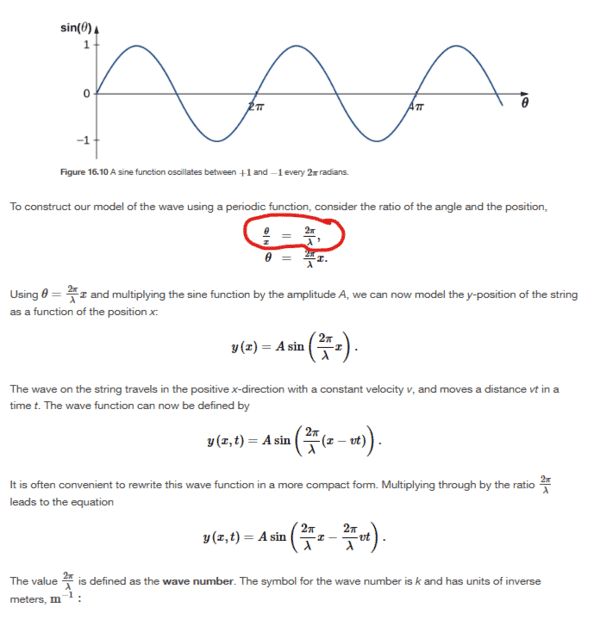
Graph of sin(θ) against θ, a sine curve oscillating between +1 and −1 with a period of 2π, with a red circle around the ratio equations θ/x = 2π/λ and θ = (2π/λ)x.

Many thanks
 
Last edited by a moderator:
Figure 16.10 is just a graph of [itex]\sin(theta)[/itex]. It is not referenced in the extract you have posted; why then you would expect the highlighted part to be directly derivable from a figure which is nowhere referred to? Perhaps look at the part of the text where the figure is actually referenced.

I suspect that, prior to the extract you have posted, it is stated that [itex]y[/itex] should have period [itex]\lambda[/itex]. Sine, of course, has a period of [itex]2\pi[/itex], so to get a function with period [itex]\lambda[/itex] you have to use [itex]\sin (2\pi x/\lambda)[/itex], so that [itex]\theta = 2\pi x/\lambda[/itex] is equal to [itex]2\pi[/itex] when [itex]x = \lambda[/itex].
 
  • Like
Likes   Reactions: Kumail Haider, topsquark, berkeman and 1 other person
pasmith said:
Figure 16.10 is just a graph of [itex]\sin(theta)[/itex]. It is not referenced in the extract you have posted; why then you would expect the highlighted part to be directly derivable from a figure which is nowhere referred to? Perhaps look at the part of the text where the figure is actually referenced.

I suspect that, prior to the extract you have posted, it is stated that [itex]y[/itex] should have period [itex]\lambda[/itex]. Sine, of course, has a period of [itex]2\pi[/itex], so to get a function with period [itex]\lambda[/itex] you have to use [itex]\sin (2\pi x/\lambda)[/itex], so that [itex]\theta = 2\pi x/\lambda[/itex] is equal to [itex]2\pi[/itex] when [itex]x = \lambda[/itex].
Thanks for your reply @pasmith! You meant to say that "it is stated that x should have a period of λ" instead of "
Text reading: it is stated that y should have period λ.
" correct?

I guess they took an arbitrary point along the wave to for ratio of phase to wavelength which they also could of picked a point on the wave which has a π phase which has a wavelength λ/2.
Equation chain: theta over x equals pi over lambda over 2 equals 2 pi over lambda, showing phase angle to position ratio equal to 2 pi over wavelength.

Many thanks
 
Callumnc1 said:
You meant to say that "it is stated that x should have a period of λ" instead of "
Small cropped text reading: it is stated that y should have period λ.
" correct?
incorrect. In ##y=\sin(2\pi x/\lambda)##, it is the value of y that repeats as x increases by λ, so we say y has period λ.
 
  • Like
Likes   Reactions: berkeman and member 731016
haruspex said:
incorrect. In ##y=\sin(2\pi x/\lambda)##, it is the value of y that repeats as x increases by λ, so we say y has period λ.
Thank you @haruspex !