Describe the position of a pulley attached to a sling

  • Thread starter Thread starter Jeroen Staps
  • Start date Start date
  • Tags Tags
    Position Pulley
Click For Summary
SUMMARY

The discussion centers on analyzing the behavior of a floating pulley attached to a sling, specifically how its position changes under varying forces applied at the drum. Key parameters include the location of the drum, the length of the sling, the weight of the load, the fixed point of the sling, and the percentage of friction in the pulley. The participants emphasize the importance of creating free body diagrams to visualize the forces acting on the system, particularly the tension in the cable and the impact of friction on the load's movement.

PREREQUISITES
  • Understanding of free body diagrams and force analysis
  • Knowledge of tension forces in pulley systems
  • Familiarity with the concept of friction in mechanical systems
  • Basic principles of dynamics, including Newton's laws of motion
NEXT STEPS
  • Study the effects of friction on pulley systems in detail
  • Learn to create and interpret free body diagrams for complex mechanical systems
  • Research the equations of motion for pulleys and their applications
  • Explore the relationship between tension and angle in pulley systems
USEFUL FOR

Mechanical engineers, physics students, and anyone involved in the design or analysis of pulley systems and mechanical advantage in lifting applications.

Jeroen Staps
Messages
36
Reaction score
0
Moved from a technical forum, so homework template missing
Hi,

I am studying the behaviour of a pulley that is attached to a sling. The situation looks like this:
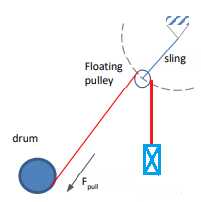
upload_2019-2-27_10-31-26-jpeg.jpg


There is a drum that can give or take cable. Then there is a floating pulley with a cable through it. The pulley can move on the circle with a radius the same as the length of the sling. At the end of the cable a load is attached.

The following parameters are known:
- location of the drum
- length of the sling
- weight of the load (so you also know the gravity working on the system)
- location of the fixed point at the sling
- % friction in the pulley

The question is how the position of the floating pulley changes when a certain force is acting on the cable at the drum.

Anyone an idea on how to solve this problem?
 

Attachments

  • upload_2019-2-27_10-31-26-jpeg.jpg
    upload_2019-2-27_10-31-26-jpeg.jpg
    3.4 KB · Views: 868
Physics news on Phys.org
Keep in mind that the force a cable exercises is tension and thereby in a direction along the cable.
Jeroen Staps said:
how to solve
Make a sketch of the forces acting (free body diagram) for the relevant parts of the setup.
 
BvU said:
Keep in mind that the force a cable exercises is tension and thereby in a direction along the cable.

Make a sketch of the forces acting (free body diagram) for the relevant parts of the setup.

There are three tensions in this systems each working on a part of a cable attached to the pulley
 
Hallo Jeroen, ##\qquad## :welcome: ##\qquad## !

Please read the guidelines . This should be in a homework forum and have the level tag B, not A.
 
BvU said:
Hallo Jeroen, ##\qquad## :welcome: ##\qquad## !

Please read the guidelines . This should be in a homework forum and have the level tag B, not A.

Alright I will post it there. But do you have an idea on how to describe the location of the pulley when there is a certain force pulling at the cable at the drum?
 
I asked a mentor to move the thread, so: patience.
Jeroen Staps said:
But do you have an idea
Yes: make the sketches I mentioned :smile:
 
BvU said:
I asked a mentor to move the thread, so: patience.
Yes: make the sketches I mentioned :smile:
upload_2019-2-27_12-14-1.png
 

Attachments

  • upload_2019-2-27_12-14-1.png
    upload_2019-2-27_12-14-1.png
    8.5 KB · Views: 568
If we ignore the "percent friction" part, then ##F_{pull}## will be the same force that is applied to the load. So the load would either accelerate upwards or downwards depending on whether ##F_{pull}## was sufficient to hold it up.

However, we have this "% friction" value that I will call ##f## - which apparently allows ##F_{pull}## and the force applied to the load (##F_{load}##) to differ. For a pulley, percent friction is the ratio in tension between the pulled end over the pulling end. So if the load is rising, we would have ##F_{load} = f F_{pull}## and if the load was dropping we would have ##F_{pull} = f F_{load}##.

I would attack the problem by solving for the dropping case first. And I would assume that the position were such that the sling was at a steady angle with the load dropping exactly vertically.
 
Last edited:
.Scott said:
If we ignore the "percent friction" part, then ##F_{pull}## will be the same force that is applied to the load. So the load would either accelerate upwards or downwards depending on whether ##F_{pull}## was sufficient to hold it up.
However, we have this "% friction" value - which apparently allows ##F_{pull}## and the force applied to the load to differ.
The problem is lacking in that there is no explanation of how this "percent friction" should be applied.

Normally kinetic friction would cause a pulley to exert some force on the cable proportional to the speed that the pulley was turning - or perhaps as a function of the stress on the pulley itself (a function of the tensions on the three lines attached to the pulley and their relative angles). But that doesn't sound like "percent friction" to me.

My guess is that the force applied to the load is only a certain percentage more or less than the ##F_{pull}## - acting to slow the pulley turning.

The percent friction means that when F_pull is +100N meaning the drum is rolling up the cable then the force in the part of the cable between the pulley and the load is F_pull * (100-percent friction)/100
 
  • #10
So this is for the pulley -- the most important one. I can see that there is no equilibrium component-wise, nor magnitude-wise.

The drum itself is outside the scope of your problem:
Jeroen Staps said:
a certain force is acting on the cable at the drum
So you want to study the effect of a change in ##|T_1|##.

And there is a complication:
Jeroen Staps said:
- % friction in the pulley
Not sure how to interpret that one, but it should cause ##|\vec T_1| \ne |\vec T_2|##.

As you know, ##m\vec a = \sum \vec F_i##, also for the pulley. Since it can only move over the dashed circle, the resultant ##\vec a## can only be tangent to that circle.
Jeroen Staps said:
do you have an idea on how to describe the location of the pulley
Yes. You do too:
One extreme case is load mass ##m=0## -- then the pulley hangs ...

An equilibrium case (with ##m \ne 0##) means ...
If then ##|T_1|## is increased, ...
But if ##|T_1|## is decreased from equilibrium, ...Basically you will now write down the equation of motion, in terms of the known symbols, among which ##|T_1|##

By the way,
Jeroen Staps said:
- length of the sling
That this is a known seems a mistake to me. It is a consequence of the motion, not an input. It looks to me like an initial condition only.
 
  • #11
Jeroen Staps said:
The percent friction means that when F_pull is +100N meaning the drum is rolling up the cable then the force in the part of the cable between the pulley and the load is F_pull * (100-percent friction)/100
Yes. I looked that up and updated my post while you were posting.
 
  • #12
BvU said:
So this is for the pulley -- the most important one. I can see that there is no equilibrium component-wise, nor magnitude-wise.

The drum itself is outside the scope of your problem:
So you want to study the effect of a change in ##|T_1|##.

And there is a complication:
Not sure how to interpret that one, but it should cause ##|\vec T_1| \ne |\vec T_2|##.

As you know, ##m\vec a = \sum \vec F_i##, also for the pulley. Since it can only move over the dashed circle, the resultant ##\vec a## can only be tangent to that circle.
Yes. You do too:
One extreme case is load mass ##m=0## -- then the pulley hangs ...

An equilibrium case means ...
If then ##|T_1|## is increased, ...
But if ##|T_1|## is decreased from equilibrium, ...Basically you will now write down the equation of motion, in terms of the known symbols, among which ##|T_1|##

By the way,
That this is a known seems a mistake to me. It is a consequence of the motion, not an input. It looks to me like an initial condition only.

In practice the pulley never hangs vertically because a cable runs through the pulley causing a certain angle.

The length of the sling is a known in fact. It is used to attach a floating pulley to a platform.
 
  • #13
Jeroen Staps said:
In practice the pulley never hangs vertically because a cable runs through the pulley causing a certain angle
Can we not ignore the mass of the cable ?

The length of the sling is a known in fact. It is used to attach a floating pulley to a platform.
My mistake. I thought cable instead of sling.
 
  • #14
.Scott said:
Yes. I looked that up and updated my post while you were posting.
I see, thanks. Any idea on how the equation of motion of the pulley would look like?
 
  • #15
BvU said:
Can we not ignore the mass of the cable ?

My mistake. I thought cable instead of sling.

Yes we can ignore the mass of the cable.

No problem :)
 
  • #16
Jeroen Staps said:
we can ignore the mass of the cable
In that case the pulley hangs vertically when there is no load (##m=0##)

This claim can be attacked by saying that the pulley is considered massless too, but that is searching for nails at low tide (old dutch expression).
 
  • #17
BvU said:
In that case the pulley hangs vertically when there is no load (##m=0##)

This claim can be attacked by saying that the pulley is considered massless too, but that is searching for nails at low tide (old dutch expression).

The pulley is also considered masless haha. But I am making a model so I can assume that the pulley can hang vertically however this is never the case.

Any idea on how to get the equation of motion? This is mainly my struggle
 
  • #18
Jeroen Staps said:
I see, thanks. Any idea on how the equation of motion of the pulley would look like?
You will have the force and direction (vertical) of ##F_{load}##. You will have the magnitude of ##F_{pull}##. With no load, the pulley would end up directly between the drum and the attachment point for the sling. So you should be able to set up equations for how far down the pulley is pulled to balance all the forces at the pulley.
 
  • #19
Jeroen Staps said:
how to get the equation of motion
I gave it to you already :rolleyes: :$$
m\vec a = \sum \vec F_i$$can't do your work for you :wink: - you read the guidelines
 
  • #20
Looks as if two threads were merged into one: I didn't see the posts @.Scott until now...
But I do get a 2 min ago alert from Jeroen without a post in the thread ?!

Well, that's what you get for double posting... :wink:
 
  • Like
Likes   Reactions: Jeroen Staps
  • #21
BvU said:
I gave it to you already :rolleyes: :$$
m\vec a = \sum \vec F_i$$can't do your work for you :wink: - you read the guidelines

The problem with dissolving the forces is that the location of the pulley is unknown.
 
  • #22
Jeroen Staps said:
The problem with dissolving the forces is that the location of the pulley is unknown.
Now is the time to make a better drawing and decompose the tension forces. First for a steady state (=balance, load hangs still). You 'll need to introduce one or two angles. And perhaps make a simplification if allowed (like: drum far enough away)
 
  • #23
Jeroen Staps said:
The percent friction means that when F_pull is +100N meaning the drum is rolling up the cable then the force in the part of the cable between the pulley and the load is F_pull * (100-percent friction)/100
That wouid mean when frictionless the percentage friction would be 100.
I suggest it means |T1-T2|=T3(f/100), or maybe /200.
 
  • #24
Jeroen Staps said:
The problem with dissolving the forces is that the location of the pulley is unknown.
Right, but you need an unknown for the angle of the sling. You can make it the angle to the vertical or to the line from the sling's anchor to the drum. You can use that to resolve the forces. You will need a bit of geometry to relate that to the angle of the line from the drum.
Is the drum's radius known? If not, you will have to take it as zero. Likewise the pulley.
 
Last edited:
  • #25
haruspex said:
Right, but you need an unknown for the angle of the sling. You can make it the angle to the vertical or to the line from the sling's anchor to the drum. You can use that to resolve the forces. You will need a bit of geometry to relate that to the angle of the line from the drum.
Is the drum's radius known? If not, you will have to take it as zero. Likewise the pulley.
The radius of the drum and pulleys are negligible for now.
In the model they are represented by a point/dot.
 
  • #26
Jeroen Staps said:
The radius of the drum and pulleys are negligible for now.
In the model they are represented by a point/dot.
Good.
Can you figure the relationship between the angles of the two strings?
 
  • #27
haruspex said:
Good.
Can you figure the relationship between the angles of the two strings?
not really no, any ideas?
 
Last edited:
  • #28
haruspex said:
That wouid mean when frictionless the percentage friction would be 100.
I suggest it means |T1-T2|=T3(f/100), or maybe /200.
If the percentage friction is zero then F_pull causes the same tension in the two parts of the cable
 
  • #29
Jeroen Staps said:
If the percentage friction is zero then F_pull causes the same tension in the two parts of the cable
Not according to what you wrote in post #9.
Also, in reality, the frictional torque would depend on the tension in the sling rather than on the tensions in the other rope. E.g. if the other rope were almost straight there would be little friction.
 
  • #30
Jeroen Staps said:
not really no, any ideas?
Consider the triangle formed by the drum, the pulley and sling's support. You know two sides and the angle one of them makes to the vertical, you can create an unknown for the angle the sling makes to the vertical. In terms of those, what angle does the rope make to the vertical?
 

Similar threads

  • · Replies 17 ·
Replies
17
Views
3K
  • · Replies 22 ·
Replies
22
Views
7K
  • · Replies 18 ·
Replies
18
Views
1K
Replies
7
Views
3K
  • · Replies 30 ·
2
Replies
30
Views
4K
  • · Replies 12 ·
Replies
12
Views
5K
  • · Replies 2 ·
Replies
2
Views
1K
  • · Replies 5 ·
Replies
5
Views
1K
  • · Replies 1 ·
Replies
1
Views
8K
  • · Replies 19 ·
Replies
19
Views
7K
