Determine stopping distance of a train traveling at 20m/s

Click For Summary

Homework Help Overview

The problem involves determining the stopping distance of a train traveling at 20 m/s, with a given time-dependent acceleration during braking. The context is rooted in dynamics, specifically focusing on the application of numerical methods for integration and comparison with analytical results.

Discussion Character

  • Exploratory, Mathematical reasoning, Problem interpretation

Approaches and Questions Raised

  • Participants discuss the use of Euler's method for numerical integration of acceleration to find stopping distance. Questions arise regarding the accuracy of the results and the application of linear interpolation to refine the stopping distance calculation.

Discussion Status

The discussion includes attempts to validate the results obtained from Euler's method, with one participant expressing concern over the discrepancy between their calculated stopping distance and the analytical value. Others provide feedback on the approach and suggest methods for interpolation, indicating a productive exploration of the problem.

Contextual Notes

There are references to specific numerical values and methods, including the potential error associated with the Euler integration method. Participants are also considering the implications of their calculations in relation to the expected analytical results.

Alexanddros81
Messages
177
Reaction score
4
This is problem 12.81 from Pytels Dynamics 2nd edition

1. Homework Statement

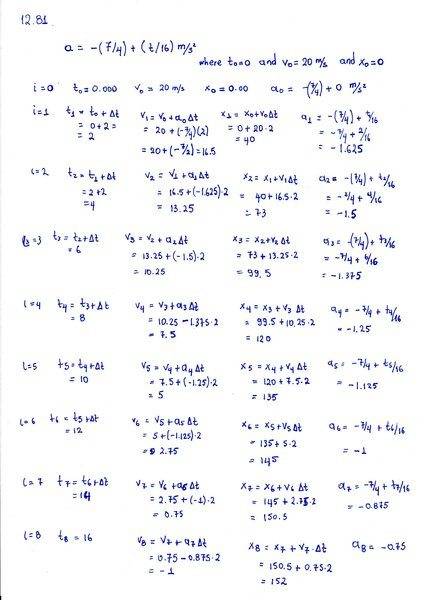
A train traveling at 20m/s is brought to an emergency stop. During braking,
the acceleration is a=-(7/4)+(t/16) m/s^2, where t is the time in seconds measured
from when the brakes were applied. (a) Integrate the acceleration from t=0 to
t=16s using Euler's method with Δt=2s. (b) Use the results of the integration to
determine the stopping distance of the train and compare you answer with 138.7m,
the value found analytically.
Homework Equations

The Attempt at a Solution


Pytel_Dynamics045.jpg

[/B]
According to the results of the Euler method above the stopping distance is between 150.5-152 m
That is way above 138.7m. Am I correct?
 
Physics news on Phys.org
Looks good to me.
 
Is the stopping distance between x7 and x8 where the velocity is 0?

Do I use linear interpolation to find the stopping distance?
for example:
Sample Problem 12_14.png


Do I use something like this?
Pytel_Dynamics047.jpg


If yes how do I apply linear interpolation in above graph to find x?
 
You could do that, but as you see there is little gain in accuracy (*)
You would use something like $${x-150\over v_7} = {x-152\over v_8} \Rightarrow x = \left ( {150.5\over v_7}-{152\over v_8} \right )/ \left ({1\over v_7}-{1\over v
_8}\right ) $$ or 151.14.

(*) the error the Euler integration makes in the first step is already about 3.5 m
( ## x = v_0 t -{1\over 2} a_0 t^2 \ ## gives 36.5 m instead of 40 m, the exact formula ##v_0 t - {1\over 2} {7\over 4} t^2 + {1\over 2}{1\over 3} {\displaystyle t^3\over 16} ## gives 36.6 m )
 

Similar threads

Replies
5
Views
2K
  • · Replies 2 ·
Replies
2
Views
2K
  • · Replies 3 ·
Replies
3
Views
2K
  • · Replies 12 ·
Replies
12
Views
2K
Replies
5
Views
2K
Replies
1
Views
1K
  • · Replies 4 ·
Replies
4
Views
4K
  • · Replies 3 ·
Replies
3
Views
6K
Replies
1
Views
3K
Replies
5
Views
2K