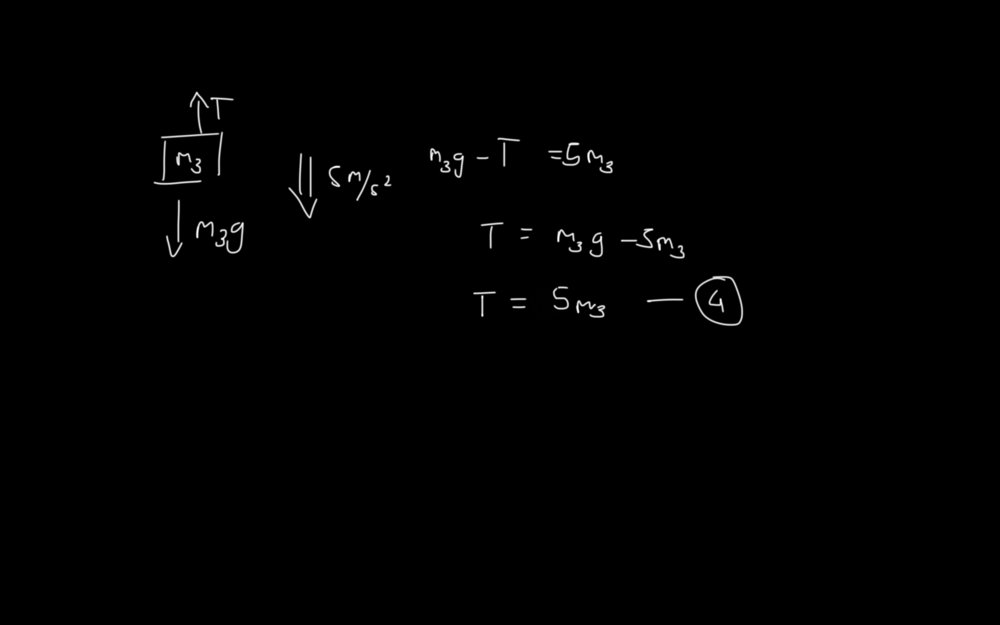
Determine the acceleration of block m1 in this wedge-pulley system

Click For Summary

Homework Help Overview

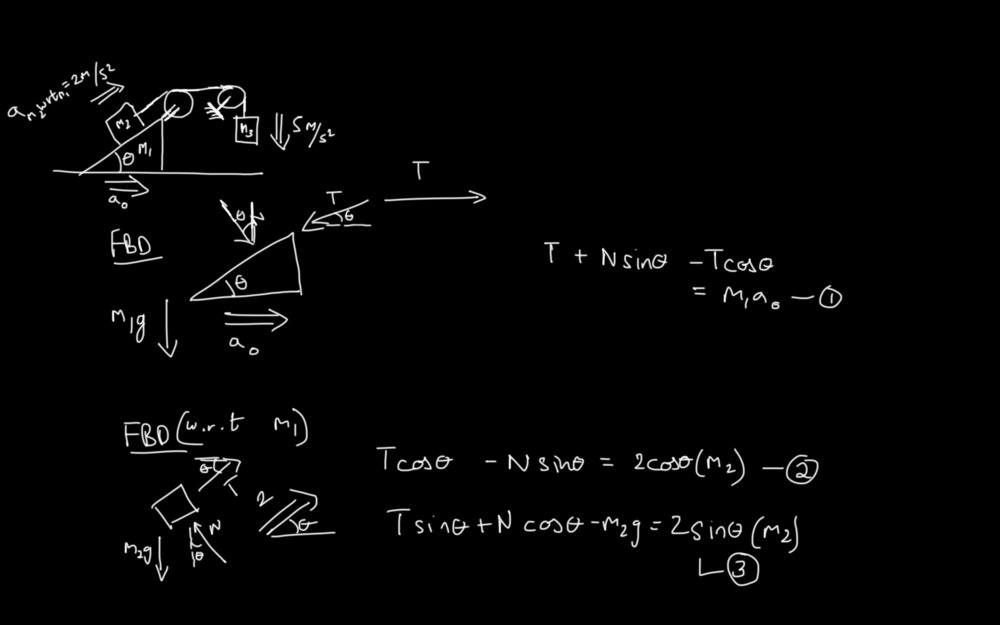
The discussion revolves around determining the acceleration of block m1 in a wedge-pulley system, specifically focusing on the rightward acceleration of block m1 (denoted as a0) and its relationship to the downward acceleration of block m3 and the diagonal acceleration of block m2.

Discussion Character

  • Exploratory, Assumption checking, Problem interpretation

Approaches and Questions Raised

  • Participants explore various scenarios, including simplifying the problem by considering blocks m1 and m2 glued together. They discuss the implications of block m1 being fixed versus free to slide, and how these conditions affect the acceleration of block m3.

Discussion Status

Participants have engaged in a back-and-forth regarding the acceleration values, with some suggesting a value of 3 m/s² for a0 based on relative acceleration concepts. There is acknowledgment of differing answers from a textbook, leading to questions about the correctness of those solutions. The discussion remains open with no explicit consensus reached.

Contextual Notes

Participants are working under the assumption that the problem is stated correctly, and there are references to specific acceleration values that may not align with textbook solutions. The context includes considerations of relative acceleration and the effects of different configurations of the blocks.

Kaushik
Messages
282
Reaction score
17
Homework Statement
The acceleration of block m2 with respect to m1 is 2m/s^2 upward along the inclination. The block m3 accelerates downward with 5 m/s^2.
Relevant Equations
a( of m2 wrt m1) = 2m/s2
a(of m3) = 5m/s2
The equations i got are attached below. Is it right? If yes what should we do after this. I tried solving the equations, but i did not arrive at the solution.
246668

246669
 
Physics news on Phys.org
What quantity are you trying to determine? If it is ##a_0## (the rightward acceleration of block ##m_1##) then you seem to be overthinking it.
 
  • Like
Likes   Reactions: Kaushik
jbriggs444 said:
What quantity are you trying to determine? If it is ##a_0## (the rightward acceleration of block ##m_1##) then you seem to be overthinking it.
Yes. I am trying to determine ##a_0##. So, do we have an easy way to solve this problem?
 
Last edited:
Kaushik said:
Yes. I am trying to determine ##a_0##. So, do we have an easy way to solve this problem?
Yes.

Let us start with a simpler version of the problem. If blocks ##m_1## and ##m_2## were glued together, how rapidly would the pair need to be accelerating rightward so that ##m_3## would be accelerating downward at 5 m/sec2?
 
  • Like
Likes   Reactions: Kaushik
jbriggs444 said:
Yes.

Let us start with a simpler version of the problem. If blocks ##m_1## and ##m_2## were glued together, how rapidly would the pair need to be accelerating rightward so that ##m_3## would be accelerating downward at 5 m/sec2?
## 5 \frac{m}{s^2} ##?
 
Kaushik said:
## 5 \frac{m}{s^2} ##?
Yes indeed.

If block ##m_1## were glued to the ground while block ##m_2## were once again free to slide, how rapidly would it need to be accelerating so that block ##m_3## would be accelerating downward at 5 m/sec2?
 
jbriggs444 said:
Yes indeed.

If block ##m_1## were glued to the ground while block ##m_2## were once again free to slide, how rapidly would it need to be accelerating so that block ##m_3## would be accelerating downward at 5 m/sec2?
## 5 \frac{m}{s^2} ##again? as the pulley attached to ## m_1 ## is not moving anymore?
 
Kaushik said:
## 5 \frac{m}{s^2} ##again? as the pulley attached to ## m_1 ## is not moving anymore?
Yes. Now unglue all blocks and return to the original problem. Can you write an equation for the downward acceleration of ##m_3## in terms of the rightward acceleration of ##m_1## and the diagonal acceleration of ##m_2##?

[If it were me, I would label the accelerations of ##m_1##, ##m_2## and ##m_3## as ##a_1##, ##a_2## and ##a_3##]
 
  • Informative
Likes   Reactions: Kaushik
jbriggs444 said:
Yes. Now unglue all blocks and return to the original problem. Can you write an equation for the downward acceleration of ##m_3## in terms of the rightward acceleration of ##m_1## and the diagonal acceleration of ##m_2##?

[If it were me, I would label the accelerations of ##m_1##, ##m_2## and ##m_3## as ##a_1##, ##a_2## and ##a_3##]
Is ## a_0 = 3 \frac{m}{s^2}##?
 
  • Like
Likes   Reactions: jbriggs444
  • #10
Kaushik said:
Is ## a_0 = 3 \frac{m}{s^2}##?
Yes
 
  • Like
Likes   Reactions: Kaushik
  • #11
jbriggs444 said:
Yes
Oh, thanks. But in my book the solution given was 2. So is the solution given in my book wrong?
 
  • #12
Kaushik said:
Oh, thanks. But in my book the solution given was 2. So is the solution given in my book wrong?
Yes, assuming the question is as stated then the book is wrong.
 
  • Like
Likes   Reactions: Kaushik
  • #13
jbriggs444 said:
Yes
I used relative acceleration.

If the block ## m_3 ## is accelerating downwards with 5, then string that is horizontal should also accelerate right with 5. But the acceleration of that horizontal string with respect to the block ## m_1 ## should be 2.

Let the horizontal string be h.

## a_h = 5 \frac{m}{s^2} ##
## a_{h} ## ( with respect to ## m_1 ## ) ##= 5 - a_0##

But as ## a_h ##(with respect to ## m_1 ## ) ## = 2 \frac{m}{s^2} ##

we get ## a_0 = 3 \frac{m}{s^2} ##
 
  • #14
jbriggs444 said:
Yes, assuming the question is as stated then the book is wrong.
Thanks for your help !
 

Similar threads

  • · Replies 37 ·
2
Replies
37
Views
3K
  • · Replies 5 ·
Replies
5
Views
1K
Replies
15
Views
2K
Replies
3
Views
1K
  • · Replies 5 ·
Replies
5
Views
2K
  • · Replies 12 ·
Replies
12
Views
3K
  • · Replies 7 ·
Replies
7
Views
1K
  • · Replies 2 ·
Replies
2
Views
2K
  • · Replies 3 ·
Replies
3
Views
2K