Determine the tension in the two strings

  • Thread starter Thread starter BunDa4Th
  • Start date Start date
  • Tags Tags
    Strings Tension
Click For Summary
The discussion focuses on calculating the tension in two strings connecting three masses, with an emphasis on the correct application of Newton's second law. The acceleration of the system is determined to be 1.28 m/s², and the tension between the first two masses (m1 and m2) is calculated to be 66.48 N. There is confusion regarding the force equations and unit consistency, particularly in the setup of the equations for the second string. Participants suggest rewriting the force equations with correct units and keeping track of the signs for acceleration. The conversation highlights the importance of correctly applying physics principles to solve for tension in a multi-mass system.
BunDa4Th
Messages
188
Reaction score
0
Three objects are connected by light strings as shown in Figure P4.62. The string connecting the m1 = 6.00 kg mass and the m2 = 4.80 kg mass passes over a light frictionless pulley.
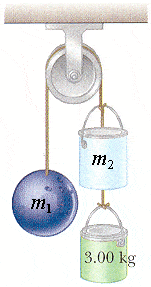
p4-62alt.gif


(b) Determine the tension in the two strings.
string between m2 and the 3.00 kg mass

I was able to do the first two part but this one is just troubling me and I am confuse. acceleration is 1.28 m/s^2

a = m2g + 3g - m1g / m1 + m2 + 3

and the tension between m1 and m2 is 66.48

T - m1g = m1a

but i can't seem to get m2 and the 3kg mass. this is what i tried

4.8(9.8) - 3(9.8) = 17.64 N

T - 17.64 = 7.8(1.28) = 27.624 which is incorrect. I don't know what I am doing wrong or where to start.
 
Last edited:
Physics news on Phys.org
You are mixing units, and that is part of your problem. a = m2g makes no sense.

Please re-write the force equations for each string, with correct units, and I think you will get it right.
 
what i did was T - m1g = m1a and T - m2g + 3g = (m2 + 3)a

then i solve for T for equation 1 to plug into equation two. I input the numbers and solve for a which is equal to 1.28.

a = (4.8(9.8) + 3(9.8)) / (6+4.6+3)
a = 1.28 with a solve i can solve for tension string between m1 and m2. which is T - m1(g) = m1(a)
T - 58.8 = 6(1.28) T = 66.48 N

I somewhat understand what i did there from reading the book but it didnt explain anything about if there was another add on to it. I am not sure if i did set up the equation correctly.
 
You may be on the right track, but keep track of the sign of a. It should be opposite for the left and right sides. Sorry, I've got to bail for the night.
 
The book claims the answer is that all the magnitudes are the same because "the gravitational force on the penguin is the same". I'm having trouble understanding this. I thought the buoyant force was equal to the weight of the fluid displaced. Weight depends on mass which depends on density. Therefore, due to the differing densities the buoyant force will be different in each case? Is this incorrect?

Similar threads

  • · Replies 1 ·
Replies
1
Views
2K
Replies
21
Views
876
Replies
16
Views
2K
  • · Replies 33 ·
2
Replies
33
Views
3K
  • · Replies 10 ·
Replies
10
Views
3K
  • · Replies 4 ·
Replies
4
Views
2K
  • · Replies 3 ·
Replies
3
Views
2K
  • · Replies 7 ·
Replies
7
Views
4K
  • · Replies 5 ·
Replies
5
Views
5K
  • · Replies 19 ·
Replies
19
Views
4K