hjam24
- 4
- 0
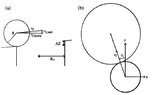
A golf is launched at a speed v,f and launch angle, β,f. The slope of the green is equal to φ. At some point the ball is located on the rim of a hole. The side view (a) and overhead view (b) looks as in the attached image.According to the author of the [paper][2] "The Physics of Putting" the vertical velocity is given by
$$ v_{f,v} = v_f \cdot \cos(\beta) \cdot \sin(\phi) $$
The horizontal velocity is equal to:
$$ v_{f,h} = v_f \cdot (\cos^2(\beta_f) \cos^2(\phi) + \sin^2(\beta_f))^{1/2} $$
I understand the reasoning behind the vertical velocity component. Basically we have the hypotenuse, v,fy (v,f * cos(β,f)) and multiply this with sin(φ). Now we have the opposite. However, why is the author not following the same logic for the horizontal velocity and multiplying the hypotenuse with cos(φ)? Please show me how his formulation is derived.
My (unsuccessful) attempt:
Pythagorean theorem
$$ \sin^2(\phi) + \cos^2(\phi) = \frac {v_{f,h}^2 + v_{f_v}^2} {v_f^2} $$
$$ v_f^2 \cdot (\sin^2(\phi) + \cos^2(\phi)) = v_{f,h}^2 + v_{f_v}^2 $$
$$ v_{f,h}^2 = v_f^2 \cdot (\sin^2(\phi) + \cos^2(\phi)) - v_{f_v}^2 $$
Substitute vertical velocity according to author
$$ v_{f,h}^2 = v_f^2 \cdot (\sin^2(\phi) + \cos^2(\phi)) - (v_f\cos(\beta)\sin(\phi))^2 $$
v,f is v,fy
$$ v_{f,h}^2 = (v_f\cos(\beta))^2 \cdot (\sin^2(\phi) + \cos^2(\phi)) - (v_f\cos(\beta)\sin(\phi))^2 $$
$$ v_{f,h}^2 = v_f^2\cos^2(\beta) \cdot (\sin^2(\phi) + \cos^2(\phi)) - v_f^2\cos^2(\beta)\sin^2(\phi) $$
$$ v_{f,h}^2 = v_f^2\cos^2(\beta)\sin^2(\phi) + v_f^2\cos^2(\beta)\cos^2(\phi) - v_f^2\cos^2(\beta)\sin^2(\phi) $$
$$ v_{f,h}^2 = v_f^2\cos^2(\beta)\cos^2(\phi) $$
$$ v_{f,h}^2 = v_f^2\cos^2(\beta)\cos^2(\phi) $$
$$ v_{f,h} = v_f(\cos^2(\beta)\cos^2(\phi))^{1/2} $$
Let me know what I am doing wrong. Thanks in advance
[2]: http://www.puttingzone.com/Science/cjp-putting.pdf
$$ v_{f,v} = v_f \cdot \cos(\beta) \cdot \sin(\phi) $$
The horizontal velocity is equal to:
$$ v_{f,h} = v_f \cdot (\cos^2(\beta_f) \cos^2(\phi) + \sin^2(\beta_f))^{1/2} $$
I understand the reasoning behind the vertical velocity component. Basically we have the hypotenuse, v,fy (v,f * cos(β,f)) and multiply this with sin(φ). Now we have the opposite. However, why is the author not following the same logic for the horizontal velocity and multiplying the hypotenuse with cos(φ)? Please show me how his formulation is derived.
My (unsuccessful) attempt:
Pythagorean theorem
$$ \sin^2(\phi) + \cos^2(\phi) = \frac {v_{f,h}^2 + v_{f_v}^2} {v_f^2} $$
$$ v_f^2 \cdot (\sin^2(\phi) + \cos^2(\phi)) = v_{f,h}^2 + v_{f_v}^2 $$
$$ v_{f,h}^2 = v_f^2 \cdot (\sin^2(\phi) + \cos^2(\phi)) - v_{f_v}^2 $$
Substitute vertical velocity according to author
$$ v_{f,h}^2 = v_f^2 \cdot (\sin^2(\phi) + \cos^2(\phi)) - (v_f\cos(\beta)\sin(\phi))^2 $$
v,f is v,fy
$$ v_{f,h}^2 = (v_f\cos(\beta))^2 \cdot (\sin^2(\phi) + \cos^2(\phi)) - (v_f\cos(\beta)\sin(\phi))^2 $$
$$ v_{f,h}^2 = v_f^2\cos^2(\beta) \cdot (\sin^2(\phi) + \cos^2(\phi)) - v_f^2\cos^2(\beta)\sin^2(\phi) $$
$$ v_{f,h}^2 = v_f^2\cos^2(\beta)\sin^2(\phi) + v_f^2\cos^2(\beta)\cos^2(\phi) - v_f^2\cos^2(\beta)\sin^2(\phi) $$
$$ v_{f,h}^2 = v_f^2\cos^2(\beta)\cos^2(\phi) $$
$$ v_{f,h}^2 = v_f^2\cos^2(\beta)\cos^2(\phi) $$
$$ v_{f,h} = v_f(\cos^2(\beta)\cos^2(\phi))^{1/2} $$
Let me know what I am doing wrong. Thanks in advance
[2]: http://www.puttingzone.com/Science/cjp-putting.pdf
Attachments
Last edited: