Determining Oscillator Frequency w/Feedback Capacitor

Click For Summary

Discussion Overview

The discussion revolves around determining the frequency of an oscillator circuit that includes a feedback capacitor. Participants explore the effects of the feedback capacitor on the oscillator's frequency and its role in maintaining oscillations, as well as the implications of negative impedance in the circuit.

Discussion Character

  • Exploratory
  • Technical explanation
  • Debate/contested
  • Mathematical reasoning

Main Points Raised

  • Some participants note that the traditional resonant frequency equation does not account for the feedback capacitor's effects on the oscillator's frequency.
  • One participant suggests that the feedback capacitor acts as a low-pass filter, potentially influencing the circuit's oscillation behavior.
  • There is mention of two circuit versions: one with a variable resistor and one with a capacitor, with the variable resistor intended to tune the oscillator.
  • Another participant proposes that the feedback capacitor appears in parallel with the resonator capacitor, which may lower the expected operating frequency.
  • Discussion includes the concept of negative capacitance and its potential impact on the circuit, with questions about how it sources current into the tuned circuit.
  • Some participants calculate the resonant frequency of the tank circuit and discuss the implications of the feedback capacitor's reactance and equivalent series resistance (ESR) on oscillation stability.
  • One participant expresses uncertainty about the necessity of introducing negative capacitance to explore resonant frequencies, suggesting the op-amp's high input impedance allows for a passive treatment of the network.
  • Concerns are raised about the loss impedance and the need for additional information to assess the circuit's performance accurately.

Areas of Agreement / Disagreement

Participants do not reach a consensus on the effects of the feedback capacitor or the necessity of negative impedance in determining the oscillator's frequency. Multiple competing views and uncertainties remain regarding the circuit's behavior and calculations.

Contextual Notes

Limitations include missing assumptions about the circuit's design, the dependence on specific component values, and unresolved mathematical steps related to the loss impedance and ESR of the capacitors involved.

tuttyfruitty
Messages
10
Reaction score
0
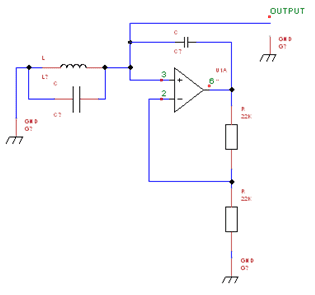
I'm trying to determine the frequency of this oscillator . The traditional resonant frequency equation for the tank circuit doesn't give the correct answer as the feed back capacitor effects the circuit .

i would also like to know what the feedback capacitor does? any help would be great.
upload_2014-10-15_21-40-3.png
 
Engineering news on Phys.org
hi there

welcome to PF :)

strange place for the output to be coming from ... I would have normally expected it to be off the output of the Op-amp. Why are you taking the output from the input to the op-amp ?

The feedback cap is making the op-amp a lowpass filter ( ie an integrator)

Dave
 
Hi Dave,

Thanks for the reply.

The circuit is used at work and the design is a few years old, so I'm unsure why the output is on the input pin. I have found 2 versions of the circuit, one with a variable resistor and one with the capacitor. I understand that the variable resistor is to "tune" the oscillator so it maintains its oscillations and the resistance of the variable resistor must match the losses of the tank circuit.

I will do some research on the integrator, do you know what the low pass filter is doing regards to maintaining oscillations?
 
tuttyfruitty said:
I'm trying to determine the frequency of this oscillator . The traditional resonant frequency equation for the tank circuit doesn't give the correct answer as the feed back capacitor effects the circuit .
I would try to see here what is min and max impedance of the network seen from the terminals of the assigned output. This is a way one usually gets resonant frequencies.
 
The OpAmp output terminal will be fairly low impedance and so the feedback capacitor will appear as is it was in parallel with the resonator capacitor. That might suggest the operating frequency might be a bit lower than you expected. Around f/√2, perhaps, if the capacitances are the same?
 
tuttyfruitty said:
I'm trying to determine the frequency of this oscillator . The traditional resonant frequency equation for the tank circuit doesn't give the correct answer as the feed back capacitor effects the circuit .

i would also like to know what the feedback capacitor does? any help would be great.
For some working circuit you've seen, what are the values of feedback capacitor and tuned-circuit capacitor?
 
The cap in the tank circuit is 10 uF and the feedback cap is 470uF, the oscillation frequency is 2174 Hz, for completeness, the inductor is 470 uH
 
It looks to me as though the impedance seen at pin 3 of the opamp (with the LC tank disconnected) will be a negative capacitance:

http://en.wikipedia.org/wiki/Negative_impedance_converter

Adjusting one of the resistors would certainly change the apparent value of the negative capacitance.

With a variable resistor in place of the capacitor (from opamp output to pin 3), the opamp circuit would present a negative resistance. That could be adjusted to compensate for the losses in the tank circuit, keeping the tank on the edge of oscillation.
 
Ive just done some research on negative impedance, that's some interesting stuff! but how does the negative capacitor effect the circuit?is it sourcing current into the tuned circuit?
 
  • #10
The frequency of the LC tank is determined by the resonance frequency of L and C. If some negative capacitance is connected in parallel with the tank's C, the effective value of capacitance in parallel with the L will be changed.
 
  • #11
Looks like a negative resistance shunted across an LC. I've designed these in before, though normally I used a gyrator instead of the inductor.
Normally, the positive feedback would be a resistor rather than cap. Also, the values are wacky. I get 2.32 kHz as the tank frequency, but a z of only 6.9 Ohms for the reactive parts! That comes to .146 Ohms for the 470uF cap, so it's ESR is probably a fair percentage of it's Z (explaining it even working) and the remaining negative capacitance (inductance) will drive the frequency up.
 
  • #12
Ive just done some research on negative impedance, that's some interesting stuff! but how does the negative capacitor effect the circuit?is it sourcing current into the tuned circuit?
Are you able to connect an oscilloscope to the output of the OP-AMP and describe the waveform you see?
 
  • #13
Output is actually input. Normally, point "6 to ground" should be considered output, no?
 
  • #14
Once I get the chance I will connect a scope up to the output.

Mike,

Just trying to get my head around your answer, from what I have read about negative capacitors, a decrease in voltage across the cap will create a increase in current . As you have worked out the resonant frequency of the tank circuit is 2.321K Hz, as soon as the feedback cap is in place the output (pin 3) changes frequency to 2.174 K Hz . My understanding is that the circuit needs to "make up" for the loses of the tank circuit which as you have calculated is 6.85 Ohms where as the reactance of the feedback cap is only 0.146 Ohms.


when I replace the feedback cap with a variable resistor the circuit oscillates when the feedback resistor is about 3.4 Ohms From my understanding, as the negative feedback part of the system causes a gain of 2 the feedback resistor needs to be half the impedance of the tank circuit.

Using that as an example I would say that the reactance of the feedback cap needs to be 3.4 Ohms. Is this saying that impedance of the cap Is made up of 0.146 Ohms of reactance and 3.2542 Ohms of ESR.

I am usual "bulk standard" electrolytic caps.
 
  • #15
As far as I can see the connection diagram, you don't need to introduce "negative capacitor" to explore resonant frequencies.
Op-amp has huge input impedance, and the network can be treated as passive one for that.
 
  • #16
Cannot say what the loss impedance is from the given info. The Z numbers correspond to loss-less inductor and capacitor. I would need the Q of the inductor at that frequency, and the ESR of the 10uF at that frequency to know the loss.
 
  • #17
tuttyfruitty said:
Once I get the chance I will connect a scope up to the output.
Awaiting the result with eager anticipation...
 

Similar threads

  • · Replies 1 ·
Replies
1
Views
2K
  • · Replies 3 ·
Replies
3
Views
5K
  • · Replies 1 ·
Replies
1
Views
2K
  • · Replies 27 ·
Replies
27
Views
3K
  • · Replies 41 ·
2
Replies
41
Views
8K
Replies
2
Views
3K
  • · Replies 4 ·
Replies
4
Views
4K
  • · Replies 9 ·
Replies
9
Views
3K
  • · Replies 15 ·
Replies
15
Views
2K
  • · Replies 4 ·
Replies
4
Views
2K