Determining the Line of Symmetry of a Reciprocal Equation.

Click For Summary
SUMMARY

The discussion centers on determining the line of symmetry for reciprocal equations, specifically using the example of the function Y=1/(x+2). It is established that the line of symmetry can be derived by adding a negative in front of the reciprocal equation, resulting in the equation of the line of symmetry being y=-(x+2). The conversation clarifies that each hyperbola has two lines of symmetry, with one passing through the vertices and the other through the center of the hyperbola, which is located at (2, 0) for the given example. The equations for these lines of symmetry are y=x-2 and y=2-x.

PREREQUISITES
  • Understanding of reciprocal functions and hyperbolas
  • Familiarity with graphing techniques for functions
  • Knowledge of symmetry in mathematical contexts
  • Ability to manipulate algebraic expressions
NEXT STEPS
  • Study the properties of hyperbolas in detail
  • Learn how to derive equations of lines of symmetry for various functions
  • Explore the concept of asymptotes in reciprocal functions
  • Practice graphing reciprocal functions and identifying their lines of symmetry
USEFUL FOR

Mathematics students, educators, and anyone interested in understanding the properties of reciprocal equations and hyperbolas, particularly in the context of symmetry and graphing techniques.

Samad
Messages
4
Reaction score
0
Problem: How do you determine the line of symmetry of a reciprocal equation?

Solution:

For example, I'll graph the reciprocal function Y=1/(x+2)

eq.jpg

^Just a quick sketch

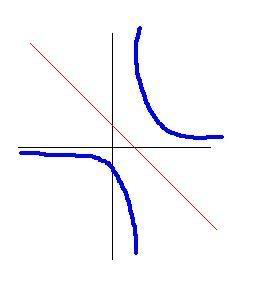
And the equation of the line of symmetry is simply -(x+2), which can be seen here:
eqsym.jpg

^Also a quick sketch

By adding a negative in front of any reciprocal equation, you have the line of symmetry. That much I figured out.

The Real Problem: Why does this happen? I mean, how can I explain it in plain english?
 
Physics news on Phys.org
First, there is no such thing as "the" line of symmetry. Any hyperbola has two lines of symmetry. In the case you give, y= 1/(x-2), (Your graph is NOT of y= 1/(x+2). That would have a vertical asymptote at x= -2.), the center of the hyperbola is at (2, 0). The line you draw, through (2,0) and perpendicular to the line containing the vertices, so with slope -1, y= -(x-2)= 2- x, is one axis of symmetry. The line through (2,0) and passing through the vertices, y= x- 2, is also an axis of symmetry.

I am not at all sure what you mean by "By adding a negative in front of any reciprocal equation, you have the line of symmetry." Do you mean "if y= 1/(x-a) is a hyperbola, then y= -1(x-a)= a- x is a line of symmetry"? If that is what you mean, then, yes, that is true. For that particular kind of hyperbola, the two lines of symmetry have slopes 1 and -1 and pass through the center of the hyperbola, (a, 0). Their equations are, therefore, y= 1(x-a)= x-a and y=-1(x-a)= a- x.

More generally, any hyperbola has two lines of symmetry: the line through the two vertices and the line through the center (half way between the vertices) perpendicular to that line.
 

Similar threads

Replies
3
Views
3K
  • · Replies 16 ·
Replies
16
Views
4K
Replies
17
Views
3K
  • · Replies 8 ·
Replies
8
Views
2K
Replies
10
Views
2K
  • · Replies 36 ·
2
Replies
36
Views
2K
  • · Replies 3 ·
Replies
3
Views
2K
  • · Replies 3 ·
Replies
3
Views
1K
  • · Replies 10 ·
Replies
10
Views
2K
  • · Replies 2 ·
Replies
2
Views
2K