Determining the voltage polarity of the independent current source

Click For Summary
SUMMARY

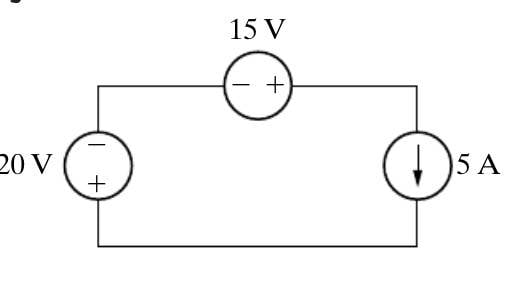
The discussion focuses on determining the voltage polarity of an independent current source in a circuit. Participants emphasize the importance of assigning the correct voltage to the current source by summing voltages around the loop to achieve zero. A key conclusion is that a terminal voltage of -5 V indicates that the positive terminal is at the bottom and the negative terminal is at the top, affecting power calculations. The conversation also clarifies that power does have polarity, particularly in active components, and that the sign of voltage and current must be considered in calculations.

PREREQUISITES
  • Understanding of circuit analysis principles, including Kirchhoff's laws.
  • Familiarity with the concepts of voltage, current, and power in electrical circuits.
  • Knowledge of active versus passive components in electrical engineering.
  • Basic skills in calculating power using the formula P = VI.
NEXT STEPS
  • Research the application of Kirchhoff's Voltage Law in complex circuits.
  • Study the behavior of active components like current sources and their impact on circuit analysis.
  • Learn about the differences in power calculations for passive versus active components.
  • Explore practical examples of voltage polarity in real-world electrical systems.
USEFUL FOR

Electrical engineering students, circuit designers, and professionals involved in power system analysis will benefit from this discussion, particularly those focusing on current sources and power calculations.
fight_club_alum
Messages
63
Reaction score
1
TL;DR
How can I determine the voltage polarity of the current source in the circuit attached?
I am so sorry if I am posting this in the wrong forum; it is just not a homework problem, and I can't find the right place - it's more of a study help question.
Screen Shot 2019-09-30 at 8.51.27 PM.jpg
 
Engineering news on Phys.org
fight_club_alum said:
Summary: How can I determine the voltage polarity of the current source in the circuit attached?
Just add up the voltages around the loop and make it zero by assigning the needed voltage to the current source.
 
  • Like
Likes fight_club_alum
phinds said:
Just add up the voltages around the loop and make it zero by assigning the needed voltage to the current source.
Thank you so much for replying
I did so and got -5 V (with that number how can I determine the positive and negative ends of the current source's voltage?)
 
Last edited:
fight_club_alum said:
Thank you so much for replying
I did so and got -5 V (with that number how can I determine the positive and negative ends of the current source's voltage?)

It would make a difference if I am calculating, for instance, the power developed and dissipated
 
Last edited:
fight_club_alum said:
Thank you so much for replying
I did so and got -5 V (with that number how can I determine the positive and negative ends of the current source's voltage?)
You just did.
 
fight_club_alum said:
It would make a difference if I am calculating, for instance, the power developed and dissipated
No, it would not. Why is that true?
 
  • Like
Likes fight_club_alum
phinds said:
No, it would not. Why is that true?
if I am going through the positive terminal of a component, I will write P = +V I
if I am going through the negative terminal of a component, I will write P = - V I
Isn't that correct?
 
fight_club_alum said:
if I am going through the positive terminal of a component, I will write P = +V I
if I am going through the negative terminal of a component, I will write P = - V I
Isn't that correct?
No. Power does not have a polarity. Think about it this way: if you have a single 10 ohm resistor drawn vertically and you connect +10 volts to the top and ground the bottom, the power dissipation is 10 watts. If, on the other hand, you connect +10 volts to the bottom and ground the top, the power dissipation will be 10 watts.

@fight_club_alum another way to look at it is that P = I*2 x R so clearly it doesn't matter which way the current is flowing.
 
Last edited:
The polarity matters. The current source has a terminal voltage of -5 volts, minus on top, plus on bottom. Since positive current exits the positive terminal, the current source is delivering power.
If the terminal voltage were reversed plus on top, then the current source is receiving power.
An example is a car battery. When starting engine, positive current exits pos terminal. Battery delivers power to crank the starter. After engine starts, pos current from alternator enters battery pos terminal. Battery here is receiving power from alternator, ie getting recharged.

Claude Abraham
EE 41 years
PhD candidate
 
  • Like
Likes phinds
  • #10
Good point. I was forgetting that it's an active component so my analogy with a passive component is not a good one.
 
  • #11
fight_club_alum said:
It would make a difference if I am calculating, for instance, the power developed and dissipated
Yes it makes a difference. But remember your example with only ideal voltage sources and ideal current sources is very unrealistic. There is no real life circuit that behaves like that example.

It is easy to create contradictory examples using ideal components. For example an ideal voltage source with a short circuit that predicts infinite current. Ideal components are extremely useful to help analyze real world circuits which never contain infinities. It is silly to apply them to unrealistic circuits.
 
  • #12
phinds said:
No. Power does not have a polarity. Think about it this way: if you have a single 10 ohm resistor drawn vertically and you connect +10 volts to the top and ground the bottom, the power dissipation is 10 watts. If, on the other hand, you connect +10 volts to the bottom and ground the top, the power dissipation will be 10 watts.
That is a bit overstated. Your example is true only true for a resistor. If power had no polarity it wouldn't matter if power flows from power plant to customer or from customer to power plant.
 
  • #13
anorlunda said:
That is a bit overstated. Your example is true only true for a resistor. If power had no polarity it wouldn't matter if power flows from power plant to customer or from customer to power plant.
Yes, see post #10
 
  • #14
phinds said:
Good point. I was forgetting that it's an active component so my analogy with a passive component is not a good one.

We all trip over our own words once in a while. I know you know this, but it is not even true for every passive circuit.

The correct statement is that P=VI does have polarity, and can be positive and negative. But in a passive resistor, when V changes sign, so does I. When the circuit includes passive L or C, that is no longer true.
 
  • Like
Likes phinds
  • #15
anorlunda said:
We all trip over our own words once in a while. I know you know this, but it is not even true for every passive circuit.

The correct statement is that P=VI does have polarity, and can be positive and negative. But in a passive resistor, when V changes sign, so does I. When the circuit includes passive L or C, that is no longer true.
DOH_small.jpg
 
  • Haha
Likes anorlunda
  • #16
phinds said:
another way to look at it is that P = I*2 x R so clearly (??) it doesn't matter which way the current is flowing.
True but (for a passive device) that doesn't take care of the P = VI sign. If you are measuring relative to the Positive terminal you will get +V and +I; if you measure relative to the - terminal you get a -V and -I so VI is positive either way.
Kirchoff II tells us that the emf's subtract from the IR's and the signs also behave properly according to whether Power is going in or going out.
 
  • #17
sophiecentaur said:
True but (for a passive device) that doesn't take care of the P = VI sign.
Did you miss #13?
 
  • #18
I think the dementia is kicking in.
 

Similar threads

  • · Replies 19 ·
Replies
19
Views
3K
  • · Replies 44 ·
2
Replies
44
Views
7K
  • · Replies 14 ·
Replies
14
Views
570
  • · Replies 4 ·
Replies
4
Views
2K
  • · Replies 42 ·
2
Replies
42
Views
5K
  • · Replies 3 ·
Replies
3
Views
2K
  • · Replies 10 ·
Replies
10
Views
2K
  • · Replies 3 ·
Replies
3
Views
2K
  • · Replies 12 ·
Replies
12
Views
2K
  • · Replies 13 ·
Replies
13
Views
3K