Diagonalizing a Matrix: Understanding the Process and Power of Matrices

Click For Summary
To diagonalize a matrix, the eigenvalues are calculated from the determinant equation, leading to matrix D. The transformation involves solving the equation PM = DP, treating P as variables, and applying the Gauss-Jordan algorithm for clarity. For raising the matrix M to the power of k, the entire expression is raised, but many terms cancel out, simplifying the process to M^k = PD^kP^(-1). The discussion also humorously touches on a language error regarding "dose" versus "does." Understanding these concepts is crucial for mastering matrix diagonalization.
member 731016
Homework Statement
Please see below
Relevant Equations
Please see below
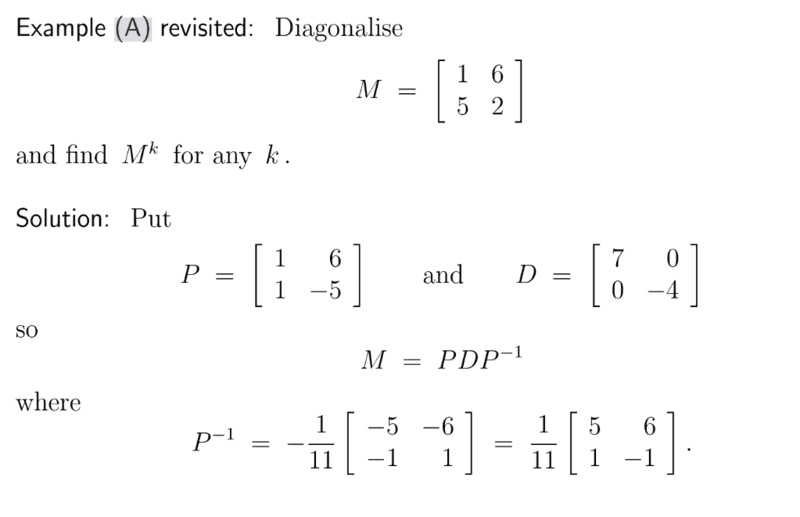
For this,
1683594850400.png

Dose someone please know where they get P and D from?

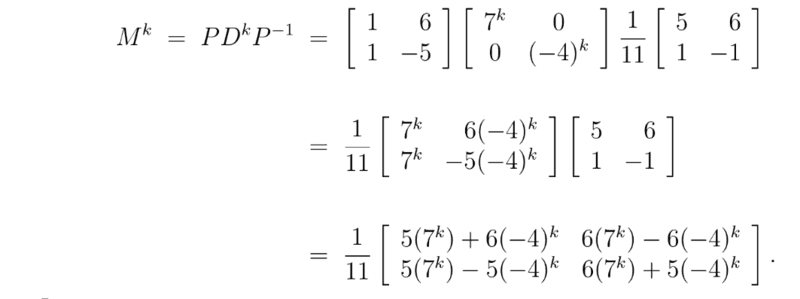
Also for ##M^k##, why did they only raise the the 2nd matrix to the power of k?
1683594915390.png

Many thanks!
 
Physics news on Phys.org
  • Like
Likes chwala, DrClaude, member 731016 and 1 other person
ChiralSuperfields said:
Also for ##M^k##, why did they only raise the the 2nd matrix to the power of k?
Just add, that they are raising the whole thing to power ##k##, but you didn't notice that many things cancel.
##M^k=(PDP^{-1})^k=PDP^{-1}PDP^{-1}\dots PDP^{-1}=PDD\dots DP^{-1}=PD^kP^{-1}##
 
  • Like
Likes member 731016, DaveE, chwala and 1 other person
ChiralSuperfields said:
Dose someone please know
I'm trying to train you to know the difference between "dose" and "does" but have been unsuccessful so far.
 
  • Like
  • Haha
Likes member 731016, chwala and SammyS
Mark44 said:
I'm trying to train you to know the difference between "dose" and "does" but have been unsuccessful so far.
Is there no antidote (or perhaps - antidose) for this?
 
  • Like
Likes member 731016
Question: A clock's minute hand has length 4 and its hour hand has length 3. What is the distance between the tips at the moment when it is increasing most rapidly?(Putnam Exam Question) Answer: Making assumption that both the hands moves at constant angular velocities, the answer is ## \sqrt{7} .## But don't you think this assumption is somewhat doubtful and wrong?

Similar threads

  • · Replies 8 ·
Replies
8
Views
2K
Replies
5
Views
1K
  • · Replies 4 ·
Replies
4
Views
1K
  • · Replies 10 ·
Replies
10
Views
2K
Replies
2
Views
2K
  • · Replies 4 ·
Replies
4
Views
1K
  • · Replies 33 ·
2
Replies
33
Views
1K
  • · Replies 4 ·
Replies
4
Views
1K
Replies
3
Views
2K
  • · Replies 2 ·
Replies
2
Views
3K