Is Diagrammatic Tensor Notation Widely Used in Mathematics?

  • Context: Undergrad 
  • Thread starter Thread starter Hill
  • Start date Start date
  • Tags Tags
    Notation Tensor
Click For Summary

Discussion Overview

The discussion revolves around the use of diagrammatic tensor notation as introduced by Roger Penrose, exploring its prevalence and acceptance within the fields of mathematics and physics. Participants examine the practicality, aesthetic appeal, and theoretical implications of this notation compared to traditional index notation.

Discussion Character

  • Debate/contested
  • Technical explanation
  • Conceptual clarification

Main Points Raised

  • Some participants note that Penrose's diagrammatic tensor notation is not widely used, citing difficulties in typesetting and quality assurance of complex 2D representations.
  • Others mention that physicists may be more inclined to use such notations, while mathematicians generally prefer to avoid coordinate systems.
  • A participant references Cvitanović's "bird tracks" as a related system that addresses some practical issues of Penrose's approach.
  • There is a discussion about the distinction between abstract index notation and coordinate systems, with some arguing that abstract notation is not tied to specific coordinates.
  • Concerns are raised about the aesthetic and practical aspects of Penrose's notation, with some participants expressing a preference for more traditional representations.
  • Several participants share anecdotes about mathematicians' aversion to coordinate systems, suggesting that this aversion may vary by subfield within mathematics.
  • Some argue that while mathematicians may avoid coordinates, they still engage with concepts that involve tensor multiplication and traces.
  • There is a debate about whether the use of abstract index notation is palatable to mathematicians, with differing opinions on its acceptance.

Areas of Agreement / Disagreement

Participants express a range of views on the use of diagrammatic tensor notation, with no clear consensus on its popularity or practicality. Some agree that it is not commonly used, while others suggest that it may have niche applications in physics.

Contextual Notes

Limitations in the discussion include varying definitions of what constitutes "coordinates" and differing perspectives on the appropriateness of various notational systems across different mathematical disciplines.
Hill
Messages
792
Reaction score
614
TL;DR
Is Penrose's diagrammatic tensor notation used by anybody else?
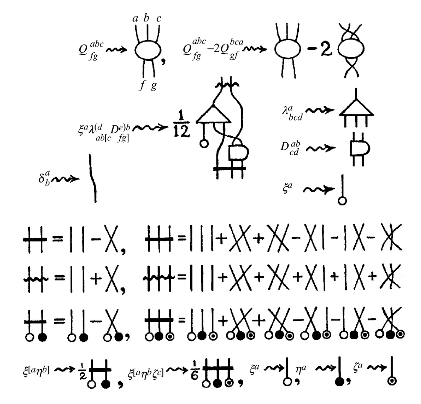
Penrose demonstrates in his book "The Road to Reality" a "diagrammatic tensor notation", e.g.,
1707566298341.png


As I haven't seen it anywhere else, I wonder if anybody else uses it.
 
Physics news on Phys.org
I can't claim to be widely read on the topic, but I would suspect it's not hugely popular. First, it's difficult to typeset. Second, 2d representations of complicated networks are tricky to quality assure. So, clever as it is, it's difficult to use.

Courtesy of @bcrowell's book I know that Cvitanović liked the representation enough to develop a system of arrows called "bird tracks" that you can read more about at birdtracks.eu. I think that partially addresses the practical issues with Penrose's diagrammatic approach.
 
  • Like
  • Informative
Likes   Reactions: jbergman and Hill
If at all, then you should ask physicists. Mathematicians try to avoid coordinates.
 
fresh_42 said:
If at all, then you should ask physicists. Mathematicians try to avoid coordinates.
I didn't find the appropriate place in the Physics forum. Anyway, just before introducing the diagrammatic tensor notation, Penrose says the following:
1707588909320.png
 
  • Like
Likes   Reactions: Orodruin
fresh_42 said:
If at all, then you should ask physicists. Mathematicians try to avoid coordinates.
I don’t see coordinates anywhere.
 
Orodruin said:
I don’t see coordinates anywhere.
I see 5: ##\mathcal{Q}_{fg}^{abc}.## And from there it get's even worse.
 
fresh_42 said:
I see 5: ##\mathcal{Q}_{fg}^{abc}.## And from there it get's even worse.
Indices do not necessarily equate to components in some coordinate basis.
https://en.m.wikipedia.org/wiki/Abstract_index_notation

Edit: In fact, Penrose points this out explicitly in the quote in #4. It therefore seems reasonable to assume that Penrose is indeed using abstract tensor notation here, which also rhymes pretty well with his notation (ghastly as it might be).
 
  • Like
Likes   Reactions: cianfa72
Orodruin said:
Indices do not necessarily equate to components in some coordinate basis.
https://en.m.wikipedia.org/wiki/Abstract_index_notation
Anyway, it is nothing a mathematician would use. ##\mathcal{Q} \in V^*\otimes V^*\otimes V^*\otimes V\otimes V## would do. It is simply ugly.
 
  • Like
Likes   Reactions: jbergman
fresh_42 said:
Anyway, it is nothing a mathematician would use. ##\mathcal{Q} \in V^*\otimes V^*\otimes V^*\otimes V\otimes V## would do. It is simply ugly.
That is not sufficient for the purposes on display here. It just tells you the structure of Q itself, nothing about the products etc.
 
  • #10
Orodruin said:
That is not sufficient for the purposes on display here. It just tells you the structure of Q itself, nothing about the products etc.
Yes, and that is where physics or computer science and coordinates - or whatever you like to call them - start.
 
  • #11
fresh_42 said:
Anyway, it is nothing a mathematician would use.
Penrose is a mathematician.
 
  • #12
martinbn said:
Penrose is a mathematician.
Maybe that's why he tried to substitute ugly indices with fancy pictures. :smile:

It is as if we would write ##v_a## instead of ##v\in V## or ##\vec{v}\in V.##
 
  • #13
fresh_42 said:
Maybe that's why he tried to substitute ugly indices with fancy pictures. :smile:

It is as if we would write ##v_a## instead of ##v\in V## or ##\vec{v}\in V.##
He is the one who introduced the abstract index notarion too.
 
  • Like
Likes   Reactions: robphy
  • #14
fresh_42 said:
Maybe that's why he tried to substitute ugly indices with fancy pictures. :smile:

It is as if we would write ##v_a## instead of ##v\in V## or ##\vec{v}\in V.##

He also does not mention the “d” word (division) in the index.

IMG_0043.jpeg
 
  • #15
Frabjous said:
He also does not mention the “d” word (division) in the index.

View attachment 340171
... or dare to express an opinion!
 
  • #16
fresh_42 said:
Yes, and that is where physics or computer science and coordinates - or whatever you like to call them - start.
Are you claiming mathematicians never multiply temsors together? Never have the need to take a trace or similar?
 
  • #17
In the preface of Volume 1: Two-Spinor Calculus and Relativistic Fields Roger Penrose, Wolfgang Rindler Penrose/Rindler say

Penrose A.jpg

Penrose B.jpg


Given the diagrammatic notation was, it seems, intended for private calculations it may be difficult answering the question if anybody else uses it.
 
Last edited:
  • Informative
Likes   Reactions: Hill
  • #18
Orodruin said:
Are you claiming mathematicians never multiply temsors together?
I knew a mathematician who refused to multiply matrices except they were triangular in which case he considered the corresponding chain of ideals.
Orodruin said:
Never have the need to take a trace or similar?
The Killing form is a trace. But as soon as the arithmetic rules have been derived, everybody notes it as ##K(X,Y)## or ##\beta(X,Y).## I didn't say that mathematicians do not use coordinates, only that they try to avoid them.
 
  • #19
But the point is that abstract tensor notation is not using coordinates. It is not tied to a particular coordinate system.

That said, I too many times try to avoid index notation when I feel I can do without, but I don’t have the same kind of deep aversion that some mathematicians seem to have. I’m not going to not use a hammer just because it is pink if it is the appropriate hammer to drive in the nail.
 
  • Like
Likes   Reactions: cianfa72
  • #20
Orodruin said:
But the point is that abstract tensor notation is not using coordinates. It is not tied to a particular coordinate system.

That said, I too many times try to avoid index notation when I feel I can do without, but I don’t have the same kind of deep aversion that some mathematicians seem to have. I’m not going to not use a hammer just because it is pink if it is the appropriate hammer to drive in the nail.
I don't think that mathematiians avoid coordinate like the plague. I think the aversion is to the physicist's practice to always use coordinates.
 
  • Like
Likes   Reactions: cianfa72 and fresh_42
  • #21
fresh_42 said:
I knew a mathematician who refused to multiply matrices except they were triangular in which case he considered the corresponding chain of ideals.
This is definitely not typical.
fresh_42 said:
The Killing form is a trace. But as soon as the arithmetic rules have been derived, everybody notes it as ##K(X,Y)## or ##\beta(X,Y).## I didn't say that mathematicians do not use coordinates, only that they try to avoid them.
This may depend on which area of mathematics we look at. Do you have any observations about differential geometers?
 
  • #22
martinbn said:
This may depend on which area of mathematics we look at. Do you have any observations about differential geometers?
Look up the Levi-Civita connection on Wikipedia. You will find under notation / motivation / Christoffel symbols the usual coordinate notation which physicists use all the time, however, the formal definition doesn't refer to a single index. That makes the difference.
 
  • #23
martinbn said:
I don't think that mathematiians avoid coordinate like the plague. I think the aversion is to the physicist's practice to always use coordinates.
But as I mentioned, abstract index notation does avoid coordinates. It was still not palatable to at least one mathematician. 😉
 
  • #24
Orodruin said:
But as I mentioned, abstract index notation does avoid coordinates. It was still not palatable to at least one mathematician. 😉
This is a rather artificial distinction that you make here. ##v_a## is index notation and it represents a component or coordinate of a vector by stating that ##v=(v_1,\ldots,v_n)^\tau## or whatever.
 
  • #25
fresh_42 said:
This is a rather artificial distinction that you make here. ##v_a## is index notation and it represents a component or coordinate of a vector by stating that ##v=(v_1,\ldots,v_n)^\tau## or whatever.
No, look up the abstract index notation.
 
  • #26
Orodruin said:
But as I mentioned, abstract index notation does avoid coordinates. It was still not palatable to at least one mathematician. 😉
Yes, but he thought it was actual indices.
 
  • #27
fresh_42 said:
Look up the Levi-Civita connection on Wikipedia. You will find under notation / motivation / Christoffel symbols the usual coordinate notation which physicists use all the time, however, the formal definition doesn't refer to a single index. That makes the difference.
But the main object the manifold is difined through coordinates.
 
  • #28
martinbn said:
But the main object the manifold is difined through coordinates.
You asked for an example in differential geometry and I gave one.

Using a manifold defined by an atlas and then claim that it needs an atlas as an example for the use of coordinates is circular reasoning. Geometry always uses coordinates in its analytical version. This manifests already in its name: "earth-measure".

Again, I do not claim that mathematicians do not use coordinates, only that they try to avoid them. Big difference!

martinbn said:
No, look up the abstract index notation.

It is artificial in my mind. The index notation wouldn't even make sense if there weren't components!
 
  • #29
fresh_42 said:
You asked for an example in differential geometry and I gave one.
No, may be i was unclear, but i wanted an example in differential geometry where a mathematician avoids coordinates.
fresh_42 said:
Using a manifold defined by an atlas and then claim that it needs an atlas as an example for the use of coordinates is circular reasoning. Geometry always uses coordinates in its analytical version. This manifests already in its name: "earth-measure".
I dont understand. One hand you say that mathematicians avoid coordinates. On the other you say that geometry always uses coordinates.
fresh_42 said:
Again, I do not claim that mathematicians do not use coordinates, only that they try to avoid them. Big difference!
Yes, but my impression is that geometers dont try to avoid them.
fresh_42 said:
It is artificial in my mind. The index notation wouldn't even make sense if there weren't components!
it is as artificial as any notation.
 
  • #30
martinbn said:
Yes, but my impression is that geometers dont try to avoid them.
How about Euclid?
 

Similar threads

  • · Replies 16 ·
Replies
16
Views
3K
  • · Replies 1 ·
Replies
1
Views
3K
  • · Replies 26 ·
Replies
26
Views
11K
  • · Replies 3 ·
Replies
3
Views
2K
  • · Replies 5 ·
Replies
5
Views
4K
  • · Replies 10 ·
Replies
10
Views
3K
  • · Replies 3 ·
Replies
3
Views
4K
  • · Replies 7 ·
Replies
7
Views
2K
  • · Replies 5 ·
Replies
5
Views
2K
  • · Replies 1 ·
Replies
1
Views
2K