Did I count this current in a circuit correctly?

Join the discussion
Ask a follow-up here, or get your own question answered by working scientists, mathematicians and engineers — people, not an autocomplete.
Real named experts · corrections over time · the nuance an AI answer skips
6 replies · 2K views
Duc Anh Le
Messages
3
Reaction score
0
This i a test question and we are not allowed to use a calculator, so I was wondering whether I did everything correctly, since the I1 = - 1/7. I am supposed to find out I3, but stopped at I1, since the result is a bit tricky.

1. Homework Statement

R1 = 10 ohm, R2 = 20 ohm, R3 = 40 ohm
I3 = ?

Homework Equations


I3 = I2 + I1
V1 = I1 * R1 + I3 * R3
V2 = R2 * I2 + I3 * R3

The Attempt at a Solution


10 = 20I1 + 40 I2 + 40I1
20 = 20I2 + 40I1 + 40I2
-10 = 70I1
I1 = -1/7
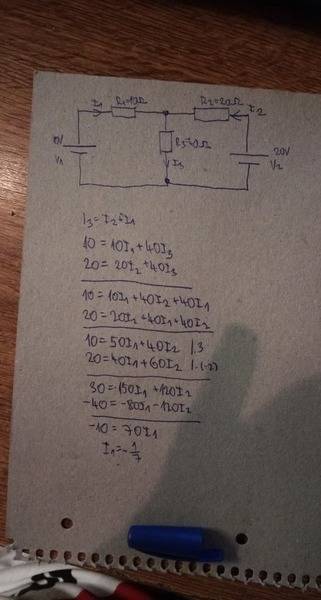
5ly1os8imkw11.jpg
[/B]
 

Attachments

  • 5ly1os8imkw11.jpg
    5ly1os8imkw11.jpg
    24 KB · Views: 319
Physics news on Phys.org
The circuit in the image is very difficult to read the component labels. Please post a closeup or draw and photograph a larger version.
Duc Anh Le said:
3. The Attempt at a Solution
10 = 20I1 + 40 I2 + 40I1
20 = 20I2 + 40I1 + 40I2
-10 = 70I1
I1 = -1/7
From what I can tell, the first term on the RHS should be 10I1 rather than 20I1. This is likely a transcription typo since your value for the current I1 looks good to me.
 
gneill said:
The circuit in the image is very difficult to read the component labels. Please post a closeup or draw and photograph a larger version.

From what I can tell, the first term on the RHS should be 10I1 rather than 20I1. This is likely a transcription typo since your value for the current I1 looks good to me.
6uVlA3E.png

Here's a better picture
 

Attachments

  • 6uVlA3E.png
    6uVlA3E.png
    6 KB · Views: 355
Duc Anh Le said:
This i a test question and we are not allowed to use a calculator, so I was wondering whether I did everything correctly, since the I1 = - 1/7. I am supposed to find out I3, but stopped at I1, since the result is a bit tricky.
...

I will show that ##I_1## is negative:

$$50 I_1 + 40 I_2 = 10;\ 40 I_1 + 60 I_2 = 20 \\
5 I_1 + 4 I_2 = 1; 2 I_1 + 3 I_2 = 1\\
3 I_1 + I_2 = 0$$
Note that ##I_1## and ##I_2## have different signs and that ##I_3 = -2 I_1##, so ##I_3## and ##I_1## have different signs. And since ##I_2## is clearly positive, we know all the signs and ##I_1## is indeed negative.
 
You are on the right track, good work so far!
Do you know about Thevinin & Norton equivalent circuit transformations yet? I think they make problems like this much easier to do.
 
DaveE said:
You are on the right track, good work so far!
Do you know about Thevinin & Norton equivalent circuit transformations yet? I think they make problems like this much easier to do.
Alright, thanks for the verification. So far we've only been taught ohm's and kirchhoff's laws.