Dielectric resonator - microwaves

Click For Summary

Discussion Overview

The discussion revolves around the effects of mixing dielectric solids with liquids on the behavior of microwaves, particularly at a frequency of ~260 GHz. Participants explore the implications of this phenomenon, its theoretical underpinnings, and potential applications, while questioning the validity of the claims made in a referenced scientific article.

Discussion Character

  • Exploratory, Technical explanation, Debate/contested

Main Points Raised

  • One participant references a scientific article claiming that mixing a high dielectric constant solid with a liquid enhances the electromagnetic field in both materials compared to the liquid alone.
  • Another participant expresses skepticism about the explanations provided in the article, seeking analogies or previous applications of similar effects.
  • A later reply highlights the limitations of low temperatures and strong magnetic fields for specific experiments, suggesting these factors could restrict practical applications.
  • One participant argues that while low temperature and high magnetic fields are necessary for certain experiments, the phenomenon of confining microwaves in a dielectric structure may have broader implications across various situations.
  • Participants discuss the relevance of the wavelength (~1mm) in the context of typical communication frequencies.

Areas of Agreement / Disagreement

Participants express a mix of curiosity and skepticism regarding the claims made in the article. There is no consensus on the validity of the explanations or the general applicability of the phenomenon.

Contextual Notes

The discussion includes assumptions about the behavior of microwaves in mixed dielectric environments and the specific conditions under which the observed effects occur. Limitations related to the experimental setup and the specific frequency used are noted but not resolved.

Who May Find This Useful

Researchers and practitioners interested in microwave applications, dielectric materials, and electromagnetic theory may find this discussion relevant.

max201
Messages
3
Reaction score
0
Hi,

recently there was an article in one scientific journal where they claimed that when microwaves are shined on a mixture of dielectric solid (powdered or crystalline) of high dielectric constant with some liquid, the EM field is much higher, both in the dielectric and in the liquid, as compared to the case of the same pure liquid. They also did some simulations (see the screenshot attached) where this is visible.

They give some explanations of the effect (microwave scattering, better penetration) but I'm not fully convinced. I have the impression that this is logically conceivable and explicable in terms of basic physics, especially for people who deal with microwaves. Have you ever seen an effect like this? Can you think of any analogy, a situation where this was previously applied? The microwave frequency was ~260 GHz here but I don't think that matters so much. Why does mixing two dielectrics with different dielectric constant will affect the one with lower dielectric constant in a way that it will "contain" more microwave field?

Thanks a lot for any ideas!
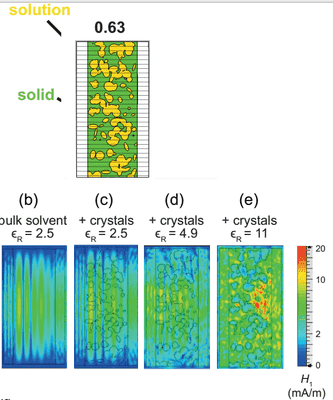
sim_900B9CA5-5056-8D7B-05D2261FB5BDFFC5.png
 
Engineering news on Phys.org
It would help to see the original article.
 
Here you go. It's quite a specific application but the idea and results are described in the abstract.
 

Attachments

Interesting phenomenon. I guess it can be very useful but requirement of low temperatures and strong magnetic fields limit application potential considerably.
 
Low temperature and high magnetic field are necessary for this particular kind of experiment (magnetic resonance, hiperpolarization) but I think the phenomenon of "confining" microwaves in a dielectric structure is much more general and applies to wide range of situations.. here indeed the wavelength is ~1mm which is shorter than typically used in communication.
 

Similar threads

Replies
1
Views
2K
Replies
2
Views
3K
  • · Replies 3 ·
Replies
3
Views
3K
  • · Replies 73 ·
3
Replies
73
Views
9K
  • · Replies 1 ·
Replies
1
Views
2K
  • · Replies 7 ·
Replies
7
Views
2K
  • · Replies 13 ·
Replies
13
Views
7K
Replies
1
Views
3K
  • · Replies 1 ·
Replies
1
Views
4K
  • · Replies 1 ·
Replies
1
Views
2K