Difference between Absolute and Gauge Pressure

Click For Summary
SUMMARY

The discussion clarifies the distinction between Absolute Pressure and Gauge Pressure. Absolute Pressure is defined as the pressure measured relative to a perfect vacuum, while Gauge Pressure measures the difference between Absolute Pressure and atmospheric pressure. For example, a car tire's pressure may read 200 kPa at sea level due to atmospheric pressure, but in a vacuum, it would read 301.3 kPa, reflecting the true Absolute Pressure. The formulas provided, P_(gage) = P_(abs) - P_(atm) and P_(vacuum) = P_(atm) - P_(abs), illustrate how these pressures relate to one another.

PREREQUISITES
  • Understanding of pressure measurement concepts
  • Familiarity with atmospheric pressure values (e.g., 101.3 kPa at sea level)
  • Basic knowledge of Pascal (Pa) as a unit of pressure
  • Ability to interpret pressure formulas and calculations
NEXT STEPS
  • Research the applications of Absolute Pressure in scientific experiments
  • Learn about pressure measurement tools, such as manometers and pressure gauges
  • Explore the effects of altitude on atmospheric pressure and its implications
  • Study the principles of vacuum systems and their applications in various industries
USEFUL FOR

Engineers, physicists, and anyone involved in fluid mechanics or pressure measurement will benefit from this discussion, particularly those looking to deepen their understanding of pressure concepts in practical applications.

tomtomtom1
Messages
160
Reaction score
8
TL;DR
Difference between Absolute and Gauge Pressure.
Hello all

I was wondering someone could help clear up my understanding about the difference between Absolute and Gauge Pressure.

After some reading i have been told that the Absolute Pressure is pressure taken at 0 relative to a vacuum.

I am trying to understand what this actually means.

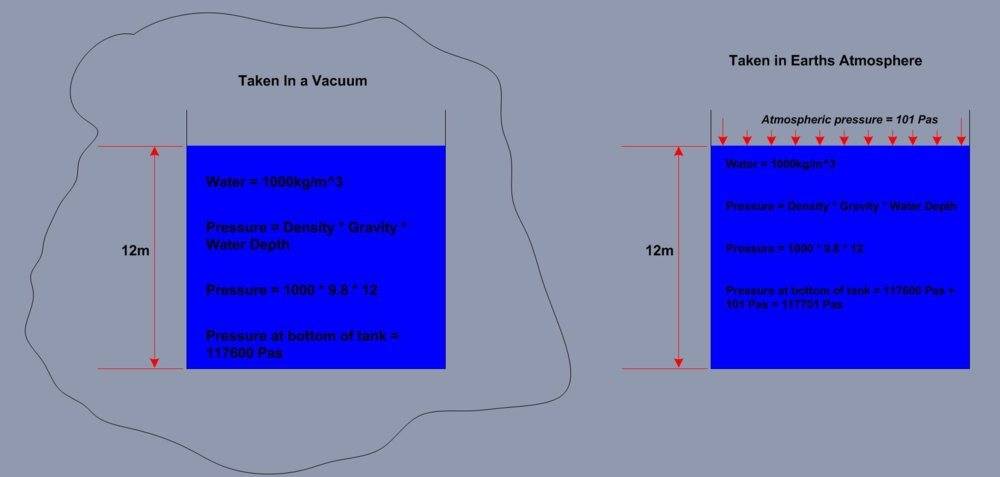
Below is a sketch i made where i have a tank of water for which i calculated the pressure at the bottom of the tank, this tank is in a Vaccum.

I calculated the same pressure on Earth with the same formula but added the Atmospheric pressure.

But i still don't get it?
ddd.JPG


Can someone help?

Thank you.
 
Engineering news on Phys.org
It's nice that you made a drawing. I wish more people would do this.

You've made a mistake regarding atmospheric pressure. At sea level atmospheric pressure is approximately 101.3 kPa. That's about 1000 times larger than the value you have. There is a rule of thumb that every 10 m below the surface of the water the absolute pressure goes up by an atmosphere. This means that at around 10 m below the surface of the water the pressure should be about double the atmospheric pressure.

There are two other very minor things that you should know. The units of Pascals are properly written as Pa not Pas. Second, generally, we put a space between the number and the units. But, hey, no big deal.

Absolute pressure is the value you get if you just calculate the force of all the particles hitting a surface and then divide that by the area. Gauge pressure is what a gauge measures; it's the difference between the pressures on the two sides of the gauge.

If, at sea level, I measure my car's tires with a pressure gauge, I'll see that it says around 200 kPa. Now, if I take my tire into a vacuum of 0 kPa (I'm also assuming that I've got a special tire that won't change its shape or burst) and I measure with my pressure gauge I will now see 301.3 kPa.

Why is this? Well, the tire had the same absolute pressure in both cases: 301.3 kPa. To push the rod or needle on your gauge this absolute pressure had to fight the pressure on the outside of the tire. In vacuum there was no pressure so you could see the full 301.3 kPa. On earth, the 301.3 kPa inside the tire had to push against atmospheric pressure, so it shows a smaller value.
 
  • Like
Likes Baluncore
Absolute Pressure: Actual pressure at a specific point
Gage Pressure: Occurs if the system has higher pressure relative to its environment (in most case atmosphere) ##P_(gage) = P_(abs) - P_(atm) ##
Vacuum Pressure: Occurs if the system has lower pressure relative to its environment
## P_(vacuum) = P_(atm) - P_(abs) ##

You can think of a car tire, it's pressure is the actual absolute pressure you measure and is higher than atmospheric pressure therefore there exist a gage pressure which is (abs) - (atm).

In the other case, you can think of a vacuum chamber, actual pressure is again the absolute pressure you measure in the chamber but this time it's lower than atmospheric pressure so there exist a vacuum pressure which is (atm) - (vacuum).

In either case you measure the difference between the actual and atmosphere, if actual is higher than difference is gage pressure, if atmospheric pressure is higher than difference is vacuum pressure.
 
  • Like
Likes trurle

Similar threads

Replies
50
Views
7K
Replies
6
Views
6K
  • · Replies 1 ·
Replies
1
Views
2K
Replies
4
Views
3K
  • · Replies 3 ·
Replies
3
Views
3K
Replies
3
Views
2K
  • · Replies 16 ·
Replies
16
Views
5K
  • · Replies 6 ·
Replies
6
Views
3K
  • · Replies 26 ·
Replies
26
Views
2K
  • · Replies 2 ·
Replies
2
Views
2K