SUMMARY
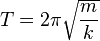
The time period of a Simple Pendulum is directly dependent on its length, while the time period of Simple Harmonic Motion (S.H.M) is influenced by mass. Additionally, the time period of S.H.M remains unaffected by the amplitude of oscillation and the acceleration due to gravity. The derivation of the pendulum's time period is valid for small amplitude oscillations, highlighting a key distinction in their operational parameters.
PREREQUISITES
- Understanding of oscillatory motion
- Familiarity with the principles of pendulums
- Basic knowledge of Simple Harmonic Motion (S.H.M)
- Concept of amplitude in oscillations
NEXT STEPS
- Research the mathematical derivation of the time period for Simple Pendulums
- Explore the characteristics of Simple Harmonic Motion (S.H.M)
- Study the effects of mass and length on oscillation periods
- Examine the impact of amplitude on different types of oscillatory systems
USEFUL FOR
Physics students, educators, and anyone interested in the principles of oscillatory motion and their applications in mechanics.