Differential amplifier common mode gain

Click For Summary
SUMMARY

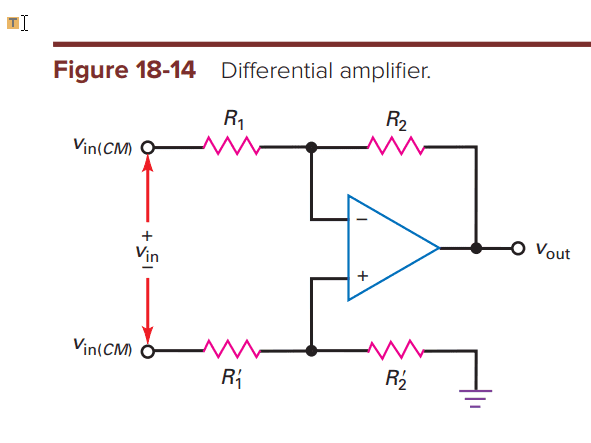
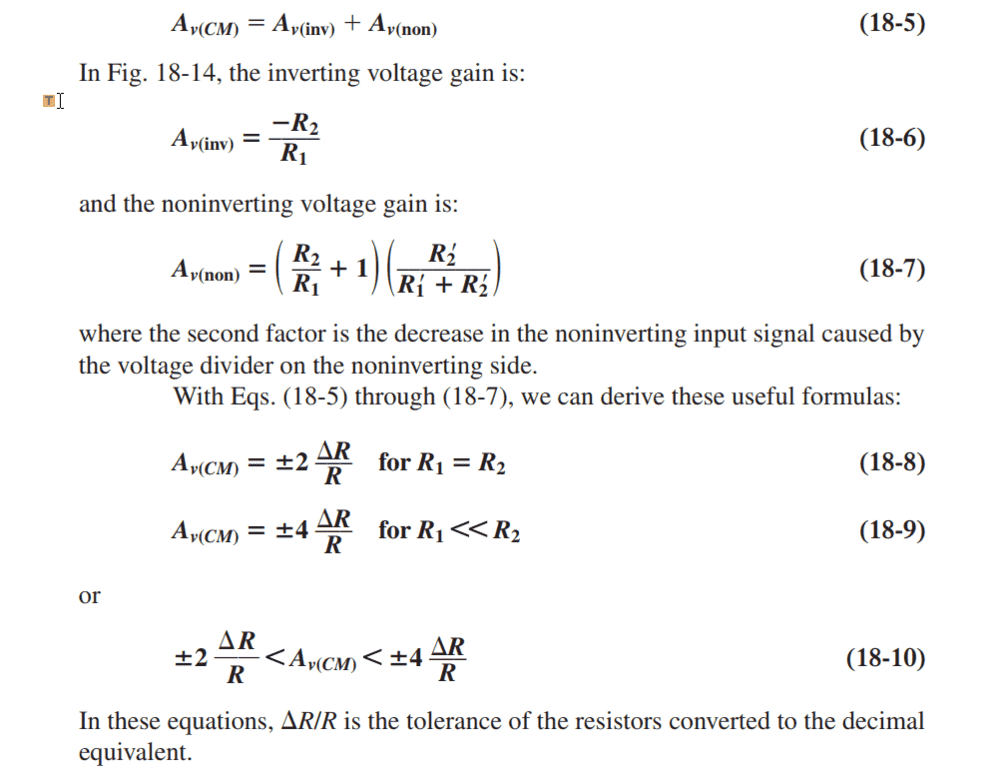
The discussion focuses on the derivation of equations 10-8 and 10-9 related to the common mode gain of differential amplifiers. It emphasizes that for a differential amplifier to function correctly, the ratio R2'/R1' must equal R2/R1, resulting in a difference mode gain of R2/R1 and a common mode gain of 0. Additionally, the sensitivity analysis involves introducing an error term to a resistor, such as R2 → R2 + ΔR, to observe discrepancies in the common mode gain calculations.

PREREQUISITES
  • Understanding of differential amplifier configurations
  • Familiarity with resistor ratios in circuit analysis
  • Knowledge of sensitivity analysis in electrical engineering
  • Ability to manipulate and derive equations in circuit theory
NEXT STEPS
  • Study the derivation of differential amplifier gain equations
  • Learn about sensitivity analysis techniques for electronic components
  • Explore common mode rejection ratio (CMRR) in differential amplifiers
  • Investigate the impact of resistor tolerances on amplifier performance
USEFUL FOR

Electrical engineers, circuit designers, and students studying analog electronics who are looking to deepen their understanding of differential amplifier performance and gain derivation.
paulmdrdo
Messages
89
Reaction score
2
Summary:: Differential amplifier common mode gain derivation of forumlas

I'm having a hard time deriving for equations 10-8 -10-9.
1592421810438.png

1592421833056.png


I tried adding equation's 18-6 and 18-7 but cannot proceed with the derivation. I need help on this. Thank you!
 
Physics news on Phys.org
It's kind of a confusing section, much appears to be left out.

For this to be a differential amp, you would have to set R2'/R1' = R2/R1. Then the difference mode gain is R2/R1 and the common mode gain is 0. If you don't do this, I don't think the premise makes sense.

Then for the sensitivity analysis, I would pick any single resistor and add in an error term eg. R2 → R2 + ΔR. Then recalculate the common mode gain. You may find some discrepancies from their result because of how you introduce the component value error term.
 

Similar threads

  • · Replies 2 ·
Replies
2
Views
3K
Replies
1
Views
3K
  • · Replies 7 ·
Replies
7
Views
2K
  • · Replies 3 ·
Replies
3
Views
3K
  • · Replies 3 ·
Replies
3
Views
2K
Replies
1
Views
4K
  • · Replies 49 ·
2
Replies
49
Views
8K
  • · Replies 4 ·
Replies
4
Views
4K
  • · Replies 5 ·
Replies
5
Views
2K
  • · Replies 1 ·
Replies
1
Views
2K