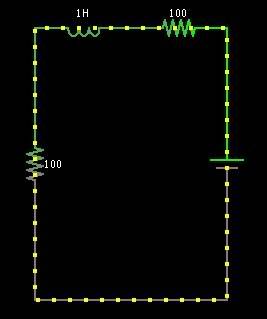
Differential EQ of this RL Circuit

Click For Summary

Homework Help Overview

The discussion revolves around a differential equation derived from an RL circuit. The original poster presents their equation and attempts to solve it, expressing uncertainty about their approach and results. The circuit involves voltage across resistors and the behavior of current over time.

Discussion Character

  • Exploratory, Assumption checking, Problem interpretation

Approaches and Questions Raised

  • Participants discuss the validity of the original differential equation and explore methods for solving it, including variable separation. Questions arise regarding initial conditions and the implications of the input voltage over time.

Discussion Status

Some participants provide guidance on rewriting the equation and suggest how to find the current and voltage across the resistors. There is acknowledgment of confusion regarding initial conditions, but no explicit consensus is reached on the interpretation of these conditions.

Contextual Notes

Participants note the lack of specified initial conditions in the problem statement, leading to questions about assumptions regarding the voltage and current at time t=0. The original poster expresses satisfaction with their simulation results, indicating some resolution in their understanding.

saad87
Messages
83
Reaction score
0
Hi,

Picture1-11.jpg


I have the above the circuit and I've ended up with the following differential equation. I've tried solving it by separating the variables, but am not sure if its the right answer.

IR + L(di/dt) + IR = x(t)

x(t) = 5V. But since IR = y(t) and di/dt = 1/R dy/dt.

y(t) is the Voltage across the 2nd Resistor.

y(t) + L/2R(dy/dt) = 2.5

Solution:

y(t) = 2.5 - e(-2*R*t)/L

y(t) is the voltage across the 2nd Resistor.

I've tried simulating it using an online applet, and I've not been getting the predicted result. Any help? How do I analyze this?
 
Physics news on Phys.org
Nevermind, just solved it.
 
The general solution to that equation is [itex]y= 2.5+ Ce^{-2Rt/L}[/itex] but to determine C you need more information, say the value of y when t= 0. With C= 1, y(0)= 2.5- 1= 1.5 volts. Is that true?
 
saad87 said:
Hi,

Picture1-11.jpg


I have the above the circuit and I've ended up with the following differential equation. I've tried solving it by separating the variables, but am not sure if its the right answer.

IR + L(di/dt) + IR = x(t)

x(t) = 5V. But since IR = y(t) and di/dt = 1/R dy/dt.

y(t) is the Voltage across the 2nd Resistor.

y(t) + L/2R(dy/dt) = 2.5

Solution:

y(t) = 2.5 - e(-2*R*t)/L

y(t) is the voltage across the 2nd Resistor.

I've tried simulating it using an online applet, and I've not been getting the predicted result. Any help? How do I analyze this?

Hello saad87, welcome to the forum.

Your original equation is OK. The way you solve it is not OK though. If you rewrite the original equation as:
[tex]2\cdot R \cdot i + L\cdot \frac{di}{dt}=x(t)[/tex]
or
[tex]\frac{di}{dt}=5-200\cdot i[/tex]
Can you proceed in solving this for i?

After having found i you can find the voltage across the resisters by applying the law of Ohm and the voltage across the coil with:
[tex]L\cdot \frac{di}{dt}[/tex]

In case of any more questions, please ask,

coomast
 
Oeps, too late...
 
Yeah, the only thing I was doing wrong I was not applying the limits, at all. Smacked my head when I found what was wrong.

Anyway, here's what I"m confused about. I'm studying a course on Signals & Systems, and the above question confused me because there were no initial conditions specified!

It simply said "find the response of the system if x(t) = 0 for t<0 and x(t)=5 for t>0"

Does this mean, that since x = 0 for t<0, that I can assume y(0) = 0?
 
Hello saad87,

What you need to do is to use the law of Ohm to find the voltage across the second resistor. This is y(t)=R*i(t)=100*i(t).
The thing to do is thus to find the current or the solution to the equation I described. The initial condition is i(0)=0. This because the voltage is applied at t=0, and at this time no current is flowing because of the presence of the coil. The complete voltage at the beginning is across this coil and goes down for t>0. This is the standard behaviour of an series-LR circuit.
Did you find the current meaning did you solve the differential equation?

coomast
 
coomast said:
Hello saad87,

What you need to do is to use the law of Ohm to find the voltage across the second resistor. This is y(t)=R*i(t)=100*i(t).
The thing to do is thus to find the current or the solution to the equation I described. The initial condition is i(0)=0. This because the voltage is applied at t=0, and at this time no current is flowing because of the presence of the coil. The complete voltage at the beginning is across this coil and goes down for t>0. This is the standard behaviour of an series-LR circuit.
Did you find the current meaning did you solve the differential equation?

coomast

Yeah, I only wanted to know if v(0) = 0. I didn't find the current and instead, found out the voltage on the 2nd Resistor directly using the differential equation I mentioned above.

I then simulated the circuit and found the voltage across the resistor at a certain time T (5 ms if you must know), and the results from my equation and the simulation agree. So I'm satisfied that my answer is correct!
 

Similar threads

  • · Replies 12 ·
Replies
12
Views
3K
  • · Replies 3 ·
Replies
3
Views
2K
  • · Replies 7 ·
Replies
7
Views
2K
  • · Replies 4 ·
Replies
4
Views
2K
  • · Replies 1 ·
Replies
1
Views
1K
  • · Replies 1 ·
Replies
1
Views
2K
  • · Replies 1 ·
Replies
1
Views
3K
  • · Replies 12 ·
Replies
12
Views
5K
  • · Replies 8 ·
Replies
8
Views
3K
Replies
6
Views
1K