Math Amateur
Gold Member
MHB
- 3,920
- 48
I am reading the book "Several Real Variables" by Shmuel Kantorovitz ... ...
I am currently focused on Chapter 2: Derivation ... ...
I need help with an aspect of Kantorovitz's Example 3 on pages 65-66 ...
Kantorovitz's Example 3 on pages 65-66 reads as follows:
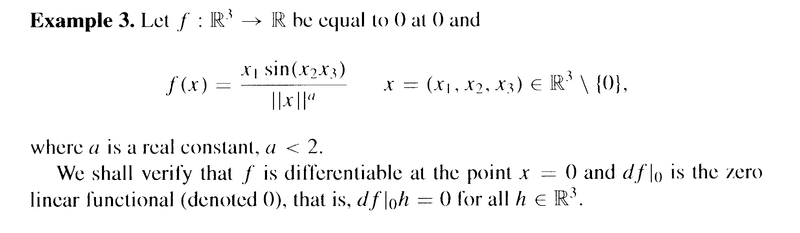
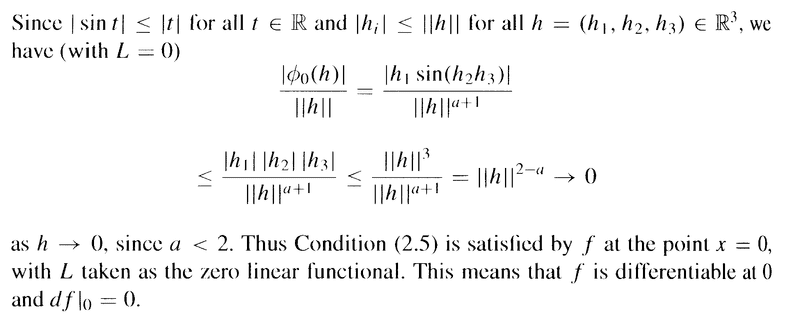
In the above example, we read the following:"... ... ##\frac{ \mid \phi_0 (h) \mid }{ \| h \| } = \frac{ \mid h_1 \text{ sin } (h_2 h_3) \mid }{ \| h \|^{ a + 1 } }## ... ... ... "
My question is as follows:In the Section on The Differential (see scanned text below) ...
Kantorovitz defines ##\phi_x(h)## as follows:
##\phi_x(h) := f(x +h) - f(x) - Lh##
so that
##\phi_0(h) := f(0 +h) - f(0 ) - Lh = f(h) - f(0)## ...... BUT in the Example ... as I understand it ... ##f(0)## does not exist for the function in Example 3 ...? ...
... BUT ... Kantorovitz effectively gives ##\mid \phi_0 (h) \mid = \frac{ \mid h_1 \text{ sin } (h_2 h_3) \mid }{ \| h \| }##
Can someone please explain how Kantorovitz gets this value for ##\mid \phi_0 (h) \mid## when ##f(0)## does not exist?Help will be much appreciated ...
Peter==============================================================================
***NOTE***
Readers of the above post may be helped by having access to Kantorovitz' Section on "The Differential" ... so I am providing the same ... as follows:
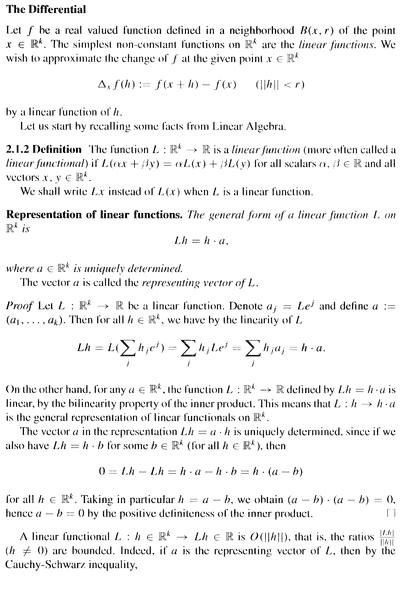
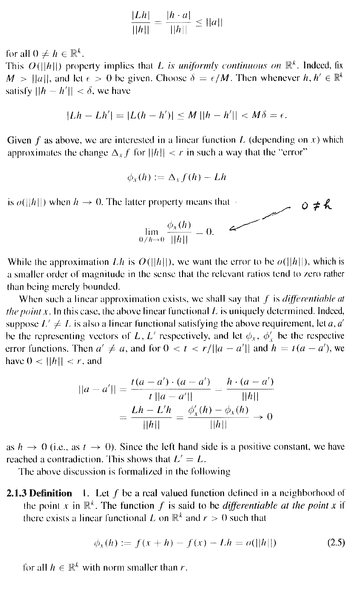
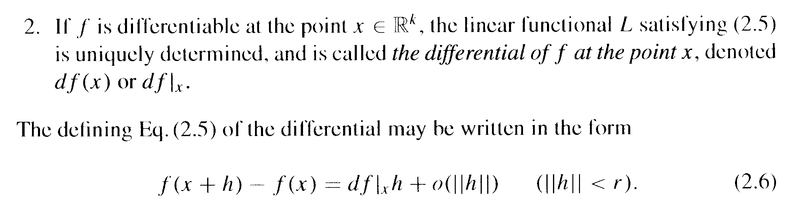
Hope that helps in understanding the post ...
Peter
I am currently focused on Chapter 2: Derivation ... ...
I need help with an aspect of Kantorovitz's Example 3 on pages 65-66 ...
Kantorovitz's Example 3 on pages 65-66 reads as follows:
In the above example, we read the following:"... ... ##\frac{ \mid \phi_0 (h) \mid }{ \| h \| } = \frac{ \mid h_1 \text{ sin } (h_2 h_3) \mid }{ \| h \|^{ a + 1 } }## ... ... ... "
My question is as follows:In the Section on The Differential (see scanned text below) ...
Kantorovitz defines ##\phi_x(h)## as follows:
##\phi_x(h) := f(x +h) - f(x) - Lh##
so that
##\phi_0(h) := f(0 +h) - f(0 ) - Lh = f(h) - f(0)## ...... BUT in the Example ... as I understand it ... ##f(0)## does not exist for the function in Example 3 ...? ...
... BUT ... Kantorovitz effectively gives ##\mid \phi_0 (h) \mid = \frac{ \mid h_1 \text{ sin } (h_2 h_3) \mid }{ \| h \| }##
Can someone please explain how Kantorovitz gets this value for ##\mid \phi_0 (h) \mid## when ##f(0)## does not exist?Help will be much appreciated ...
Peter==============================================================================
***NOTE***
Readers of the above post may be helped by having access to Kantorovitz' Section on "The Differential" ... so I am providing the same ... as follows:
Hope that helps in understanding the post ...
Peter
Attachments
-
 Kantorovitz - 1 - Example 3 ... Page 65 ... PART 1 ... .png15.3 KB · Views: 871
 -
 Kantorovitz - 2 - Example 3 ... Page 65 ... PART 2 ... .png17.1 KB · Views: 454
 -
 Kantorovitz - 1 - Sectiion on the DIfferential ... PART 1 ... .png27.4 KB · Views: 463
 -
 Kantorovitz - 2 - Sectiion on the DIfferential ... PART 2 ... .png34.9 KB · Views: 458
 -
 Kantorovitz - 3 - Sectiion on the DIfferential ... PART 3 ... .png13.2 KB · Views: 372
 ... careless of me to miss that!