Differentials in Multivariable Functions ....

Click For Summary

Discussion Overview

The discussion centers around the concept of differentials in multivariable functions, specifically focusing on a limit involving a function defined in the context of Shmuel Kantorovitz's book "Several Real Variables." Participants are exploring the implications of the notation and behavior of the function as it approaches zero, particularly in relation to the example provided in the text.

Discussion Character

  • Technical explanation
  • Mathematical reasoning
  • Homework-related

Main Points Raised

  • Peter seeks help in demonstrating that ##\frac{ \phi_0 (h) }{ \| h \| } \rightarrow 0## as ##h \rightarrow 0##, referencing Kantorovitz's Example 4.
  • Some participants suggest that ##\phi_0(h) = \mathcal O(h^2)## implies that ##\phi_0(h)/h=\mathcal O(h)##, indicating a relationship between the growth of the function and its limit.
  • Peter expresses confusion about applying the ##\mathcal O## notation to the limit and acknowledges a lack of clarity in understanding the implications.
  • Further elaboration is provided on the meaning of ##O(g(x))## in terms of bounding behavior, with examples related to matrix multiplication algorithms and their complexity.

Areas of Agreement / Disagreement

Participants do not appear to reach a consensus, as there are differing levels of understanding regarding the application of the ##\mathcal O## notation and its implications for the limit in question. Some participants provide insights while others express confusion.

Contextual Notes

There are limitations in the discussion regarding the assumptions made about the behavior of the function as it approaches zero, as well as the definitions of the notation used. The mathematical steps involved in demonstrating the limit remain unresolved.

Math Amateur
Gold Member
MHB
Messages
3,920
Reaction score
48
I am reading the book "Several Real Variables" by Shmuel Kantorovitz ... ...

I am currently focused on Chapter 2: Derivation ... ...

I need help with an aspect of Kantorovitz's Example 4 on page 66 ...

Kantorovitz's Example 4 on page 66 reads as follows:
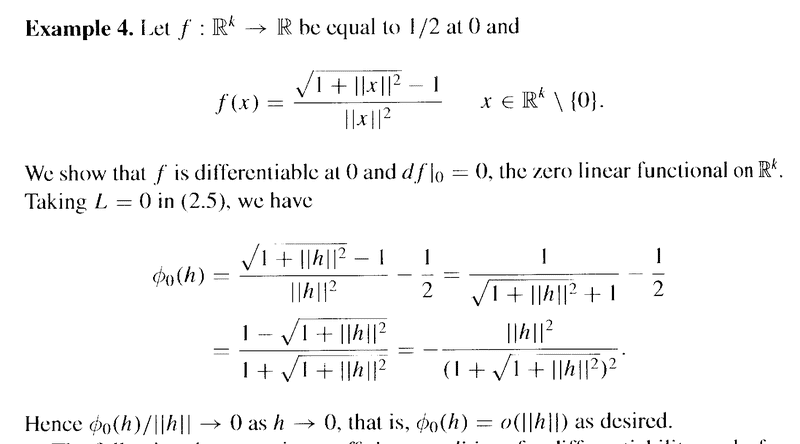
Kantorovitz - Example 4 ...  Page 66 ...  ... .png

In the above example, Kantorovitz shows that##\phi_0 (h) = - \frac{ \| h \|^2 }{( 1 + \sqrt{ 1 + \| h \|^2 )}^2 }##Kantorovitz then declares that ## \frac{ \phi_0 (h) }{ \| h \| } \rightarrow 0## as ##h \rightarrow 0## ... ...Can someone please show me how to demonstrate rigorously that this is true ... that is that
## \frac{ \phi_0 (h) }{ \| h \| } \rightarrow 0## as ##h \rightarrow 0## ... ...
Help will be much appreciated ...

Peter============================================================================================

***NOTE***

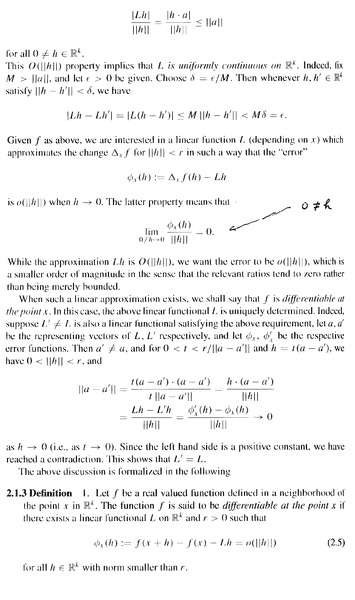
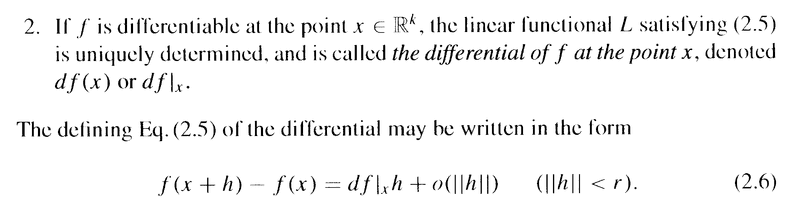
Readers of the above post may be helped by having access to Kantorovitz' Section on "The Differential" ... so I am providing the same ... as follows:
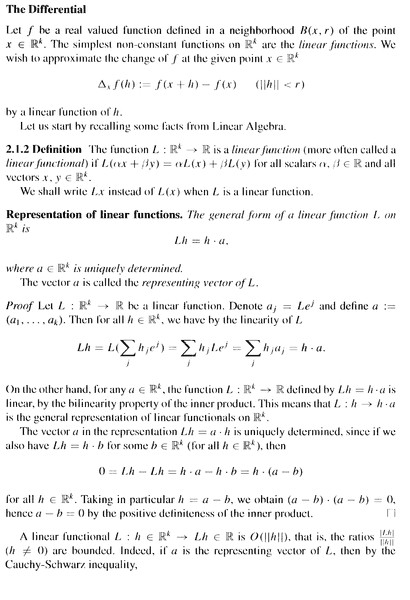
Kantorovitz - 1 - Sectiion on the DIfferential ... PART 1 ... .png

Kantorovitz - 2 - Sectiion on the DIfferential ... PART 2 ... .png

Kantorovitz - 3 - Sectiion on the DIfferential ... PART 3 ... .png
Hope that helps readers understand the context and notation of the above post ,,, ,,,

Peter
 

Attachments

  • Kantorovitz - Example 4 ...  Page 66 ...  ... .png
    Kantorovitz - Example 4 ... Page 66 ... ... .png
    18.8 KB · Views: 972
  • Kantorovitz - 1 - Sectiion on the DIfferential ... PART 1 ... .png
    Kantorovitz - 1 - Sectiion on the DIfferential ... PART 1 ... .png
    27.4 KB · Views: 551
  • Kantorovitz - 2 - Sectiion on the DIfferential ... PART 2 ... .png
    Kantorovitz - 2 - Sectiion on the DIfferential ... PART 2 ... .png
    34.9 KB · Views: 531
  • Kantorovitz - 3 - Sectiion on the DIfferential ... PART 3 ... .png
    Kantorovitz - 3 - Sectiion on the DIfferential ... PART 3 ... .png
    13.2 KB · Views: 542
Last edited:
Physics news on Phys.org
##\phi_0(h) = \mathcal O(h^2)## implies that ##\phi_0(h)/h=\mathcal O(h)##.
 
Orodruin said:
##\phi_0(h) = \mathcal O(h^2)## implies that ##\phi_0(h)/h=\mathcal O(h)##.
Thanks for the reply Orodruin ...

BUT ... don't quite follow ... and do not see how to apply to the limit ...

Apologies if I'm being slow ...

PeterEdit: I do know that ##O( \| h \| ) \Longrightarrow## the ratios ##\frac{ \mid \phi_0(h) \mid }{ \| h \| } ( h \neq 0 )## are bounded ...
 
Math Amateur said:
Thanks for the reply Orodruin ...

BUT ... don't quite follow ... and do not see how to apply to the limit ...

Apologies if I'm being slow ...

PeterEdit: I do know that ##O( \| h \| ) \Longrightarrow## the ratios ##\frac{ \mid \phi_0(h) \mid }{ \| h \| } ( h \neq 0 )## are bounded ...
You can think of ##f(x)=O(g(x))## as ##f(x) \leq c\cdot g(x)## for some constant ##c##.

E.g. if ##f(h)=c_1{h^2}+c_2{h^3}+c_3{h^4}+\ldots ## for small ## h > 0##, then we can assume ##h < 1## and ##h^2 > h^3 > h^4 >\ldots## which means ## f(h) \leq (\sum c_i) h^2##. So if the coefficients don't outnumber the behavior of ##{h}##, i.e. if ##\sum c_i = c## is finite, then we get ##f(h) \leq c \cdot h^2## which we write as ##f(h)=O(h^2).## In this case however, we also have ##\frac{1}{h}f(h) < c\cdot h## and thus ##\frac{f(h)}{h} =O(h)\,.##

A simple example for its usage is the matrix exponent. The question is about algorithms: How many multiplications of input variables are necessary to multiply two ##(n \times n)## matrices?

The ordinary way is to do it by ##n^3## multiplications. Improved algorithms can do it with ##c \cdot n^\gamma## multiplications (above some fixed ##n## where the improvement starts to be one) and ##\gamma## is somewhere above ##2## and of course below ##3## and ##c## a constant independent of ##n##. The matrix algorithm then goes by ##O(n^\gamma)## essential multiplications. The infimum of these ##\gamma## is called the matrix exponent ##\omega ##, but this only as a side note. For short people say: matrix multiplication goes by ##O(n^\omega)##. IIRC multiplication of ##2 \times 2## matrices which are usually done by eight multiplications can be done by only seven at the cost of additional additions, which shows ##\omega < 3##.

The example above, ##f(h)=O(h^2)## means, that ##f(h)## doesn't grow faster than a constant multiple of ##h^2\,.##
One of my favorite jokes is to write constants as ##O(1)##.
 
  • Like
Likes   Reactions: Math Amateur

Similar threads

Replies
3
Views
2K
  • · Replies 1 ·
Replies
1
Views
2K
Replies
2
Views
2K
  • · Replies 8 ·
Replies
8
Views
2K
Replies
3
Views
2K
  • · Replies 2 ·
Replies
2
Views
2K
  • · Replies 4 ·
Replies
4
Views
2K
  • · Replies 2 ·
Replies
2
Views
1K
  • · Replies 2 ·
Replies
2
Views
2K
Replies
2
Views
2K