Differential operator, inverse thereof

Click For Summary

Discussion Overview

The discussion revolves around the concept of the Green's function associated with a differential operator, specifically addressing its definition, boundary conditions, and the implications for solving linear differential equations. Participants explore the relationship between the Green's function and the inverse of the differential operator, as well as the conditions under which these functions are defined.

Discussion Character

  • Technical explanation
  • Conceptual clarification
  • Debate/contested
  • Mathematical reasoning

Main Points Raised

  • Some participants explain that the Green's function is defined by the equation $$\mathscr B G(x,s) = \delta(x-s)$$ with specific boundary conditions, such as ##G(0,s) = G(1,s) = 0##.
  • Others question the necessity of homogeneous boundary conditions for the Green's function, asking if it is always the case that the boundaries must be zero.
  • One participant suggests that the Green's function should satisfy homogeneous boundary conditions similar to those of the differential equation, even if the equation itself has inhomogeneous conditions.
  • Another participant proposes using Neumann conditions instead of Dirichlet conditions, noting potential incompatibilities with certain parameter values.
  • Some participants express confusion regarding the derivation of the Green's function when the parameter ##B_0 = 0##, leading to a discussion about the implications of this case.
  • There is a mention of the identity operator resulting from the application of the differential operator and its inverse on a function.
  • Participants share their attempts to derive the Green's function and express uncertainty about reproducing results from the text being reviewed.
  • One participant references a book that discusses the general form of Green's function solutions, indicating a source for further reading.

Areas of Agreement / Disagreement

Participants do not reach a consensus on the boundary conditions required for the Green's function or the implications of using different types of boundary conditions. There are competing views on the necessity of homogeneous conditions and the treatment of the case where ##B_0 = 0## remains unresolved.

Contextual Notes

Limitations include the dependence on specific boundary conditions and the unresolved nature of the mathematical steps involved in deriving the Green's function for different cases.

member 428835
Hi PF!

I'm reviewing a text and the author writes

Screen Shot 2018-01-09 at 12.53.43 AM.png

where ##g## is an arbitrary function and ##B## is a differential operator. ##Bo## is a parameter. Then the author states the inverse of ##B## is
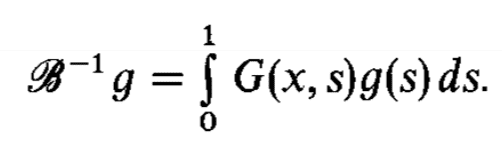
Screen Shot 2018-01-09 at 12.54.03 AM.png

where ##G## is the Green's function of ##B##. Can someone explain how we know this?
 

Attachments

  • Screen Shot 2018-01-09 at 12.53.43 AM.png
    Screen Shot 2018-01-09 at 12.53.43 AM.png
    5.5 KB · Views: 1,027
  • Screen Shot 2018-01-09 at 12.54.03 AM.png
    Screen Shot 2018-01-09 at 12.54.03 AM.png
    4 KB · Views: 1,098
Physics news on Phys.org
The Green's function in this case is defined as the function for which
$$
\mathscr B G(x,s) = \delta(x-s)
$$
and ##G(0,s) = G(1,s) = 0##. Hence
$$
\mathscr B \mathscr B^{-1} g = \int_0^1 \mathscr B G(x,s) g(s) ds = \int_0^1 \delta(x-s) g(s) ds = g(x)
$$
and ##\mathscr B \mathscr B^{-1}## is the identity operator.
 
  • Like
Likes   Reactions: member 428835
Thanks!
 
Orodruin said:
The Green's function in this case is defined as the function for which
$$
\mathscr B G(x,s) = \delta(x-s)
$$
and ##G(0,s) = G(1,s) = 0##.
Can you explain where you got the BC from? Is is always the case for Greens functions that the boundaries be zero? If so, would you mind explaining why?
 
Typically you want the Green's function to satisfy homogeneous boundary conditions of the same type as the boundary conditions of your differential equation (even if the differential equation has inhomogeneous boundary conditions). This means that you can built the inhomogeneity in the differential equation from the Green's function without affecting the boundary conditions. You are then left with solving the homogeneous differential equation if you have inhomogeneous boundary conditions. This can also be done using the Green's function, but is yet another step and you anyway have homogeneous boundary conditions.

Exercise: Check that letting the Green's function satisfy homogeneous boundary conditions lead to ##g## satisfying homogeneous boundary conditions.
 
Oh, sorry. I misread the original post. You should use Neumann conditions instead. Note that this will be incompatible with the case ##B_0 = 0## though. Anyway, the boundary conditions are not the main issue for your question.
 
Orodruin said:
Exercise: Check that letting the Green's function satisfy homogeneous boundary conditions lead to ##g## satisfying homogeneous boundary conditions.
Okay, so to find the Green's function I would take, as you said, ##BG(x,s) = \delta(x-s)##. For simplicity, let's let ##Bo = 0##. Then we have ##d^2_x G = \delta(x-s)## subject to ##G(x=0)=0## and ##G(x=1)=0##. To satisfy BC without a trivial solution, make the Green's function a continuous, but not necessarily every differentiable, function. Then we have a left and right (with respect to ##s \in (0,1)##) solution to ##d^2_x G = 0## taking the form ##G_L = a x## and ##G_R = b (1-x)##. Continuity implies ##G_L(x=s) = G_R(x=s)## and a final condition requires ##\int_{x-}^{x+} G'' = 1##. Then the solutions I get are $$G_L = (1-s)x\\ G_R = s(1-x).$$ So far so good?
 
Orodruin said:
Oh, sorry. I misread the original post. You should use Neumann conditions instead. Note that this will be incompatible with the case ##B_0 = 0## though. Anyway, the boundary conditions are not the main issue for your question.
Sorry, I just saw this after responding to your previous post. But the text also gives
Screen Shot 2018-01-09 at 12.54.22 AM.png

and I'm unsure how to arrive at the case where ##Bo = 0##. Any ideas?
 

Attachments

  • Screen Shot 2018-01-09 at 12.54.22 AM.png
    Screen Shot 2018-01-09 at 12.54.22 AM.png
    10.6 KB · Views: 618
joshmccraney said:
But the text also gives
This does not look correct to me. For example, taking the ##Bo = 0## case, it is clear that ##\partial_x^2 G = 1##, not ##\delta(x-s)##.
 
  • #10
Orodruin said:
This does not look correct to me. For example, taking the ##Bo = 0## case, it is clear that ##\partial_x^2 G = 1##, not ##\delta(x-s)##.
Yea, it didn't seem like I could reproduce their work either. Would you mind looking at the two attachments? This is where the author begins discussing the ##B## operator. I'm agree (obviously) with the eigenvalues and eigenfunctions of ##B##. But I am lost at the Green's functions. Does reading this snippet make anything clearer to you?
1.png
2.png
 

Attachments

  • 1.png
    1.png
    31.5 KB · Views: 621
  • 2.png
    2.png
    17.7 KB · Views: 610
  • #11
Orodruin said:
The Green's function in this case is defined as the function for which
$$
\mathscr B G(x,s) = \delta(x-s)
$$
and ##G(0,s) = G(1,s) = 0##. Hence
$$
\mathscr B \mathscr B^{-1} g = \int_0^1 \mathscr B G(x,s) g(s) ds = \int_0^1 \delta(x-s) g(s) ds = g(x)
$$
and ##\mathscr B \mathscr B^{-1}## is the identity operator.
I had a question for you Orodruin: why is the Green's function defined in the case with homogenous BCs: ##G(0,s) = G(1,s) = 0##? If we're finding the inverse operator of ##B##, I'm confused why there are any restrictions at all on the boundaries of ##G##?
 
  • #12
Because you want to solve a linear differential equation with exactly those homogeneous boundary conditions and superpositions of such Green's functions also satisfy those homogeneous boundary conditions. If you have inhomogeneous boundary conditions you still want to define the Green's function with homogeneous boundary conditions. You then write the solution as a superposition of the integral with the Green's function that will satisfy the inhomogeneity in the differential equation and a solution to the homogeneous differential equation that takes care of the inhomogeneous boundary conditions.

I discuss the general form of the Green's function solutions to a linear problem with linear boundary conditions in section 7.2.3 of my book.
 
  • #13
Orodruin said:
I discuss the general form of the Green's function solutions to a linear problem with linear boundary conditions in section 7.2.3 of my book.
Thanks! What's the book you're referring to? Have a title (and author, since I'm not sure of your name)?
 
  • #15
Thanks!
 
  • #17
Very interesting article. Shockingly sounds very relevant to what I do. I'll have to grab a copy (but I'm first going to check our library, maybe they've beat me to the punch).
 

Similar threads

  • · Replies 11 ·
Replies
11
Views
2K
  • · Replies 6 ·
Replies
6
Views
4K
  • · Replies 4 ·
Replies
4
Views
2K
  • · Replies 8 ·
Replies
8
Views
2K
  • · Replies 14 ·
Replies
14
Views
3K
  • · Replies 1 ·
Replies
1
Views
2K
  • · Replies 1 ·
Replies
1
Views
3K
  • · Replies 9 ·
Replies
9
Views
3K
  • · Replies 5 ·
Replies
5
Views
2K
  • · Replies 11 ·
Replies
11
Views
3K