Undergrad Differentials in Multivariable Functions ....

Click For Summary
The discussion centers on a specific example from Shmuel Kantorovitz's book "Several Real Variables," focusing on the limit of the function φ₀(h) as h approaches zero. The key point is demonstrating that φ₀(h)/||h|| approaches zero as h approaches zero, which is linked to the notation O(||h||²). Participants clarify that if φ₀(h) is O(||h||²), then φ₀(h)/||h|| is O(||h||), indicating that the ratio remains bounded. The conversation emphasizes the need for a rigorous understanding of these limits and the application of big O notation in this context. Overall, the thread seeks clarity on the mathematical implications of the example provided.
Math Amateur
Gold Member
MHB
Messages
3,920
Reaction score
48
I am reading the book "Several Real Variables" by Shmuel Kantorovitz ... ...

I am currently focused on Chapter 2: Derivation ... ...

I need help with an aspect of Kantorovitz's Example 4 on page 66 ...

Kantorovitz's Example 4 on page 66 reads as follows:
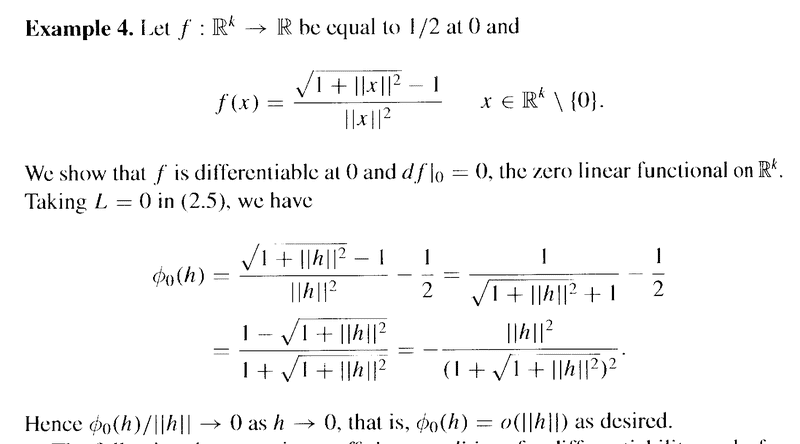
Kantorovitz - Example 4 ...  Page 66 ...  ... .png

In the above example, Kantorovitz shows that##\phi_0 (h) = - \frac{ \| h \|^2 }{( 1 + \sqrt{ 1 + \| h \|^2 )}^2 }##Kantorovitz then declares that ## \frac{ \phi_0 (h) }{ \| h \| } \rightarrow 0## as ##h \rightarrow 0## ... ...Can someone please show me how to demonstrate rigorously that this is true ... that is that
## \frac{ \phi_0 (h) }{ \| h \| } \rightarrow 0## as ##h \rightarrow 0## ... ...
Help will be much appreciated ...

Peter============================================================================================

***NOTE***

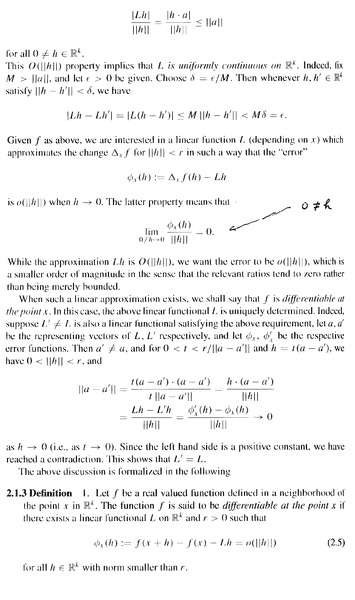
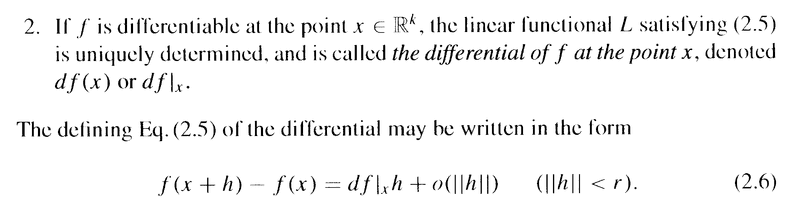
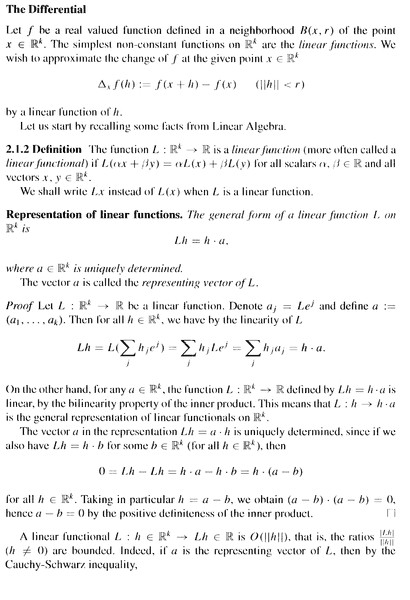
Readers of the above post may be helped by having access to Kantorovitz' Section on "The Differential" ... so I am providing the same ... as follows:
Kantorovitz - 1 - Sectiion on the DIfferential ... PART 1 ... .png

Kantorovitz - 2 - Sectiion on the DIfferential ... PART 2 ... .png

Kantorovitz - 3 - Sectiion on the DIfferential ... PART 3 ... .png
Hope that helps readers understand the context and notation of the above post ,,, ,,,

Peter
 

Attachments

  • Kantorovitz - Example 4 ...  Page 66 ...  ... .png
    Kantorovitz - Example 4 ... Page 66 ... ... .png
    18.8 KB · Views: 954
  • Kantorovitz - 1 - Sectiion on the DIfferential ... PART 1 ... .png
    Kantorovitz - 1 - Sectiion on the DIfferential ... PART 1 ... .png
    27.4 KB · Views: 531
  • Kantorovitz - 2 - Sectiion on the DIfferential ... PART 2 ... .png
    Kantorovitz - 2 - Sectiion on the DIfferential ... PART 2 ... .png
    34.9 KB · Views: 512
  • Kantorovitz - 3 - Sectiion on the DIfferential ... PART 3 ... .png
    Kantorovitz - 3 - Sectiion on the DIfferential ... PART 3 ... .png
    13.2 KB · Views: 521
Last edited:
Physics news on Phys.org
##\phi_0(h) = \mathcal O(h^2)## implies that ##\phi_0(h)/h=\mathcal O(h)##.
 
Orodruin said:
##\phi_0(h) = \mathcal O(h^2)## implies that ##\phi_0(h)/h=\mathcal O(h)##.
Thanks for the reply Orodruin ...

BUT ... don't quite follow ... and do not see how to apply to the limit ...

Apologies if I'm being slow ...

PeterEdit: I do know that ##O( \| h \| ) \Longrightarrow## the ratios ##\frac{ \mid \phi_0(h) \mid }{ \| h \| } ( h \neq 0 )## are bounded ...
 
Math Amateur said:
Thanks for the reply Orodruin ...

BUT ... don't quite follow ... and do not see how to apply to the limit ...

Apologies if I'm being slow ...

PeterEdit: I do know that ##O( \| h \| ) \Longrightarrow## the ratios ##\frac{ \mid \phi_0(h) \mid }{ \| h \| } ( h \neq 0 )## are bounded ...
You can think of ##f(x)=O(g(x))## as ##f(x) \leq c\cdot g(x)## for some constant ##c##.

E.g. if ##f(h)=c_1{h^2}+c_2{h^3}+c_3{h^4}+\ldots ## for small ## h > 0##, then we can assume ##h < 1## and ##h^2 > h^3 > h^4 >\ldots## which means ## f(h) \leq (\sum c_i) h^2##. So if the coefficients don't outnumber the behavior of ##{h}##, i.e. if ##\sum c_i = c## is finite, then we get ##f(h) \leq c \cdot h^2## which we write as ##f(h)=O(h^2).## In this case however, we also have ##\frac{1}{h}f(h) < c\cdot h## and thus ##\frac{f(h)}{h} =O(h)\,.##

A simple example for its usage is the matrix exponent. The question is about algorithms: How many multiplications of input variables are necessary to multiply two ##(n \times n)## matrices?

The ordinary way is to do it by ##n^3## multiplications. Improved algorithms can do it with ##c \cdot n^\gamma## multiplications (above some fixed ##n## where the improvement starts to be one) and ##\gamma## is somewhere above ##2## and of course below ##3## and ##c## a constant independent of ##n##. The matrix algorithm then goes by ##O(n^\gamma)## essential multiplications. The infimum of these ##\gamma## is called the matrix exponent ##\omega ##, but this only as a side note. For short people say: matrix multiplication goes by ##O(n^\omega)##. IIRC multiplication of ##2 \times 2## matrices which are usually done by eight multiplications can be done by only seven at the cost of additional additions, which shows ##\omega < 3##.

The example above, ##f(h)=O(h^2)## means, that ##f(h)## doesn't grow faster than a constant multiple of ##h^2\,.##
One of my favorite jokes is to write constants as ##O(1)##.
 
  • Like
Likes Math Amateur
We all know the definition of n-dimensional topological manifold uses open sets and homeomorphisms onto the image as open set in ##\mathbb R^n##. It should be possible to reformulate the definition of n-dimensional topological manifold using closed sets on the manifold's topology and on ##\mathbb R^n## ? I'm positive for this. Perhaps the definition of smooth manifold would be problematic, though.

Similar threads

Replies
3
Views
2K
  • · Replies 1 ·
Replies
1
Views
2K
Replies
2
Views
2K
  • · Replies 8 ·
Replies
8
Views
2K
Replies
3
Views
1K
  • · Replies 2 ·
Replies
2
Views
2K
  • · Replies 4 ·
Replies
4
Views
2K
  • · Replies 2 ·
Replies
2
Views
1K
  • · Replies 2 ·
Replies
2
Views
2K
Replies
2
Views
2K