Differentiating a composite function involving chain rule

3 replies · 2K views · last reply
houssamxd
Messages
15
Reaction score
0

Homework Statement


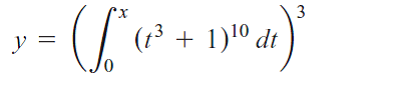
Equation y = (integral from 0 to x of (t^3 + 1)^10 dt) raised to the power 3, with the integral's limits 0 and x shown.


Homework Equations


[itex]\frac{d}{dx}[/itex]
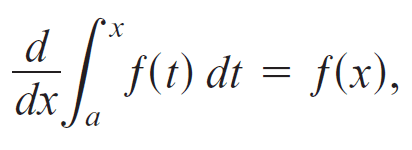
Equation: d/dx of the integral from a to x of f(t) dt equals f(x), with the upper limit x and lower limit a shown on the integral sign.


Equation: integral from a to x of F'(t) dt = F(x) - F(a), the fundamental theorem of calculus, written as displayed mathematics.

The Attempt at a Solution


i couldn't do it because we didnt learn this type of question
 
Attachments
  • Equation y = (integral from 0 to x of (t^3 + 1)^10 dt), raised to the power 3, with the integral's limits 0 and x and the integrand (t^3 + 1)^10 dt.
    a.png
    2.9 KB · Views: 483
  • Equation: d/dx of the integral from a to x of f(t) dt equals f(x), the first part of the fundamental theorem of calculus.
    b.png
    3.3 KB · Views: 652
  • Fundamental theorem of calculus equation: the integral from a to x of F prime of t dt equals F of x minus F of a, with a comma at the end.
    c.png
    5.3 KB · Views: 521
hi houssamxd! :smile:

(is the question to find dy/dx? :confused:)

why can't you just use the first of your "relevant equations"?
 
houssamxd said:

Homework Statement


Equation y = (integral from 0 to x of (t^3 + 1)^10 dt) raised to the power 3, with the integral enclosed in parentheses and the exponent 3 written above the closing bracket.


Homework Equations


[itex]\frac{d}{dx}[/itex]

Equation: d/dx of the integral from a to x of f(t) dt equals f(x), with the integral sign's lower limit a and upper limit x.


Equation: integral from a to x of F'(t) dt = F(x) - F(a), with a comma after the right-hand side.

The Attempt at a Solution


i couldn't do it because we didnt learn this type of question
$$\text{Let}~ G(x) = \int_0^x (t^3 + 1)^{10}dt$$

Then y = [G(x)]3

How would you find dy/dx?
 
So your question is to find the derivative [itex]d u^3/dx[/itex] where [itex]u= \int_a^x f(t)dt[/itex]?

Surely, you have learned the chain rule:
[tex]\frac{dy}{dx}= \frac{dy}{du}\frac{du}{dx}[/tex]

And to find du/dx, you need the "Fundamental Theorem of Calculus" which you give as a "relevant equation".