Difficult Ladder Against Wall Torque Problem

  • Thread starter Thread starter whoopie88
  • Start date Start date
  • Tags Tags
    Torque Wall
Click For Summary
SUMMARY

The discussion revolves around solving a torque problem involving a ladder and a person standing on it. The ladder is 3.9 m long, weighs 6.6 kg, and supports an 85 kg person. The normal force exerted by the floor is calculated to be 898.6 N, while the normal force from the wall is incorrectly estimated at 698.1 N. The participants emphasize the importance of calculating torque around the base of the ladder to find the correct forces without needing the coefficient of friction.

PREREQUISITES
  • Understanding of torque and force equilibrium principles
  • Familiarity with normal and frictional forces in static systems
  • Knowledge of how to apply Newton's laws to solve mechanics problems
  • Ability to interpret and analyze free-body diagrams
NEXT STEPS
  • Learn how to calculate torque in static equilibrium scenarios
  • Study the principles of normal and frictional forces in detail
  • Explore the concept of free-body diagrams for complex systems
  • Practice similar problems involving ladders and forces to solidify understanding
USEFUL FOR

Students studying physics, particularly those focusing on mechanics and torque problems, as well as educators looking for examples of static equilibrium in real-world applications.

whoopie88
Messages
52
Reaction score
0
Difficult Ladder Against Wall Torque Problem!

Homework Statement


An 85 kg person stands on a uniform 6.6 kg ladder that is 3.9 m long, as shown. The floor is rough; hence it exerts both a normal force, f1, and a frictional force, f2, on the ladder. The wall, on the other hand, is frictionless; it exerts only a normal force, f3. Using the dimensions in the figure, find the magnitudes of f1, f2, and f3.

Homework Equations


All forces and torque formulas.

The Attempt at a Solution


I found f1 - 898.6 N. I can't find f2 and f3, which I think are supposed to be equal. No matter what I try, I can't seem to get an answer. Here's my work:
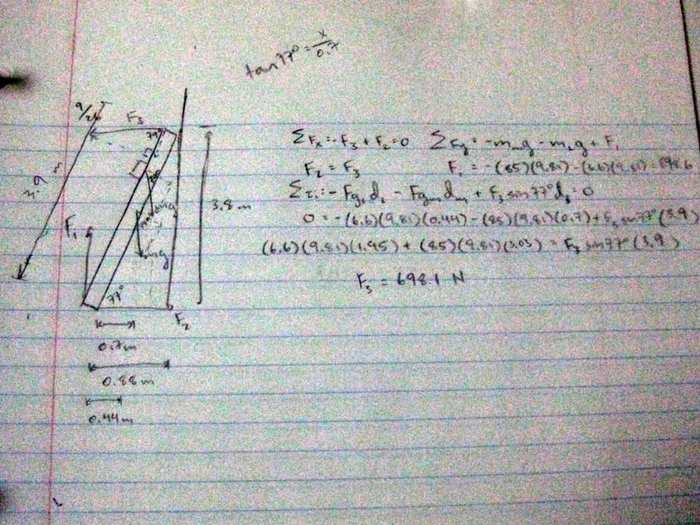
16hok91.jpg


Help please? Thanks in advance.
 
Physics news on Phys.org


Have you tried applying f = μN, where f is the frictional force and N is the normal force? Where you given the coefficient of friction, μ?


No; I wasn't given the coefficient of friction. My instructor, for all of our problems relating to torque, has made it clear that we do not need to apply f = μN.


Alright. At the end of your work it looks like you wrote "f3 = 698.1N". Is this not what you were looking for?


That is what I was looking for, but that's an incorrect answer.


Got it. Just one last question; how far up (or down) the ladder does the problem say the man is standing?


That information is not given.

Here is the diagram that goes along with the problem:

11-3ae.gif


Great. It is hard to see your work in the picture, but try solving for the torque around the top of the ladder. Show me the equation you set up. I got to a different answer.


Find the torque (moment) about the contact point at the bottom of the ladder. It doesn't involve f1 or f2 and it doesn't depend
upon the person's distance up the ladder.
 

Similar threads

Replies
30
Views
4K
Replies
17
Views
3K
Replies
6
Views
3K
Replies
6
Views
2K
  • · Replies 20 ·
Replies
20
Views
2K
  • · Replies 12 ·
Replies
12
Views
1K
  • · Replies 5 ·
Replies
5
Views
3K
  • · Replies 5 ·
Replies
5
Views
3K
  • · Replies 3 ·
Replies
3
Views
4K
  • · Replies 5 ·
Replies
5
Views
4K