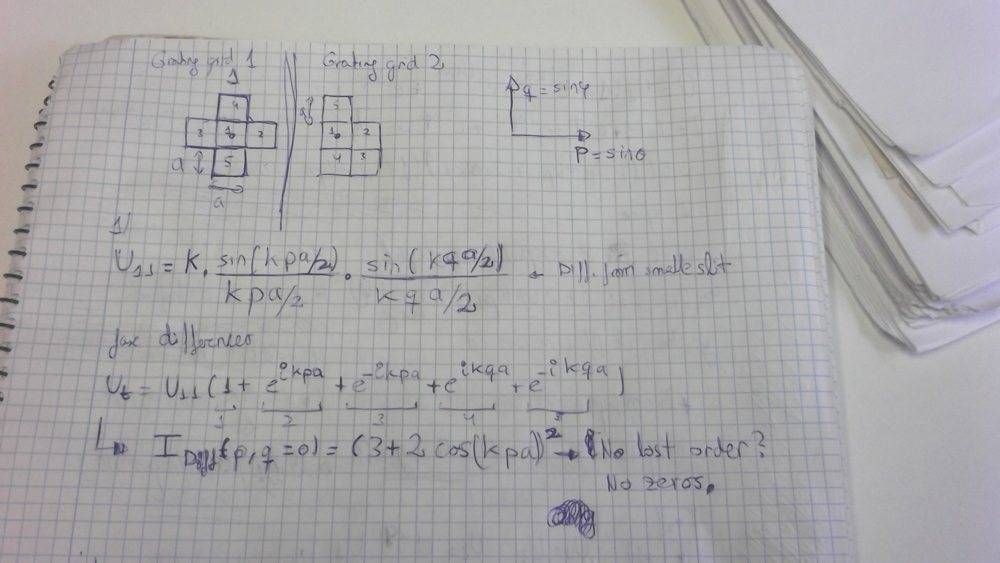
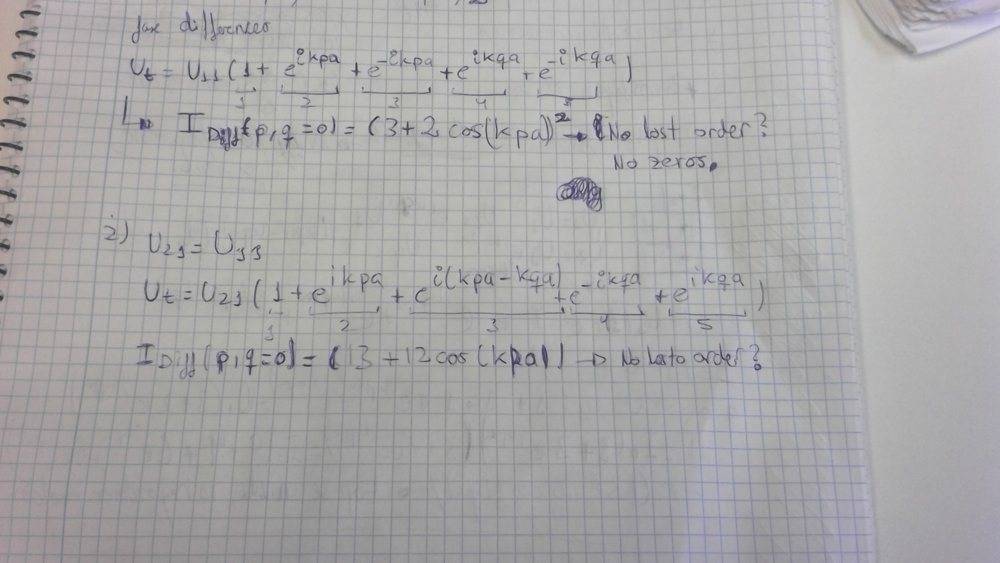
This took me a while to figure out what they are asking, but I think I have it: ## \\ ## In one dimension you need to calculate the diffraction term across the ##x ## direction for the far field case: ## I(\theta)=| \int\limits_{single \, slit}E_o \, t(x) e^{i \phi(x)} \, dx|^2 ## where ## t(x) ## is the weighting function for the different parts of the slit, and ## \phi(x)=\frac{2 \pi x \sin{\theta}}{\lambda}##. ## \\ ## (##E_o ## is an arbitrary constant).## \\ ## ## I(\theta) ## is likely to have some zeros at places where ## m \lambda=(5a) \sin{\theta} ## which are the ## \theta's ## for the interference peaks for integer ## m ##. If the diffraction integral gives zero for an integer ## m ##, this is a lost interference maximum. ## \\ ## Note: You should be able to designate any part of the slit as the origin ## x=0 ##. Choosing a different location for the origin will just introduce a factor ## e^{i \phi_o} ##, which will be converted to a unity factor when you take ## I(\theta)= |E(\theta)|^2 ##. ## \\ ## And I think I solved it correctly=I didn't try all the cases, but a slit that has 5 squares in a column gives me a bunch of lost orders (I'm not going to give you the complete answer), but I don't think any other configuration gives any lost orders. (I haven't checked my result very carefully=I'll leave that part to you).