chempinaki
- 2
- 0
Hello all,
I joined this amazing forum just today.I hope that my question will get answered soon.
So here it is.I am unable to understand a some steps in calculation. Please help me understand.
Here is a linear homogeneous first order differential equation
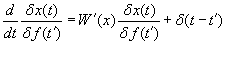
whose solution a research paper writes to be:

Now Integrating factor for solving the differential equation should have been:
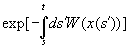
And the final solution according to the standard procedure of solving linear homogeneous first order differential equation should have been:

But in the paper solution is not the same.Please guide me if I am wrong with my justifications.
Also in the final step delta function selects only s=t prime value.I am unable understand why theta function is coming.please elaborate on this step too.Any help will be deeply appreciated. I don't come from a maths background.
I joined this amazing forum just today.I hope that my question will get answered soon.
So here it is.I am unable to understand a some steps in calculation. Please help me understand.
Here is a linear homogeneous first order differential equation
whose solution a research paper writes to be:
Now Integrating factor for solving the differential equation should have been:
And the final solution according to the standard procedure of solving linear homogeneous first order differential equation should have been:
But in the paper solution is not the same.Please guide me if I am wrong with my justifications.
Also in the final step delta function selects only s=t prime value.I am unable understand why theta function is coming.please elaborate on this step too.Any help will be deeply appreciated. I don't come from a maths background.