arpon
- 234
- 16
We know,
$$\delta(x) = \begin{cases}
\infty & \text{if } x = 0 \\
0 & \text{if } x \neq 0
\end{cases}$$
And, also,
$$\int_{-\infty}^{\infty}\delta(x)\,dx=1$$
Using Fourier Transformation, it can be shown that,
$$\delta(x)=\lim_{\Omega \rightarrow \infty}\frac{\sin{(\Omega x)}}{\pi x}$$
Let's look at the graph of ##y=\frac{\sin{(\Omega x)}}{\pi x}##, for large ##\Omega##.
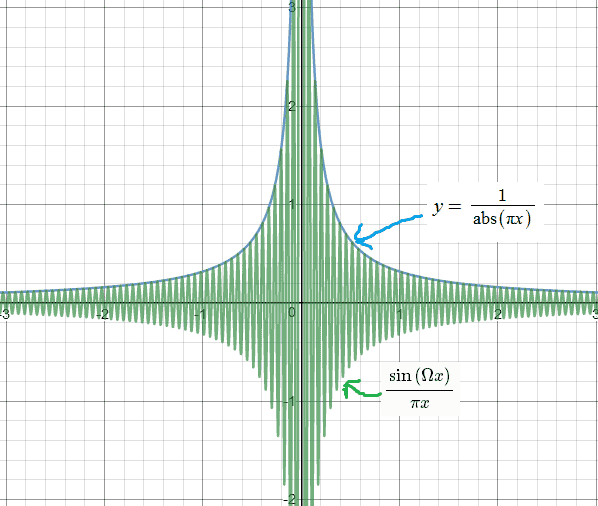
So, from this graph, it seems,
$$\lim_{\Omega \rightarrow \infty}\frac{\sin{(\Omega x)}}{\pi x}\neq 0 \text{ , for } x\neq 0 $$
But, this is actually the Fourier transformation of the function,
$$f(t)=1=\exp{(i\cdot 0\cdot t)}$$
So, intution tells me that the frequency spectrum of ##f(t)## should have infinite amplitude at ##x=0## and ##0## amplitude otherwise, just like the Dirac-delta function.
Now, how can I show that,
$$\lim_{\Omega \rightarrow \infty}\frac{\sin{(\Omega x)}}{\pi x} = 0 \text{ when, } x\neq 0$$
$$\delta(x) = \begin{cases}
\infty & \text{if } x = 0 \\
0 & \text{if } x \neq 0
\end{cases}$$
And, also,
$$\int_{-\infty}^{\infty}\delta(x)\,dx=1$$
Using Fourier Transformation, it can be shown that,
$$\delta(x)=\lim_{\Omega \rightarrow \infty}\frac{\sin{(\Omega x)}}{\pi x}$$
Let's look at the graph of ##y=\frac{\sin{(\Omega x)}}{\pi x}##, for large ##\Omega##.
So, from this graph, it seems,
$$\lim_{\Omega \rightarrow \infty}\frac{\sin{(\Omega x)}}{\pi x}\neq 0 \text{ , for } x\neq 0 $$
But, this is actually the Fourier transformation of the function,
$$f(t)=1=\exp{(i\cdot 0\cdot t)}$$
So, intution tells me that the frequency spectrum of ##f(t)## should have infinite amplitude at ##x=0## and ##0## amplitude otherwise, just like the Dirac-delta function.
Now, how can I show that,
$$\lim_{\Omega \rightarrow \infty}\frac{\sin{(\Omega x)}}{\pi x} = 0 \text{ when, } x\neq 0$$
Last edited: