Dirac notation - expectation value of kinetic energy

Click For Summary

Homework Help Overview

The discussion revolves around the expectation value of kinetic energy in quantum mechanics, specifically using Dirac notation. The original poster is tasked with expressing the expectation value in terms of an integral involving the derivative of the wavefunction, Ψ, and is seeking clarification on the positivity of the integral involved.

Discussion Character

  • Exploratory, Conceptual clarification, Mathematical reasoning

Approaches and Questions Raised

  • The original poster attempts to understand how to express the expectation value of kinetic energy and is particularly focused on proving that the integral cannot be negative. Participants discuss the positivity of the integrand and the implications of integrating over the entire real line.

Discussion Status

Participants are actively engaging with the original poster's questions, providing clarifications about the nature of the integral and the positivity of the components involved. There is a productive exchange regarding the interpretation of the integral and its limits.

Contextual Notes

The problem is set within the context of a particle in a one-dimensional potential energy well, and the discussion includes considerations of Dirac notation and the properties of wavefunctions.

Clarky48
Messages
6
Reaction score
0
It's my first post so big thanks in advance :)

1. Homework Statement

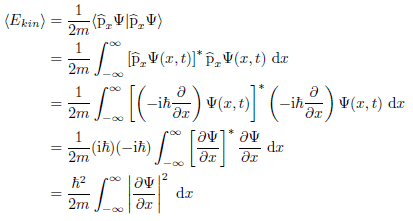
So the question states "By interpreting <pxΨ|pxΨ> in terms of an integral over x, express <Ekin> in terms of an integral involving |∂Ψ/∂x|. Confirm explicitly that your answer cannot be negative in value." ##The 'px's should have hats to indicate an operator##
If it helps, it's part of a question where Ψ is the wavefunction of a particle in a 1D pot energy well and the question is testing on a chapter about introducing and working with Dirac notation.

Homework Equations


None that I can think of

The Attempt at a Solution


The maths of my solution so far is
CJx2b66.png


So, the part I'm stuck with is proving explicitly that it can't be negative in value. Obviously the factor to the left is always positive but it's the integral that's the problem. I know the integrand is always real and positive as it's a modulus squared, I just can't see any way to prove that the integral of that, over infinity, is never negative.

It's due in for next Monday so any help would be greatly appreciated!
 
Physics news on Phys.org
Looks good.

You are integrating from ##- \infty## to ##+ \infty##. So, what is the sign of ##dx## in the integral?
 
I'm not sure what you mean - I'd presume ##\text{d}x## is always positive, as it's effectively a small interval ##\delta x## centered on ##x##.

So are you saying if I take the integral to be the infinite sum of small sections ##| \partial \Psi / \partial x|^2 ~ \delta x##, then each section must be positive, as both ##| \partial \Psi / \partial x|^2## and ##\delta x## are always positive?

Thanks
 
Clarky48 said:
So are you saying if I take the integral to be the infinite sum of small sections ##| \partial \Psi / \partial x|^2 ~ \delta x##, then each section must be positive, as both ##| \partial \Psi / \partial x|^2## and ##\delta x## are always positive?

Thanks

Yes.

Another way to think about it is that ##|\partial \Psi / \partial x|^2## is a non-negative function of x. So, the integral is the "area under" the graph of a function that never goes below the x axis. So, the area is positive according to the sign conventions of area-under-a-graph as used in calculus.
 
Ah right, I think I get you.

So, to check I understand it - if the limits of integration were reversed ##\int^{-\infty}_{\infty}## (so you're integrating across the graph in the negative x direction), would the integral be negative?
 
Clarky48 said:
So, to check I understand it - if the limits of integration were reversed ##\int^{-\infty}_{\infty}## (so you're integrating across the graph in the negative x direction), would the integral be negative?
Yes, that's right.
 
Awesome. Thanks for all the help :smile:
 

Similar threads

  • · Replies 2 ·
Replies
2
Views
2K
  • · Replies 5 ·
Replies
5
Views
2K
  • · Replies 12 ·
Replies
12
Views
4K
  • · Replies 3 ·
Replies
3
Views
2K
  • · Replies 2 ·
Replies
2
Views
2K
  • · Replies 8 ·
Replies
8
Views
2K
Replies
7
Views
3K
Replies
1
Views
6K
Replies
8
Views
13K
  • · Replies 1 ·
Replies
1
Views
5K