Directing sunlight into the optical fiber

Click For Summary
SUMMARY

Directing sunlight into optical fiber requires a lens rather than a prism, as the latter only works in one plane and does not provide the necessary acceptance angle. The acceptance angle, defined by the numerical aperture (NA), dictates the design of the lens, which should have an f-number of 1/(2NA) to match the fiber's requirements. A parabolic reflector is recommended for maximizing light intensity, while safety precautions are crucial to prevent eye damage and fire hazards when experimenting with focused sunlight.

PREREQUISITES
  • Understanding of optical fiber acceptance angle and numerical aperture (NA)
  • Knowledge of lens focal length and f-number calculations
  • Familiarity with light focusing techniques, including the use of parabolic reflectors
  • Awareness of safety measures when working with concentrated sunlight
NEXT STEPS
  • Research the principles of optical fiber numerical aperture (NA) and its implications for light propagation
  • Learn about lens design and selection for optimal light coupling into optical fibers
  • Explore the use of parabolic reflectors in light concentration applications
  • Study safety protocols for experiments involving focused sunlight and high-intensity light sources
USEFUL FOR

Optical engineers, physicists, hobbyists in optics, and anyone interested in safely experimenting with light concentration techniques.
aminmix
Hello
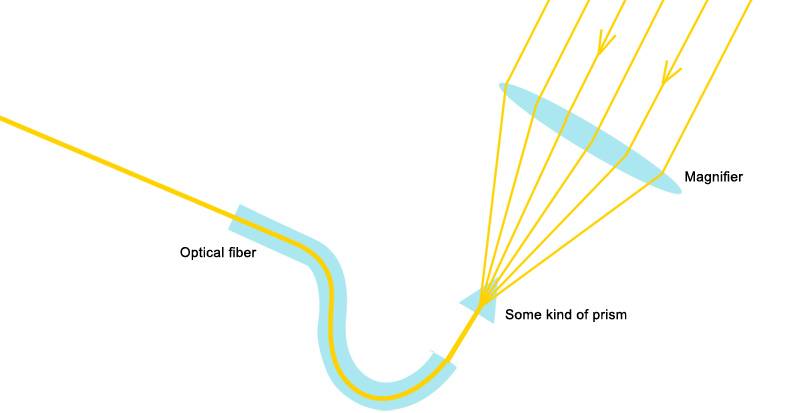
Is it possible to direct sunlight into the optical fiber by magnifying glass and a prism like the image below?
prism.jpg

if yes , what shape of prism should i use to do this?
Thank you
 
Science news on Phys.org
I think a prism bends light the other way...

annot3206_1.png
 
Hi and welcome.
A prism is not what you need, imo. (The optics has to be symmetrical about the axis, and a prism only works in one plane. Your idea would actually require a cone and not a prism and it will not produce a focussed spot) What counts is the 'acceptance angle' of the fibre, which is the range of angles of incident light on the end that will actually propagate down the fibre. Whatever the width of the fibre, you need a lens with a focal length that will provide a cone of light that will enter the fibre. The only light that will get into the fibre will be what is within that acceptance cone. If you have a large lens close up, a lot of the light from the spot you have focussed will not get into the fibre. That means you need a long focal length.
You can measure the acceptance angle by observing a small light source and move it from side to side until you can't see it through the fibre or by looking at the cone of light that emerges from the fibre (on a paper sheet) when you put a light at the other end. That will tell you how big your lens needs to be. The longer the focal length, the more efficient the illumination of the fibre.
Note, you can overheat the fibre if the lens area is too great and the power that doesn't get into the fibre will dissipate on the way in. So you should mask off the outer part of the lens to restrict the power input to a safe level.
 
  • Like
Likes   Reactions: anorlunda
You don't need any prism or cone. The lens is all you need.

This is a good time to learn about etendue: https://en.wikipedia.org/wiki/Etendue
Since etendue cannot increase, it doesn't help to add extra prisms.

The fiber has a limited acceptance angle (normally specified by numerical aperture NA).
NA = n sin(theta)
where theta is the acceptance half-angle. You should choose a lens with an f-number = 1/(2NA). This will match the bend angle of the lens to the acceptance angle of the fiber.
 
  • Like
Likes   Reactions: sophiecentaur and davenn
Are you designing a light tube illumination system?
 
Khashishi said:
You should choose a lens with an f-number = 1/(2NA).
Of course - f number. Brilliant.
 
My goal is to make a powerful light from sun that burns like laser and all light lines are so close and all of them are in same direction
This is the last thing that i found :
optical-fiber.jpg
 
A parabolic reflector is much cheaper, for a given diameter, if you just want raw power. A s/h reflector from an old telescope could be a very reasonable price and it's the sort of thing that amateur astronomers keep, rather than chucking away with an old Newtonian telescope.
It concerns me that the fibre solution could overheat with a few tens of Watts of Power unless you have a high quality fibre. A fibre doesn't actually collimate the light so the beam will spread out at the other end (same cone as on the way in, without a further lens. If you want to produce your intense spot of sunlight at a distance, you are probably better off with a lens / reflector with a very long focal length.
What is the actual application you had in mind - or is it just that you would like to do it? Unless you really want a very narrow spot of light, it is often better (and easier) to direct the energy onto a slightly defocussed area. Same Power but less Power per square cm.

PS Safety is important here. Focussing sunlight on a slam spot can produce an image that can damage your eyes. Even it it doesn't seem painfully bright when looking at it, the 'spots' in your vision may not be completely temporary.
 
I closed this thread because it develops into very dangerous areas. Any experiments with direct sunlight can seriously damage someone's eyesight, in which way processed ever. The more if it is bundled. I can only appeal to everybody to avoid these kind of experiments: fun for a few minutes and blind for the rest of your life. This isn't a good deal. Moreover it bears the risk of an uncontrolled fire. The many wild fires each year tell us how easy a fire can get started and how difficult if not impossible it is to control or extinct.

I want to take the opportunity and remind everybody who reads this, to be very, very careful with the observation of the upcoming eclipse. Direct observations should be avoided at any costs! Get some of the cheap protection glasses (or foils) which are usually available in these cases. Do not look into the sun without protection. Even usual sun glasses will not be sufficient! It will burn your retina and this will be a lasting damage: no healing, no surgery.
 
  • Like
Likes   Reactions: aminmix, davenn, berkeman and 1 other person

Similar threads

  • · Replies 1 ·
Replies
1
Views
2K
  • · Replies 25 ·
Replies
25
Views
4K
  • · Replies 22 ·
Replies
22
Views
4K
  • · Replies 1 ·
Replies
1
Views
2K
  • · Replies 7 ·
Replies
7
Views
2K
Replies
11
Views
2K
  • · Replies 9 ·
Replies
9
Views
3K
Replies
12
Views
1K
  • · Replies 37 ·
2
Replies
37
Views
4K
  • · Replies 2 ·
Replies
2
Views
3K