Direction of car friction in a free-body

Click For Summary
SUMMARY

The direction of friction for a car in motion can be forward, contrary to the common belief that it always opposes motion. This occurs when the wheels are rotating backward while the car moves forward, indicating that friction acts to prevent the tires from slipping on the road. The determination of friction's direction relies on the relationship between the rolling object and the surface, specifically whether the object is attempting to slide or spin without moving. Understanding these dynamics is crucial for accurately analyzing free-body diagrams in physics.

PREREQUISITES
  • Understanding of free-body diagrams
  • Knowledge of frictional forces and their behavior
  • Familiarity with concepts of rolling motion and inertia
  • Basic principles of Newtonian mechanics
NEXT STEPS
  • Study the principles of rolling resistance and its effects on vehicle dynamics
  • Learn about the relationship between friction and motion in different surfaces
  • Explore advanced topics in Newtonian mechanics related to rotational motion
  • Investigate the impact of tire deformation on vehicle performance
USEFUL FOR

Physics students, automotive engineers, and anyone interested in understanding the mechanics of vehicle motion and friction dynamics.

SkyrimKhajiit
Messages
17
Reaction score
1
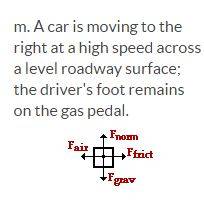
Usually when we've done free-body diagrams with cars, the direction of friction was reasonably opposite the direction of the motion. But here it's different...

1. Homework Statement
hGLP9nm.jpg


All I want to know is why the direction of friction is forward. My only guesses are that the wheels are turning backward creating forward motion (what?)
 
Physics news on Phys.org
In general, the (positive) direction of the frictional force of a surface on an object rolling over it cannot be determined without knowing whether the rolling object is "trying to slide" over the surface or trying to "trying to spin without moving". Determing the positive direction depends on the specifics of other applied forces and moment of inertia. In this problem, since the surface is flat, the wheels would spin without moving if there were no friction. The frictional force can be drawn so it opposes the motion of the surface of a tire attempting to spin across it. Theoretically, It doesn't really matter how you pick the positive direction for drawing force vectors. If you draw them pointing the wrong way, you get a negative value for their magnitude and you conclude they point in the opposite direction.
 
  • Like
Likes   Reactions: SkyrimKhajiit
To add to Stephen's comments, "friction opposes motion" is a common misconception. Friction opposes relative motion of the surfaces in contact. For a car accelerating on the flat or moving at a steady speed uphill, friction acts in the forward direction (to prevent the tyres slipping on the road). Unfortunately, many problem setters who ought to know better refer to a car working against friction when they mean rolling resistance: energy losses mostly in tyre deformation.
 
  • Like
Likes   Reactions: SkyrimKhajiit

Similar threads

Replies
4
Views
1K
  • · Replies 7 ·
Replies
7
Views
1K
  • · Replies 10 ·
Replies
10
Views
2K
Replies
24
Views
3K
  • · Replies 30 ·
2
Replies
30
Views
4K
Replies
13
Views
2K
  • · Replies 1 ·
Replies
1
Views
1K
  • · Replies 10 ·
Replies
10
Views
2K
Replies
6
Views
3K
Replies
13
Views
2K