RiverRunner
- 1
- 0
Hi,
The following question is related to my individual design for an engineering subject.
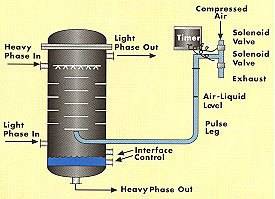
I am trying to calculate the fluid displacement in a packed vessel when air is pulsed through a pulse leg, which is connected to the bottom of the vessel. Using equations from literature, I have calculated the amplitude and frequency of the pulse to be 0.4m and 1 s-1, respectively.The following picture shows the general setup, although the pulse leg is above the vessel.
 Help/Tips/Suggestions to do this would be fantastic, I only need a starting point.
Information:
There are two fluids inside the vessel.
The ratio of fluid 1 to fluid 2 is 2:1.
The density of fluid 2 is 1100 kg/m^3
The density of fluid 1 is 850 kg/m^3
The space the packing takes up in the column is 70%
The diameter of the vessel is 0.4m.
The height of the vessel is 1.7m
The height of the pulse leg is 2.2m
The amplitude of the pulse is 0.4m
The frequency of the pulse is 1s-1
Many thanks
The following question is related to my individual design for an engineering subject.
I am trying to calculate the fluid displacement in a packed vessel when air is pulsed through a pulse leg, which is connected to the bottom of the vessel. Using equations from literature, I have calculated the amplitude and frequency of the pulse to be 0.4m and 1 s-1, respectively.The following picture shows the general setup, although the pulse leg is above the vessel.
Information:
There are two fluids inside the vessel.
The ratio of fluid 1 to fluid 2 is 2:1.
The density of fluid 2 is 1100 kg/m^3
The density of fluid 1 is 850 kg/m^3
The space the packing takes up in the column is 70%
The diameter of the vessel is 0.4m.
The height of the vessel is 1.7m
The height of the pulse leg is 2.2m
The amplitude of the pulse is 0.4m
The frequency of the pulse is 1s-1
Many thanks
Last edited: