How Do You Calculate the Dissolution Time of a Corroding Metal Sphere?

  • Context: Undergrad 
  • Thread starter Thread starter johnsonb.engr
  • Start date Start date
  • Tags Tags
    Metal Sphere
Click For Summary
SUMMARY

The discussion focuses on calculating the dissolution time of a corroding metal sphere, specifically using the equations derived from the article found at http://arxiv.org/pdf/1208.5925.pdf. The key equations include dm/dt = -c*s(m) and the general solution m(t) = mo - A*(mo^2/3)*t + (1/3)*(A^2)*(mo^(1/3))*(t^2) - 1/27*(A^3)*(t^3). The user successfully derived a trendline using Excel to find A = 0.0173 but struggles to relate the corrosion rate coefficient c = -0.003 mg/(s*mm^2) to A. The discussion emphasizes the importance of understanding the physical properties represented by the constants in the equations.

PREREQUISITES
  • Understanding of differential equations, particularly in the context of mass loss over time.
  • Familiarity with corrosion rates and their mathematical representation.
  • Knowledge of sphere geometry, specifically surface area and volume calculations.
  • Proficiency in using Excel for data analysis and trendline calculations.
NEXT STEPS
  • Research the relationship between corrosion rate coefficients and constants in differential equations.
  • Study the derivation of mass loss equations for spherical objects in corrosion contexts.
  • Learn about the physical significance of constants in mathematical models of dissolution.
  • Explore advanced Excel techniques for fitting curves and analyzing trends in scientific data.
USEFUL FOR

This discussion is beneficial for materials scientists, chemical engineers, and researchers focused on corrosion science, as well as students studying differential equations in physical contexts.

johnsonb.engr
Messages
11
Reaction score
0
Hello All

I could get some help I would greatly appreciate it.

I am trying to figure how to calculate the dissolution time of sphere undergoing constant corrosion at a rate
of corrosion.

Through a little google-fu, I found an article which gives me the solution ( http://arxiv.org/pdf/1208.5925.pdf )
but I am having trouble understanding the proof.

In this article there is a dissolving sphere

From this article we know that

the mass of the sphere is equal to dm/dt = -c*s(m) (1

and the general solution is

m(t)=mo - A*(mo^2/3)*t + (1/3)*(A^2)*(mo^(1/3))*(t^2) -1/27*(A^3)*(t^3)
or

m(t) = (a-k*t)^3
a = initial mass = (mo)^1/3
k = (A/3).

The article then gives an example where

mo = initial mass = 10 grams
p = density = 0.8 mg/mm^2
c = corrosion rate = -0.003 mg/(s*mm^2)

I am having difficulty understanding how to relate the rate of corrosion c to A.

I know that c = (dm/dt)/s(m)

The article shows a series of graphs for Mass, Radius, SA, and Volume vs time.

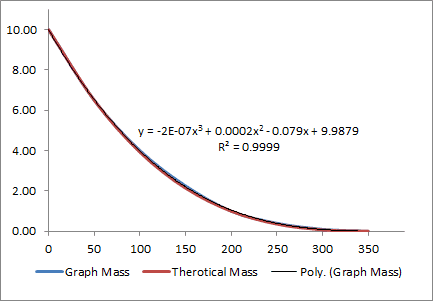
I copied these graphs into excel and add used excel to find a trendline.

m(t) = -2E-07*t^3 + 0.0002*t^2 - 0.079t+ 9.9879

By plugging values into the trend line above I was able to find a solution to

A = 0.0173.
upload_2016-3-7_15-39-24.png


However, do not understand how to relate A to c(-0.003).

Some help would be greatly appreciated.
 

Attachments

  • upload_2016-3-7_15-35-49.png
    upload_2016-3-7_15-35-49.png
    3 KB · Views: 522
  • upload_2016-3-7_15-37-21.png
    upload_2016-3-7_15-37-21.png
    1.6 KB · Views: 546
  • upload_2016-3-7_15-51-29.png
    upload_2016-3-7_15-51-29.png
    25.9 KB · Views: 544
  • upload_2016-3-7_15-51-40.png
    upload_2016-3-7_15-51-40.png
    17.3 KB · Views: 545
Physics news on Phys.org
corrosion rate coefficient is given as a number c milligrams of mass dissolved per second from each square millimeter of surface area.
Therefore, an object with surface area A square millimeters will have an instantaneous rate of mass loss of ##\dot m =cA## milligrams per second.
You know how to find the surface area of a solid sphere from it's mass and density right?
 
Last edited:
Hello Simon,

Thank you very much for your response.

Maybe I am not fully understanding your answer.

The A, I am trying to find is not the surface area of the sphere but rather a constant found in the solution to

dm/dt = -c*s(m) = -c*4πi*(3m/(4πi*ρ)^(2/3) (equation 1)

where the solution to the equation listed above is

m(t)=mo - A*(mo^2/3)*t + (1/3)*(A^2)*(mo^(1/3))*(t^2) -1/27*(A^3)*(t^3) (equation 2)

which simplifies to

m(t) = (mo^(1/3) - (A/3)t)^(1/3) (equation 3)

Where A is constant. Maybe I am wrong here, but I do not believe that A equation 2 and 3 is equal to the surfaces area of the sphere.

Am I wrong here?

If I am only given the density, rate of corrosion, and diameter of sphere, how would I go about finding equation 3.

Thank you very much for your help.
 
Then you need to identify what physical property the article is using the letter A to stand for. So far you have A=3k ... but that begs the question: what is k? (Though it is possible that A is just the constant of integration...)
Either that - or discard the article and work out your own solution.
The second is probably faster... I've already done it: took me a couple of minutes but then, I've had practise.
 
Last edited:

Similar threads

  • · Replies 7 ·
Replies
7
Views
3K
  • · Replies 4 ·
Replies
4
Views
3K
  • · Replies 12 ·
Replies
12
Views
2K
  • · Replies 2 ·
Replies
2
Views
4K
  • · Replies 97 ·
4
Replies
97
Views
6K
  • · Replies 7 ·
Replies
7
Views
3K
  • · Replies 2 ·
Replies
2
Views
2K
  • · Replies 17 ·
Replies
17
Views
2K
  • · Replies 1 ·
Replies
1
Views
3K
Replies
9
Views
2K