Nick89
- 553
- 0
Hi,
I was asked this question on another forum and was interested in it... It's somewhat related to what I have been doing lately so I gave it a (few) tries, but I never really worked it out...
Consider a circle with a radius of 32 units. We want to divide the area of the circle into 9 areas that have, if possible, exactly the same area. See the following image:
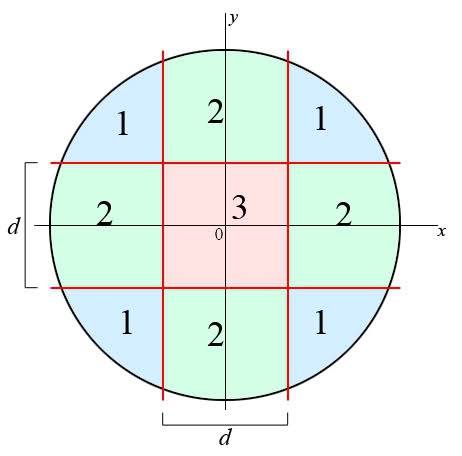
The red lines are the 'dividing lines', spaced by a distance d (in the x as well as the y direction).
The areas 1 (blue) and 2 (green) and the area 3 (red) are marked with the colors. Note that there are four areas 1 and four areas 2, they should be equal in area.
The question is how to find the distance d that will yield the optimal result (if possible, that all areas are equal).
The first thing I thought about (but which doesn't seem to be working, see later) is simply to do the following:
We know the area of the complete circle: A_{tot} = \pi 32^2
Therefore, if the 9 areas are to be divided in equal areas, the area of one the subareas will be: A_{sub} = \frac{ \pi 32^2}{9}
We also know the area A_3 since it's just a square: A_3 = d^2
Therefore: d = \sqrt{ \frac{ \pi 32^2}{9}}.
I tried to graph it and it seemed alright to the eye, but I wanted to be sure, so I went on...
The following way I could think of was to calculate the subareas seperately using integrals and then looking for a d that would minimize their deviation.
I came up with the following area's; A_1 is calculated from the top-right area1 and A_2 is calculated from the rightmost area2.
A_1 = \int_\frac{d}{2}^b \left( \sqrt{ 1024-x^2} - \frac{d}{2} \right) \, dx
A_2 = 2 \times \left( \int_b^{32} \sqrt{1024-x^2} \, dx \right) + d \sqrt{1024-\frac{d^2}{4}}
A_3 = d^2
where the limit b is the intersection of the circle with y = d/2:
b = \sqrt{1024-\frac{d^2}{4}}
When I now plugged in the value for d I found above I don't get the same result, I get a different result for each area...
So, I thought, maybe my simple solution above wasn't right.
But now I have found three areas each as a function of d. I should be able to minimize the deviation between the areas for one value of d, right? I can't see any way how to do that though... Maybe taking the absolute value of the deviation (A_1 - A_2 for example) and using solving it's derivative for 0? Even then I only minimized A_1 - A_2 and had nothing to do with A_3...
Where have I gone wrong:
1) Assuming there is a solution where all areas are equal;
2) Assuming this solution was simply to divide the total area by 9 and equaling this to d^2;
3) Calculating the areas using integrals?
I can't see any other mistakes I may have made, so I assume it must be one of the three...
Could anyone help me out here?
I was asked this question on another forum and was interested in it... It's somewhat related to what I have been doing lately so I gave it a (few) tries, but I never really worked it out...
Consider a circle with a radius of 32 units. We want to divide the area of the circle into 9 areas that have, if possible, exactly the same area. See the following image:
The red lines are the 'dividing lines', spaced by a distance d (in the x as well as the y direction).
The areas 1 (blue) and 2 (green) and the area 3 (red) are marked with the colors. Note that there are four areas 1 and four areas 2, they should be equal in area.
The question is how to find the distance d that will yield the optimal result (if possible, that all areas are equal).
The first thing I thought about (but which doesn't seem to be working, see later) is simply to do the following:
We know the area of the complete circle: A_{tot} = \pi 32^2
Therefore, if the 9 areas are to be divided in equal areas, the area of one the subareas will be: A_{sub} = \frac{ \pi 32^2}{9}
We also know the area A_3 since it's just a square: A_3 = d^2
Therefore: d = \sqrt{ \frac{ \pi 32^2}{9}}.
I tried to graph it and it seemed alright to the eye, but I wanted to be sure, so I went on...
The following way I could think of was to calculate the subareas seperately using integrals and then looking for a d that would minimize their deviation.
I came up with the following area's; A_1 is calculated from the top-right area1 and A_2 is calculated from the rightmost area2.
A_1 = \int_\frac{d}{2}^b \left( \sqrt{ 1024-x^2} - \frac{d}{2} \right) \, dx
A_2 = 2 \times \left( \int_b^{32} \sqrt{1024-x^2} \, dx \right) + d \sqrt{1024-\frac{d^2}{4}}
A_3 = d^2
where the limit b is the intersection of the circle with y = d/2:
b = \sqrt{1024-\frac{d^2}{4}}
When I now plugged in the value for d I found above I don't get the same result, I get a different result for each area...
So, I thought, maybe my simple solution above wasn't right.
But now I have found three areas each as a function of d. I should be able to minimize the deviation between the areas for one value of d, right? I can't see any way how to do that though... Maybe taking the absolute value of the deviation (A_1 - A_2 for example) and using solving it's derivative for 0? Even then I only minimized A_1 - A_2 and had nothing to do with A_3...
Where have I gone wrong:
1) Assuming there is a solution where all areas are equal;
2) Assuming this solution was simply to divide the total area by 9 and equaling this to d^2;
3) Calculating the areas using integrals?
I can't see any other mistakes I may have made, so I assume it must be one of the three...
Could anyone help me out here?