DIY Electromagnetic Induction Experiment

Click For Summary
SUMMARY

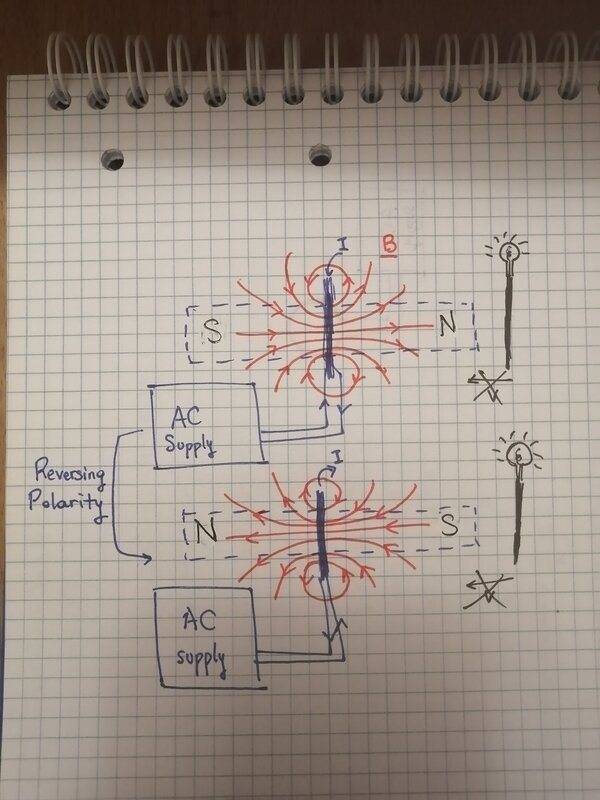
The forum discussion centers on a DIY electromagnetic induction experiment where a transformer is created without an iron core. The primary circuit operates at 30-50 kHz AC, generating a magnetic field that induces current in a secondary coil connected to a light bulb. The light bulb remains continuously lit due to the limitations of its heating and cooling response, as well as the human eye's persistence of vision, which cannot detect rapid brightness changes. The experiment highlights the principles of Faraday's Law and the effects of high-frequency AC on light emission.

PREREQUISITES
  • Understanding of Faraday's Law of Electromagnetic Induction
  • Knowledge of AC circuit theory and frequency effects
  • Familiarity with light bulb operation and response times
  • Basic principles of electromagnetic fields and coils
NEXT STEPS
  • Research the effects of frequency on electromagnetic induction in coils
  • Explore the differences between AC and DC current in practical applications
  • Learn about the persistence of vision and its implications in visual perception
  • Investigate alternative light sources like LEDs and their response to high-frequency signals
USEFUL FOR

Students, educators, and hobbyists interested in physics, electrical engineering, and DIY electronics projects will benefit from this discussion.

KDPhysics
Messages
73
Reaction score
24
So I was watching this video containing DIY experiments on electromagnetic induction .
At minute 4:45, the dude pretty much creates a transformer without using an iron core.
He runs 30-50 kHz AC in a coil (forming the primary circuit) and then brings another coil with its ends attached to a light bulb (forming the secondary circuit).
As the current runs into the primary circuit, a magnetic field is created as shown below. Since this is AC, the magnetic field changes polarity 30-50 thousand times every second. This in turn induces a current in the secondary coil, which by Faraday's Law must be a current running in the same direction as the primary circuit.
In the video, we can see that the light bulb lights up, but doesn't turn off and on as it should.
Could this be because of the extremely high frequency of AC, which makes the light bulb turn on and off 30-50 thousand times a second?
Or is the current induced in the secondary coil actually direct current?
IMG_20200518_213706.jpg
 

Attachments

  • IMG_20200518_213327.jpg
    IMG_20200518_213327.jpg
    73.9 KB · Views: 193
Physics news on Phys.org
KDPhysics said:
Could this be because of the extremely high frequency of AC, which makes the light bulb turn on and off 30-50 thousand times a second?
It's more because the light bulb can't heat and cool fast enough for the brightness to change in one cycle. But even if it could do that (e.g. a neon lamp or fluorescent lamp), your eyes still can't track the brightness variations anyway (persistence of vision). This applies even at typical mains frequencies like a mere 50 or 60 cycles per second.
 
  • Like
Likes   Reactions: anorlunda, vanhees71 and KDPhysics
In the secondary coil he has a LED (a light emitting diode). The LED blinks at 30 KHz but the video is made at 50 Hz. The image persistence on the retina is 30 ms thus you can not see that the LED blinks in the video (not if you make the experiment)
 

Similar threads

  • · Replies 21 ·
Replies
21
Views
2K
  • · Replies 6 ·
Replies
6
Views
2K
  • · Replies 16 ·
Replies
16
Views
4K
  • · Replies 23 ·
Replies
23
Views
2K
  • · Replies 6 ·
Replies
6
Views
2K
  • · Replies 8 ·
Replies
8
Views
2K
  • · Replies 17 ·
Replies
17
Views
4K
  • · Replies 1 ·
Replies
1
Views
1K
  • · Replies 60 ·
3
Replies
60
Views
7K
  • · Replies 3 ·
Replies
3
Views
2K