Do Streamlines Change Shape Depending on Frame of Reference in Fluid Dynamics?

  • Thread starter Thread starter member 428835
  • Start date Start date
  • Tags Tags
    Fluids
Click For Summary

Discussion Overview

The discussion centers on whether streamlines in fluid dynamics change shape depending on the frame of reference, particularly in the context of a sphere moving through a fluid at low Reynolds number. Participants explore the visual representation of streamlines from both the perspective of an observer moving with the sphere and one stationary relative to the flow.

Discussion Character

  • Exploratory
  • Technical explanation
  • Debate/contested

Main Points Raised

  • One participant suggests that streamlines around a moving sphere would appear steady from the sphere's frame of reference, while they would seem to "move backwards" from a stationary observer's perspective.
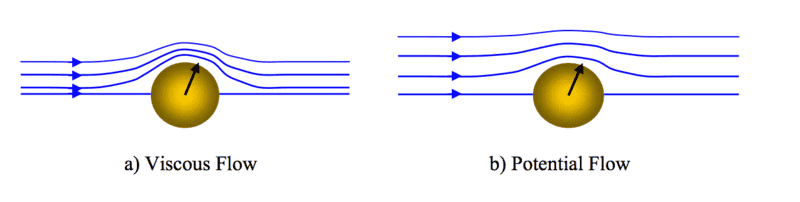
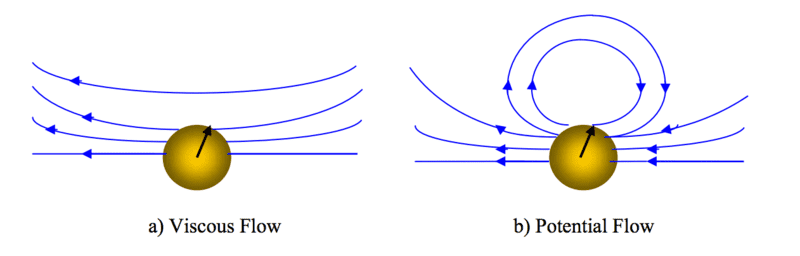
  • Another participant clarifies that the top images in the referenced paper depict streamlines as viewed by a stationary observer, while the bottom images show the perspective of an observer moving with the sphere.
  • A participant questions whether the curved streamlines in the upper figures represent parts of a circle that reconnect, noting that the upper left figure seems unlikely to attach to itself.
  • It is pointed out that the images are hand-drawn for illustrative purposes, and in a viscous flow, fluid particles would likely loop around the sphere but end at different locations upstream of where they started.
  • Two participants express interest in references for deriving the velocity potential for flow around a moving cylinder, indicating a desire for further technical exploration.

Areas of Agreement / Disagreement

Participants express differing views on the interpretation of the streamlines and their behavior in different frames of reference. There is no consensus on the exact nature of the streamlines or their reconnection properties, and the discussion remains unresolved regarding the specifics of the flow around the sphere.

Contextual Notes

Participants note that the images referenced may not represent computed streamlines, and there are discussions about the implications of viscous flow on the behavior of fluid particles around the sphere.

Who May Find This Useful

This discussion may be of interest to those studying fluid dynamics, particularly in the context of frame of reference effects on streamline behavior and potential flow theory.

member 428835
Hi PF!

I read that streamlines around a body change according to one's frame of reference. If we consider a sphere that is moving in a flow (low Re) would the streamlines change shape as we change our reference frame from being on the ball verses sitting aside and watching the ball move past us?

I think the two would look basically the same: the streamlines from the ball's frame of reference would look steady and wrap around the ball in an orderly fashion, where the streamlines from a sitting observer's perspective would appear to "move backwards" so as to constantly wrap around the ball.

Any ideas?

Edit: I just found these two images from a paper here: http://webspace.clarkson.edu/projects/crcd/me537/downloads/02_Pastsphere.pdf
The top images are in a moving frame of reference and the bottom two are in a stationary frame (I assume stationary implies as seen from the sphere). Can someone explain these? Perhaps @boneh3ad or @Chestermiller
moving.png
stationary.png
 
Last edited by a moderator:
Engineering news on Phys.org
The top pictures are the streamlines as viewed by a stationary observer. The bottom pictures are the streamlines as viewed by an observer moving with the ball. The top is basically the equivalent of subtracting the free-stream velocity from the bottom images. Basically, if you sit still and watch a ball pass, it will push a fluid particle away from its front, and then the particle will wrap back around the ball (or try to) due to the pressure gradient and end up fairly close to where it started (exactly where it started for potential flow).
 
  • Like
Likes   Reactions: Chestermiller
boneh3ad said:
Basically, if you sit still and watch a ball pass, it will push a fluid particle away from its front, and then the particle will wrap back around the ball (or try to) due to the pressure gradient and end up fairly close to where it started (exactly where it started for potential flow).
So for the upper figures are you suggesting that the curved streamlines are actually parts of a circle that will reconnect? This is evident for the upper right, but the upper left doesn't seem like it would ever attach to itself.
 
joshmccraney said:
So for the upper figures are you suggesting that the curved streamlines are actually parts of a circle that will reconnect? This is evident for the upper right, but the upper left doesn't seem like it would ever attach to itself.

Well those pictures are clearly not computed streamlines. They are hand-drawn for illustrative purposes. In a viscous flow, the ball would drag some of the fluid with it, so a fluid particle would likely still loop around, but it would end at a different location upstream of where it started (upstream as in further along the ball's movement path, which is upstream in the case of the stationary ball frame).
 
Thanks, that makes a lot of sense!
 
Hi, i want to know if there is any reference regarding the derivation of this velocity potential.
By which i mean the problem of "flow around a moving cylinder". I want to derive the velocity potential of the fluid around a moving cylinder.

Thank you !
 
Last edited by a moderator:
dimasmr21 said:
Hi, i want to know if there is any reference regarding the derivation of this velocity potential.
By which i mean the problem of "flow around a moving cylinder". I want to derive the velocity potential of the fluid around a moving cylinder.

Thank you !
Post a new thread.
 
BvU said:
Post a new thread.
sorry, i will start a new thread.
 

Similar threads

Replies
0
Views
2K
  • · Replies 5 ·
Replies
5
Views
5K
Replies
2
Views
1K
  • · Replies 1 ·
Replies
1
Views
1K
  • · Replies 31 ·
2
Replies
31
Views
5K
  • · Replies 18 ·
Replies
18
Views
2K
  • · Replies 35 ·
2
Replies
35
Views
5K
  • · Replies 4 ·
Replies
4
Views
2K
  • · Replies 48 ·
2
Replies
48
Views
5K
  • · Replies 1 ·
Replies
1
Views
2K