Does a Double Pulley System Double the Stretch Distance of a Spring?

  • Context: High School 
  • Thread starter Thread starter tamtam402
  • Start date Start date
  • Tags Tags
    Pulleys
Click For Summary
SUMMARY

A double pulley system allows the rope to move twice the distance of the load, but this does not directly translate to the stretch distance of a spring. When visualizing the system, it becomes clear that only half of the rope's length increase contributes to the downward movement of the load. Therefore, the effective stretch distance of the spring is half of the distance moved by the load, confirming that the load experiences a movement of y = /2.

PREREQUISITES
  • Understanding of basic pulley mechanics
  • Knowledge of spring dynamics and Hooke's Law
  • Familiarity with visualizing mechanical systems
  • Basic geometry for analyzing movement and displacement
NEXT STEPS
  • Study the principles of pulley systems in physics
  • Explore Hooke's Law and its applications in spring mechanics
  • Learn about mechanical advantage in simple machines
  • Visualize mechanical systems using diagrams and models
USEFUL FOR

Physics students, mechanical engineers, and anyone interested in understanding the mechanics of pulley systems and spring dynamics.
tamtam402
Messages
199
Reaction score
0
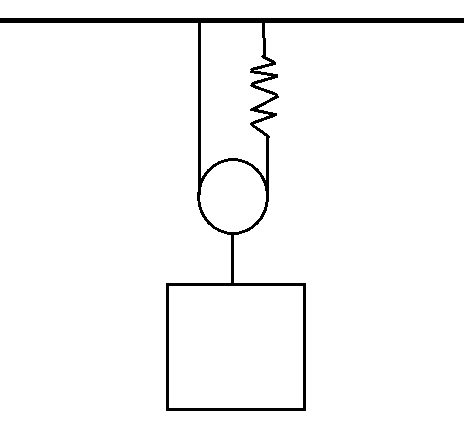
I know in a double pulley system, the rope moves twice the distance of the load. What about a system such as this? Would the stretch distance of the spring be twice the moved distance of the load?

uTqlwvj.png


I'm having trouble visualizing these things.

Thanks!
 
Physics news on Phys.org
tamtam402 said:
I'm having trouble visualizing these things.

Draw two pictures, one in which the spring is replaced with a length of chain one meter long and another in which the spring is replaced with a length of chain two meters long. Keep the length of the rope the same in the two pictures.

Compare them... You'll see the answer to your question pretty quickly, and forever after be better at visualizing these things.
 
Thanks. I think I see it now. Half of the "rope" (spring) length increase must be "used" to increase the length of the rope on the other side of the pulley. This other half of the length increase is not used to displace the system towards the bottom.

It follows that the load would indeed only see a y = <LengthIncrease>/2 movement towards the bottom. Sorry about the vocabulary used, I'm not a native english speaker.
 

Similar threads

  • · Replies 20 ·
Replies
20
Views
907
  • · Replies 17 ·
Replies
17
Views
2K
  • · Replies 8 ·
Replies
8
Views
3K
  • · Replies 17 ·
Replies
17
Views
5K
  • · Replies 16 ·
Replies
16
Views
3K
  • · Replies 31 ·
2
Replies
31
Views
5K
  • · Replies 2 ·
Replies
2
Views
3K
  • · Replies 12 ·
Replies
12
Views
3K
  • · Replies 1 ·
Replies
1
Views
1K
  • · Replies 4 ·
Replies
4
Views
3K