sezw
- 12
- 0
i think if they gave obama a peace prize for continuing a war they should definitely give hawkins a nobel physics award
sezw said:i think if they gave obama a peace prize for continuing a war they should definitely give hawkins a nobel physics award
mgb_phys said:Sorry - is that supposed to make sense?
If they gave Halle Berry the oscar for the history's worst Bond movie they should give Terry Pratchett the Booker prize for Good Omens.

But is he positing that this would be possible in GR, or is he positing that GR is incorrect even in the classical limit? I think they've shown that, based on the mass of the objects inferred from orbiting stars and the maximum possible radius inferred from the radius at which the stars closest to them are orbiting, that they are definitely over the Schwarzschild limit, so according to GR there doesn't seem to be any way to escape the conclusion that they're black holes and not just really dense quark stars or whatever...Frame Dragger said:I'm going to go out on a limb here and assume that Phrak is aware of current imaging studies of (commonly accepted, by me as well) BHs. I think he's positing that something other than a singularity enshrouded by an event horizon is causing polar jets, and accretion discs.
JesseM said:But is he positing that this would be possible in GR, or is he positing that GR is incorrect even in the classical limit? I think they've shown that, based on the mass of the objects inferred from orbiting stars and the maximum possible radius inferred from the radius at which the stars closest to them are orbiting, that they are definitely over the Schwarzschild limit, so according to GR there doesn't seem to be any way to escape the conclusion that they're black holes and not just really dense quark stars or whatever...
JesseM said:Do you think it's delusional to think general relativity is probably correct at far lower energy densities than the Planck scale, and thus that its theoretical predictions about collapsing stars becoming black holes are very likely to be correct too? Or do you think that, even given the assumption that GR is correct on a theoretical level, it's delusional to think that various astronomical objects which appear to fit the profile for what GR would predict about black holes (like this one, which does have what seems to be an accretion disc and jets in photos...likewise, see here and here for photos of a jet from the center of M87 which is believed to contain a supermassive black hole) are in fact black holes?
Phrak said:How long does it take for a black hole to form? How long does it take for its mass to increase? What is the age of the universe? What is the theoretical justification for claiming accreation disks, jets, and other evidence of black holes are not also evidence of pre-collapsed dense masses?
Could you answer my question about whether you are willing to accept the likelihood that GR (plus quantum field theory on curved spacetime, perhaps) is correct when dealing with energy densities far below the Planck scale? In the context of GR your questions about black holes should all have well-defined answers, but perhaps you are questioning the validity of GR itself? Or maybe you accept GR, but wish to use a coordinate system (like Schwarzschild coordinates) where it takes an infinite coordinate time for a collapsing star to actually reach the Schwarzschild limit? (if the latter, note that all coordinate systems are equally valid in GR and there are plenty of coordinate systems where you can cross the event horizon in finite time, and any particle in the star will cross the horizon in finite proper time regardless of what coordinate system you choose)Phrak said:How long does it take for a black hole to form? How long does it take for its mass to increase? What is the age of the universe? What is the theoretical justification for claiming accreation disks, jets, and other evidence of black holes are not also evidence of pre-collapsed dense masses?
JesseM said:Could you answer my question about whether you are willing to accept the likelihood that GR (plus quantum field theory on curved spacetime, perhaps) is correct when dealing with energy densities far below the Planck scale? In the context of GR your questions about black holes should all have well-defined answers, but perhaps you are questioning the validity of GR itself?
Or maybe you accept GR, but wish to use a coordinate system (like Schwarzschild coordinates) where it takes an infinite coordinate time for a collapsing star to actually reach the Schwarzschild limit? (if the latter, note that all coordinate systems are equally valid in GR and there are plenty of coordinate systems where you can cross the event horizon in finite time, and any particle in the star will cross the horizon in finite proper time regardless of what coordinate system you choose)
Yes...relative to another coordinate system containing the the coordinate singularity--assuming we have a black hole to start with. But this is putting the horse before the cart. The infalling clock has no event horizon to cross...in GR and there are plenty of coordinate systems where you can cross the event horizon in finite time..
"Applicable" to what?Phrak said:But not all coordinate systems are applicable. Schwarzschild coordinates are applicable to good approximation.
What do you mean by "record formation"? Receiving light from an event on the horizon? In this case, the only clocks that will do so will be ones that cross the horizon themselves, but I don't see the problem with that.Phrak said:Our clocks and telescopes are attached to the Earth or Sun system. Populate the universe with clocks and dense objects. Not one clock will record formation of an event horizon.
Do you argue that because outside observers never see infalling clocks reach some finite proper time T, that implies an observer traveling with the clock would never see it reach T or beyond?Phrak said:Yes...relative to another coordinate system containing the the coordinate singularity--assuming we have a black hole to start with. But this is putting the horse before the cart. The infalling clock has no event horizon to cross.
Why do you say that? It would certainly form an event horizon in finite time in Kruskal-Szekeres coordinates, to name one. On the right side of this diagram from the Gravitation textbook by Misner/Thorne/Wheeler, you can see a collapsing star in KS coordinates, the gray area representing the interior and the black curve representing the surface, with the event horizon as the line at a 45 degree angle labeled r=2M, t=infinity (the label referring to Schwarzschild coordinates):Phrak said:Let's assume one of your infalling coordinate systems and that the Earth is falling into a massive object. The massive object will not form an event horizon.
What would a coordinate system have to do with a picture? A photo isn't "native" to any particular coordinate system.Phrak said:Where are the applicable coordinate systems where we can say "lookie here. This is a picture of an accreation disk of a black hole."
Q: How long does it take for a black hole to form?Phrak said:I believe I've answered your questions. Will you answer mine?
Phrak said:Where are the applicable coordinate systems where we can say "lookie here. This is a picture of an accreation disk of a black hole."
Frame Dragger said:If a BH loses mass through periods of NOT accreting, and emitting HR, to the point of eventual destruction (whatever form that takes) I fail to see how they can be perpetual motion machines, even in theory. They require angular momentum from their original collapsing body, or from infalling matter to rotate, and without infalling matter they slowly shrink and "get hotter". Seems like a strange thermodynamic process (or analogue thereof), but it seems limited.
 ). So I'd guess the PMM stuff is way beyond being even wrong to believe in it!
 Altabeh said:It is limited and Kerr BHs can't get so much faster in their rotation than a limit of 1/72 of their total angular momentum. Don't ask how I got this limit (it is going to be explained in my PHD thesis.
AB
Frame Dragger said:Well, if a Kerr BH did rotate faster, it wouldn't have an EH anymore... or am I thinking of another solutioon. Anyway, thanks very much, I never really considered before this thread that a BHH in any way could be a PMM. I look forward to your thesis btw; good luck and soon(realtively speaking of course)-to-be congratulations.
Altabeh said:Thank you so much. Actually my work itself makes use of Bondi mass as an infalling matter, so the BH would lose mass and therefore it would get smaller in its size but not motionless at all, but the Penrose process on the other hand gets involved to not let this happen because according to Penrose, in any case except BHs with accretion disks, the angular momentum of infalling particles decreases the total angular momentum of BH which itself is limited by the fact(?) that HR carries away angular momentum by the emission of rotating particles so it's going to make BH stop rotating. Here to have a PMM we need to know Penrose process is less happening than mine in a Kerr BH without an accretion disk. But the important thing is that in case of accretion disks, both make a BH rotate perpetually which only is possible if HR does not exist or it occurs so much slower than PP or my own process!
AB
JesseM said:"Applicable" to what?
What do you mean by "record formation"? Receiving light from an event on the horizon? In this case, the only clocks that will do so will be ones that cross the horizon themselves, but I don't see the problem with that.
Do you argue that because outside observers never see infalling clocks reach some finite proper time T, that implies an observer traveling with the clock would never see it reach T or beyond?
If so, someone could make the same sort of argument about the Rindler horizon, since after all, an accelerating observer who remains outside the horizon (like one of the ones at fixed coordinate position in Rindler coordinates) will never see anything cross it, the only way to see light from an event on the Rindler horizon is to cross the horizon yourself (which should not be too surprising, since from the perspective of an inertial frame the 'Rindler horizon' is just one edge of a future light cone). Note that the relationship between Rindler coordinates (where the Rindler horizon is at fixed coordinate position and it takes an infinite coordinate time to reach it) and inertial coordinates (where the horizon is moving outward at the speed of light and can be crossed in finite time) is very closely analogous to the relationship between Schwarzschild coordinates and Kruskal-Szekeres coordinates (where the event horizon expands outward at the speed of light). So if some accelerating observer who remained forever outside the Rindler horizon seriously argued that worldlines simply "end" before reaching the proper time T where they are supposed to cross it, what would your response be? I don't see how your position is any less implausible.
Why do you say that? It would certainly form an event horizon in finite time in Kruskal-Szekeres coordinates, to name one. On the right side of this diagram from the Gravitation textbook by Misner/Thorne/Wheeler, you can see a collapsing star in KS coordinates, the gray area representing the interior and the black curve representing the surface, with the event horizon as the line at a 45 degree angle labeled r=2M, t=infinity (the label referring to Schwarzschild coordinates):
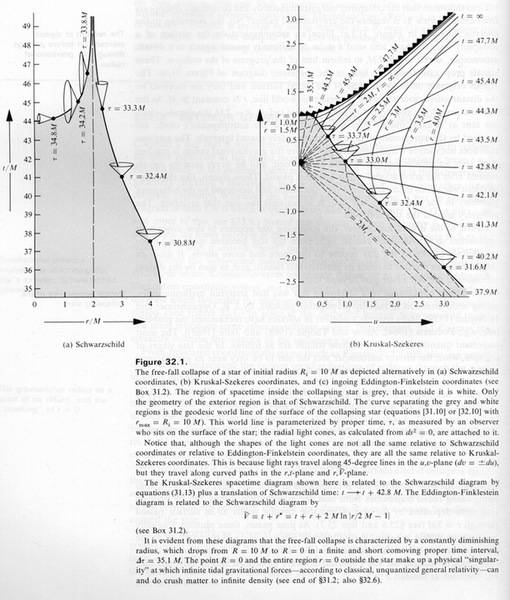
What would a coordinate system have to do with a picture? A photo isn't "native" to any particular coordinate system.
Q: How long does it take for a black hole to form?
A: Too vague. Depends if you are talking about coordinate time in some system, or proper time of some clock...and of course it also depends on physical specifics like the mass of the black hole, the point of the collapse you want to start counting down from, etc.
Q: How long does it take for its mass to increase?
A: You mean, when a new object falls in? I don't think there's any well-defined way to measure the "mass" of an extended object in a coordinate-independent way, so this would presumably depend on your choice of coordinate system too, and how you define "mass" (see this page on the difficulty in defining 'energy' in GR in a non-local sense, since mass and energy are equivalent the problems should be the same)
Q: What is the age of the universe?
A: Again depends on what coordinate system/clock you use, but the most common definition uses a coordinate system whose definition of simultaneity is such that the universe's density is about the same everywhere at a give coordinate time (the average rest frame of the cosmic microwave background radiation), and whose time coordinate matches up with the proper time of a clock that remains at rest in this system. In this case the universe's age since the Big Bang is estimated at 13.7 billion years.
Q: What is the theoretical justification for claiming accreation disks, jets, and other evidence of black holes are not also evidence of pre-collapsed dense masses?
A: Because as long as you accept GR, and you accept the principle of "geodesic completeness" which says geodesics shouldn't just "stop" at some finite proper time when it's possible to extend the spacetime manifold in a way that allows them to continue and which respects the Einstein Field Equations everywhere, then for a sufficiently massive object collapsed below a certain radius, it can be proved that an event horizon must form and that whatever's inside cannot be a stable dense mass but will collapse into a singularity (that's what the singularity theorems mentioned at the start of the thread are all about).
No problem, if you want to start the discussion again later when you have more time, send me a message to let me know (I haven't been hanging out on this forum as much lately so I miss a lot of threads).Phrak said:This is going nowhere but devolving into debate. My fault of course. I did kick it off accusations of delusional beliefs. I do appreciate the response very much however, as I haven't gotten any action on this forum, on this matter without kicking the sacred cow. When I get over a full schedule of real work, moonlighting, and all-important down time, I want to post some assertions in the venue of objective science that I hope you can tear into with equal objectivity.