Understanding the Doppler Effect: Solving the Bat Problem

Click For Summary
SUMMARY

The discussion centers on solving a problem related to the Doppler Effect, specifically involving a bat emitting a 40.0 kHz chirp while chasing an insect. The bat's speed is 4.10 m/s, and the echo received is at 40.4 kHz, with the speed of sound in air taken as 340 m/s. Participants clarify that the solution requires treating the bat as both the source and observer in a two-stage process, where the observed frequency from the insect is used as the source frequency for the bat's echo. The final equation for the observed frequency must differentiate between the frequencies to avoid confusion.

PREREQUISITES
  • Understanding of the Doppler Effect principles
  • Familiarity with frequency calculations in wave physics
  • Knowledge of the relevant equations, particularly f_o = f_s(v + v_o)/(v - v_s)
  • Basic understanding of sound propagation in air
NEXT STEPS
  • Study the derivation of the Doppler Effect equations in different contexts
  • Learn about the implications of source and observer motion on frequency shifts
  • Explore practical applications of the Doppler Effect in real-world scenarios
  • Review examples of multi-stage Doppler Effect problems for deeper understanding
USEFUL FOR

Students studying physics, particularly those focusing on wave mechanics and the Doppler Effect, as well as educators seeking to clarify complex concepts in sound frequency analysis.

physicsfan999
Messages
1
Reaction score
0
Homework Statement
A bat flying at 4.10 m/s is chasing an insect flying in the same direction. The bat emits a 40.0-kHz chirp and receives back an echo at 40.4 kHz. (Take the speed of sound in air to be 340 m/s.)
Relevant Equations
f_o=f_s(v+v_o/v-v_s)
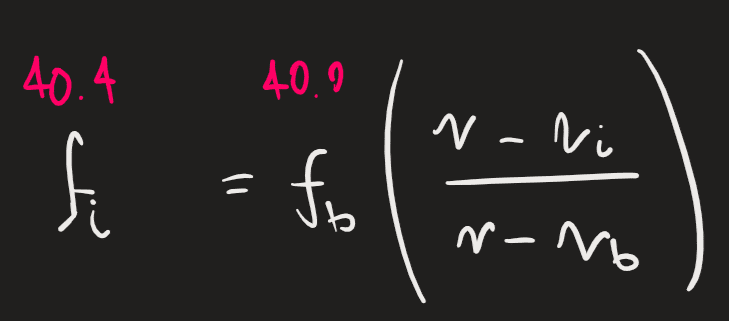
I'm struggling a lot with this problem on the Doppler effect. I understand the first step which is to treat the bat as the source of the emitted sound, giving
1614718292037.png


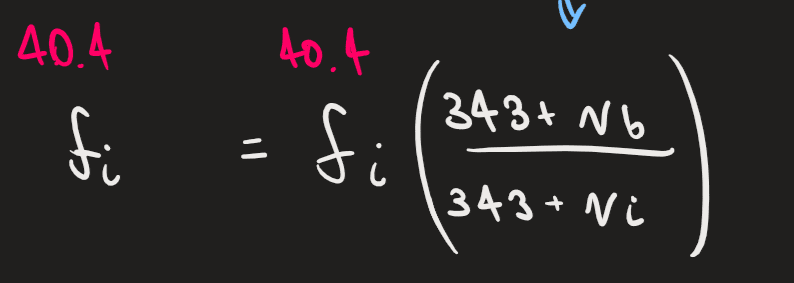
And the second to treat the bat now as the observer, but instead of using f_b on the left the solution involves setting both frequencies to the reflected wave.
1614718268174.png

I understand there should 2 different variables here for the equation to make sense but I need help understanding why the second step involves setting the two frequencies the same. Thanks in advance!
 
Physics news on Phys.org
physicsfan999 said:
Homework Statement:: A bat flying at 4.10 m/s is chasing an insect flying in the same direction. The bat emits a 40.0-kHz chirp and receives back an echo at 40.4 kHz. (Take the speed of sound in air to be 340 m/s.)
Relevant Equations:: f_o=f_s(v+v_o/v-v_s)

I'm struggling a lot with this problem on the Doppler effect. I understand the first step which is to treat the bat as the source of the emitted sound, giving

View attachment 279012

And the second to treat the bat now as the observer, but instead of using f_b on the left the solution involves setting both frequencies to the reflected wave.
View attachment 279011
I understand there should 2 different variables here for the equation to make sense but I need help understanding why the second step involves setting the two frequencies the same. Thanks in advance!
As you correctly say, this is a 2-stage process. In stage-1 we find the observed frequency (##f_i##) with the insect as the observer). In stage-2 we treat ##f_i## as the source frequency because this is the frequency of the reflected signal sent from the insect to the bat.

Your final equation$$f_i = f_i (\frac {343 + v_b}{343 + v_i})$$is wrong. You need to give the final observed frequency (by the bat) a different symbol:$$f_{observed-by-bat} = f_i (\frac {343 + v_b}{343 + v_i})$$Can I suggest you watch this:
Edit - typo' corrected.
 
  • Like
Likes   Reactions: collinsmark, Doc Al and rsk

Similar threads

  • · Replies 8 ·
Replies
8
Views
897
  • · Replies 15 ·
Replies
15
Views
1K
Replies
8
Views
1K
  • · Replies 1 ·
Replies
1
Views
2K
  • · Replies 4 ·
Replies
4
Views
3K
  • · Replies 3 ·
Replies
3
Views
3K
  • · Replies 10 ·
Replies
10
Views
6K
  • · Replies 7 ·
Replies
7
Views
3K
  • · Replies 10 ·
Replies
10
Views
12K
  • · Replies 4 ·
Replies
4
Views
1K