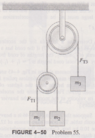
Double Atwood machine with pulley and masses

16 replies · 6K views · last reply
Minming
Messages
9
Reaction score
6
Homework Statement
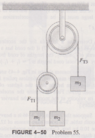
The double Atwood machine shown in Fig. 4-50 has frictionless, massless pulleys and cords. Determine (a) the acceleration of masses m1, m2 and m3, and (b) the tensions FT1 and FT3 in the cords.
My answer is different from the book‘s!
Please to see the attach file.
Relevant Equations
F=ma
Diagram of a double Atwood machine: a ceiling pulley, a movable pulley holding a cord tension labelled FT1, and masses m1, m2 hanging on one side and m3 on the other with tension FT3 labelled in the cord.


​

Solution:
Four free-body diagrams labeled (a) to (d) for a double Atwood machine: separate upward tension arrows and downward weight arrows on masses m3, m1 and m2, plus a pulley diagram with masses m1 and m2 hanging on either side and total weight (m1 + m2)g.

Handwritten-style derivation page: equations (3) to (6) on acceleration relations, and Figure Q-4-41 showing a double Atwood machine with a ceiling-mounted pulley, a smaller pulley s, masses m1, m2 and m3, and arrows labelled a1-c, a2-c and as-c.

Typeset system of equations for a double Atwood machine: a3 = (FT3 - m3g)/m3, a1 = (FT1 - m1g)/m1, a2 = (FT1 - m2g)/m2, as = (FT3 - (m1+m2)g)/(m1+m2), a3 = -as, a1 - as = -(a2 - as), followed by MATLAB syms and eq1, eq2 code lines.

Text listing Maxima-style code with equations eq3 to eq6 and a solve call, followed by printed solutions for a1, a2, a3, FT1 and FT3 written as fractions in m1, m2, m3 and g.

Printed answer key listing formulas for tensions FT1 and FT3 and accelerations a1, a2, a3 in terms of masses m1, m2, m3 and g.
 
Attachments
  • question55.docx
    question55.docx
    1.2 MB · Views: 130
  • Diagram of a double Atwood machine: a large pulley hangs from a ceiling bar, and a smaller pulley hangs below it. Masses m1 and m2 hang from the smaller pulley, and m3 hangs from the large pulley on the right. Tensions F_T1 and F_T3 are labelled.
    附图55.png
    52.2 KB · Views: 189
  • Diagram of a double Atwood machine: a fixed pulley hangs from the ceiling, with a smaller movable pulley below it supporting masses m1 and m2, and a cord running over the upper pulley to mass m3. Tensions F_T1 and F_T3 are labelled.
    附图55.png
    52.2 KB · Views: 163
  • Like
Likes   Reactions: PeroK and Delta2
You equation for ##a_s## doesn't look correct to me. It should involve ##F_{T_1}## and ##F_{T_3}## and not the masses m1,m2 and g, at least not directly.
 
  • Like
Likes   Reactions: Lnewqban and Steve4Physics
An easier way to assemble the equations would be to consider that the acceleration of an Atwood machine pulley on the right does not depend on whether there is another Atwood machine on the left side of its cord or an effective mass ##m_{\text{eff.}}##. Assuming that ##m_3## is accelerating and moving down, the known equations for the acceleration and tension of a single Atwood machine hanging from a fixed support are $$a_3=\frac{m_3-m_{\text{eff.}}}{m_3+ m_{\text{eff.}}}g~;~~F_{T_3}=\frac{2m_3~ m_{\text{eff.}}}{m_3+ m_{\text{eff.}}}g.$$The left pulley is accelerating up with acceleration ##a_3## which means that it can be treated as a fixed Atwood machine in an effective gravitational field ##g_{\text{eff.}}=(g+a_3).## So we write $$F_{T_1} = \frac{2m_2~ m_1}{m_2+ m_1}(g+a_3).$$ We also have that ##F_{T_1}=\frac{1}{2}F_{T_3}##. This gives a second equation and hence a system of two equations and two unknowns, ##a_3## and ## m_{\text{eff.}}## $$\begin{align}
& a_3=\frac{m_3-m_{\text{eff.}}}{m_3+ m_{\text{eff.}}}g \\
&\frac{2m_2~ m_1}{m_2+ m_1}(g+a_3)=\frac{1}{2}\times \frac{2m_3~ m_{\text{eff.}}}{m_3+ m_{\text{eff.}}}g \\
\end{align}$$ Having obtained ##a_3## and ## m_{\text{eff.}}##, one can find ##F_{T_3}## and ##F_{T_1}.## Knowing ##F_{T_1},## accelerations ##a_1## and ##a_2## can be found through the usual free body diagrams. I think this method is more transparent and easier to implement without the use of MATLAB.

Edited to fix typo in equation (2) where ##\frac{1}{2}## was on the wrong side.
 
Last edited:
  • Like
Likes   Reactions: Minming, MatinSAR, Delta2 and 1 other person
Hi @Minming. It might be worth saying a little more about the mistake in ‘equation 4’. It's worth you understanding why it's wrong.

Consider ##m_1, m_2## and ##s## as forming a separate body, X (which internally is a simple Atwood machine).

That’s what you did when incorrectly applying ‘a = F/m’ to X to give ##a_s = \frac {F_{T3} – (m_1+m_2)g} {m_1+m_2}##.

The right-hand side is actually the acceleration of X’s centre of mass, ##a_{XCoM}##. But X’s centre of mass is not stationary relative to ##s## because of the ‘internal’ motion of ##m_1## and ##m_2## inside X. So ##a_s \neq a_{XCoM}## (except in the special case when ##m_1 = m_2##).
 
  • Like
Likes   Reactions: Delta2 and SammyS
BvU said:
Hello @Minming
:welcome:​

Check your eq (4)

##\ ##
Hi, BvU
I take the pulley, m1 and m2 as a box.
This box's mass is (m1+m2), and ΣF=FT3-(m1+m2)g.
 
kuruman said:
An easier way to assemble the equations would be to consider that the acceleration of an Atwood machine pulley on the right does not depend on whether there is another Atwood machine on the left side of its cord or an effective mass ##m_{\text{eff.}}##. Assuming that ##m_3## is accelerating and moving down, the known equations for the acceleration and tension of a single Atwood machine hanging from a fixed support are $$a_3=\frac{m_3-m_{\text{eff.}}}{m_3+ m_{\text{eff.}}}g~;~~F_{T_3}=\frac{2m_3~ m_{\text{eff.}}}{m_3+ m_{\text{eff.}}}g.$$The left pulley is accelerating up with acceleration ##a_3## which means that it can be treated as a fixed Atwood machine in an effective gravitational field ##g_{\text{eff.}}=(g+a_3).## So we write $$F_{T_1} = \frac{2m_2~ m_1}{m_2+ m_1}(g+a_3).$$ We also have that ##F_{T_1}=\frac{1}{2}F_{T_3}##. This gives a second equation and hence a system of two equations and two unknowns, ##a_3## and ## m_{\text{eff.}}## $$\begin{align}
& a_3=\frac{m_3-m_{\text{eff.}}}{m_3+ m_{\text{eff.}}}g \\
&\frac{2m_2~ m_1}{m_2+ m_1}(g+a_3)=\frac{1}{2}\times \frac{2m_3~ m_{\text{eff.}}}{m_3+ m_{\text{eff.}}}g \\
\end{align}$$ Having obtained ##a_3## and ## m_{\text{eff.}}##, one can find ##F_{T_3}## and ##F_{T_1}.## Knowing ##F_{T_1},## accelerations ##a_1## and ##a_2## can be found through the usual free body diagrams. I think this method is more transparent and easier to implement without the use of MATLAB.

Edited to fix typo in equation (2) where ##\frac{1}{2}## was on the wrong side.
Thank you, kuruman
I have a misstake in the knowledge in pully.
And your advice about effective mass and effective acceleration is very useful for me.
Thanks.
 
  • Like
Likes   Reactions: Delta2 and Lnewqban
Steve4Physics said:
Hi @Minming. It might be worth saying a little more about the mistake in ‘equation 4’. It's worth you understanding why it's wrong.

Consider ##m_1, m_2## and ##s## as forming a separate body, X (which internally is a simple Atwood machine).

That’s what you did when incorrectly applying ‘a = F/m’ to X to give ##a_s = \frac {F_{T3} – (m_1+m_2)g} {m_1+m_2}##.

The right-hand side is actually the acceleration of X’s centre of mass, ##a_{XCoM}##. But X’s centre of mass is not stationary relative to ##s## because of the ‘internal’ motion of ##m_1## and ##m_2## inside X. So ##a_s \neq a_{XCoM}## (except in the special case when ##m_1 = m_2##).
Hi, Steve4
I get it ,thinks.
 
  • Like
Likes   Reactions: Steve4Physics
Minming said:
Thanks. I get it.
As an exercise, I decided to hit this with some Lagrangian mechanics:

I took ##x_1, x_2, x_3## as the (downward positive) displacements of the masses, and ##X_1, X_2## as the displacements of ##m_1, m_2## relative to the pulley over which they slide. We have the constraints:
$$x_1 = X_1 - x_3, \ x_2 = X_2 - x_3, \ X_2 = -X_1$$Which leads to$$x_2 = -x_1 -2x_3$$This leads to the Lagragian:$$L = KE - PE$$$$L = \frac 1 2 m_1 \dot x_1^2 + \frac 1 2 m_2(\dot x_1 + 2x_3)^2 + \frac 1 2 m_3\dot x_3^2 + \big (m_1x_1 - m_2(x_1 + 2x_3) + m_3x_3 \big ) g$$Then we use the Euler-Lagrange equations (##i = 1, 3##):
$$\frac{\partial L}{\partial x_i} = \frac d {dt}\frac{\partial L}{\partial \dot x_i}$$The first equation is:
$$\frac{\partial L}{\partial x_1} = \frac d {dt} \frac{\partial L}{\partial \dot x_1}$$$$\Rightarrow (m_1 - m_2)g = \frac d {dt} \bigg (m_1\dot x_1 + m_2(\dot x_1 + 2\dot x_3) \bigg )$$$$\Rightarrow (m_1 + m_2)\ddot x_1 + 2m_2 \ddot x_3 = (m_1 - m_2) g$$Similarly, the second Euler-Lagrange equation is:
$$2m_2 \ddot x_1 + (4m_2 - m_3)\ddot x_3 = (m_3 - 2m_2)g$$Eliminating ##\ddot x_1## gives:
$$(m_1m_3 + m_2m_3 + 4m_1m_2)\ddot x_3 = (m_1m_3 +m_2m_3 - 4m_1m_2)g$$Eliminating ##\ddot x_3## gives:$$(m_1m_3 + m_2m_3 + 4m_1m_2)\ddot x_1 = (4m_1m_2 + m_1m_3 - 3m_2m_3)g$$You can then get the tension from ##T_i = m_i(g - \ddot x_i)##.

The quickest way to get ##\ddot x_2## is to note that by symmetry it must be the same as ##\ddot x_1## with ##m_1## and ##m_2## interchanged.

Tough problem and not much easier using Euler-Lagrange.
 
  • Informative
  • Like
Likes   Reactions: PhDeezNutz, Minming, MatinSAR and 1 other person
Minming said:
Thank you.
The Lagrangian mechanics seems difficult....
It's beautiful. You'll learn it at some stage in your degree. All modern physics (QM, QFT, GR) is based on Lagrangian or Hamiltonian mechanics, as Newton's laws themselves do not generalise.
 
  • Like
Likes   Reactions: Delta2 and PhDeezNutz
Minming said:
Thank you.
The Lagrangian mechanics seems difficult....

If your major is physics you will find out just how beautiful it is and how it makes Newtonian mechanics EASIER.

I was going to do a Lagrangian approach for this problem but @PeroK beat me to it.

Might still do it for fun.
 
PhDeezNutz said:
If your major is physics you will find out just how beautiful it is and how it makes Newtonian mechanics EASIER.

I was going to do a Lagrangian approach for this problem but @PeroK beat me to it.

Might still do it for fun.
You could do a double-double Atwood machine with four masses on three pullies.
 
PeroK said:
You could do a double-double Atwood machine with four masses on three pullies.
Don’t tempt me. I might. Let me first do the one with 2 pullies to see if I get the same answer as you. Then I might try the second scenario.

@Minming when you learn Lagrangian, Hamiltonian mechanics you will come to prefer it.
 
For the double-double Atwood machine, if we let ##p_1## be the displacement (downwards positive) of the first pulley, supporting masses ##m_1## and ##m_2##; and ##p_2## likewise supporting masses ##m_3## and ##m_4##, then the constraints are:
$$x_2 = -x_1 + 2p_1, \ x_4 = -x_3 - 2p_1$$The Euler-Lagrange equations are:
$$(m_1 + m_2)\ddot x_1 - 2m_2 \ddot p_1 = (m_1 - m_2)g$$$$(m_3 + m_4)\ddot x_3 + 2m_4 \ddot p_1 = (m_3 - m_4)g$$$$-m_2\ddot x_1 + m_4\ddot x_3 +2(m_2+m_4) \ddot p_1 = (m_2 - m_4)g$$Solving for ##\ddot x_1## gives:
$$\ddot x_1 = \frac{m_1\big(m_2(m_3 + m_4) + m_3m_4\big) - 3m_2m_3m_4}{(m_1 + m_2)m_3m_4 + (m_3 + m_4)m_1m_2}g$$By symmetry, the others can be obtained from this. E.g.
$$\ddot x_3 = \frac{m_3\big(m_4(m_1 + m_2) + m_1m_2\big) - 3m_1m_2m_4}{(m_1 + m_2)m_3m_4 + (m_3 + m_4)m_1m_2}g$$Finally, if we let ##m_3 = m_4 = \frac 1 2 M##, then we recover the solution for the double Atwood machine above, with ##M## replacing the original ##m_3##:
$$\ddot x_1 = \frac{m_1\big(m_2M + \frac 1 4 M^2\big) - \frac 3 4 m_2M^2}{(m_1 + m_2)\frac 1 4 M^2 + Mm_1m_2}g$$$$\ddot x_1 = \frac{4m_1m_2 + m_1M - 3m_2M}{(m_1 + m_2)M + 4m_1m_2}g$$$$\ddot x_3 =\frac{\frac 1 2 M\big(\frac 1 2 M(m_1 + m_2) + m_1m_2\big) - \frac 3 2 m_1m_2M}{(m_1 + m_2)\frac 1 4 M^2 + Mm_1m_2}g$$$$\ddot x_3 =\frac{M(m_1 + m_2) - 4m_1m_2}{(m_1 + m_2)M + 4m_1m_2}g$$And all is good!