[Double integral] Area of a triangle

Click For Summary
SUMMARY

The discussion focuses on calculating the double integral ∫∫ (x-y)*|ln(x+2y)| dxdy over a triangular region defined by the vertices (0,0), (1,1), and (-3,3). The user proposes a substitution of variables with u = (x-y) and v = (x+2y), leading to the integral ∫∫ u*|ln(v)| dudv. However, the user encounters difficulties in determining the new integration limits in the u-v domain. An alternative substitution of u = (x-y) and v = (x+y) is suggested to maintain simpler boundaries for the triangular region.

PREREQUISITES
  • Understanding of double integrals and their applications
  • Familiarity with coordinate transformations in calculus
  • Knowledge of logarithmic functions and their properties
  • Experience with setting up integration limits in multiple dimensions
NEXT STEPS
  • Study the method of variable substitution in double integrals
  • Learn how to determine new integration limits after a change of variables
  • Explore the properties of logarithmic functions in integrals
  • Practice solving double integrals over triangular regions
USEFUL FOR

Students and professionals in mathematics, particularly those studying calculus and integral equations, as well as educators looking for examples of double integrals in triangular domains.

Hatmpatn
Messages
6
Reaction score
0
Hi! I'm stuck with the following problem:

-----------------------------------
Calculate

∫∫ (x-y)*|ln(x+2y)| dxdy

where D is the triangle with corners in the coordinates (0,0), (1,1) and (-3,3)
-----------------------------------

I get the following lines that forms the triangle: y=-x, y=x and y=-1/2*x+3/2
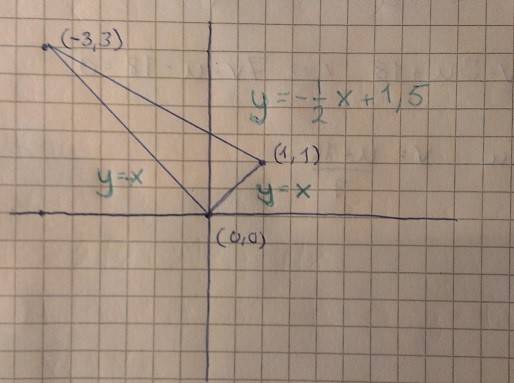
BX4tVDi.jpg


Im thinking that I start with substitution: (x-y)=u and x+2y=v

Which gives me ∫∫ u*|ln(v)| dudv

After that I don't know how to continue. I would like to know which new "intervals" I should do the integral between when I am in my new u- and v-domain?
 
Physics news on Phys.org
Hatmpatn said:
Im thinking that I start with substitution: (x-y)=u and x+2y=v
That gives ugly borders.
I would use u=x-y and v=x+y then your triangle stays a nice rectangular triangle.

In either case, find the coordinates of the corners in the new coordinate system and then set up the integral again.
 
Relativistic Momentum, Mass, and Energy Momentum and mass (...), the classic equations for conserving momentum and energy are not adequate for the analysis of high-speed collisions. (...) The momentum of a particle moving with velocity ##v## is given by $$p=\cfrac{mv}{\sqrt{1-(v^2/c^2)}}\qquad{R-10}$$ ENERGY In relativistic mechanics, as in classic mechanics, the net force on a particle is equal to the time rate of change of the momentum of the particle. Considering one-dimensional...

Similar threads

  • · Replies 3 ·
Replies
3
Views
3K
  • · Replies 24 ·
Replies
24
Views
4K
  • · Replies 5 ·
Replies
5
Views
2K
  • · Replies 5 ·
Replies
5
Views
2K
  • · Replies 11 ·
Replies
11
Views
3K
  • · Replies 2 ·
Replies
2
Views
2K
  • · Replies 2 ·
Replies
2
Views
3K
  • · Replies 1 ·
Replies
1
Views
2K
  • · Replies 8 ·
Replies
8
Views
3K
  • · Replies 16 ·
Replies
16
Views
19K