Homework Help Overview
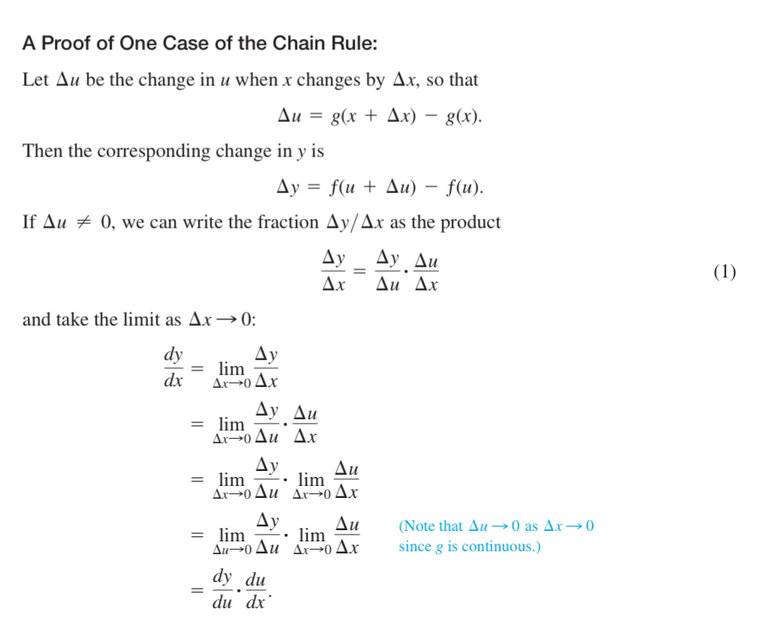
The discussion revolves around the proof of the Chain Rule as presented in Thomas’s Calculus, specifically addressing its applicability to functions that may oscillate rapidly, such as g(x) = sin(1/x). Participants explore the implications of the proof when applied to non-one-to-one functions and the conditions under which the Chain Rule holds.
Discussion Character
- Conceptual clarification, Assumption checking
Approaches and Questions Raised
- Participants question the applicability of the Chain Rule to non-one-to-one functions and discuss examples of rapidly oscillating functions. There is an exploration of the conditions under which the proof may fail, particularly focusing on differentiability and the behavior of functions near points of interest.
Discussion Status
The discussion is ongoing, with various interpretations being explored regarding the proof's limitations. Some participants have provided examples and counterexamples, while others have raised questions about the assumptions made in the proof. There is no explicit consensus yet on the implications of the proof for different types of functions.
Contextual Notes
Participants note that the proof may not apply when functions are not differentiable at certain points, and there is a focus on the behavior of functions that oscillate near the origin. The original poster's question about the proof's applicability to one-to-one functions also remains a point of contention.